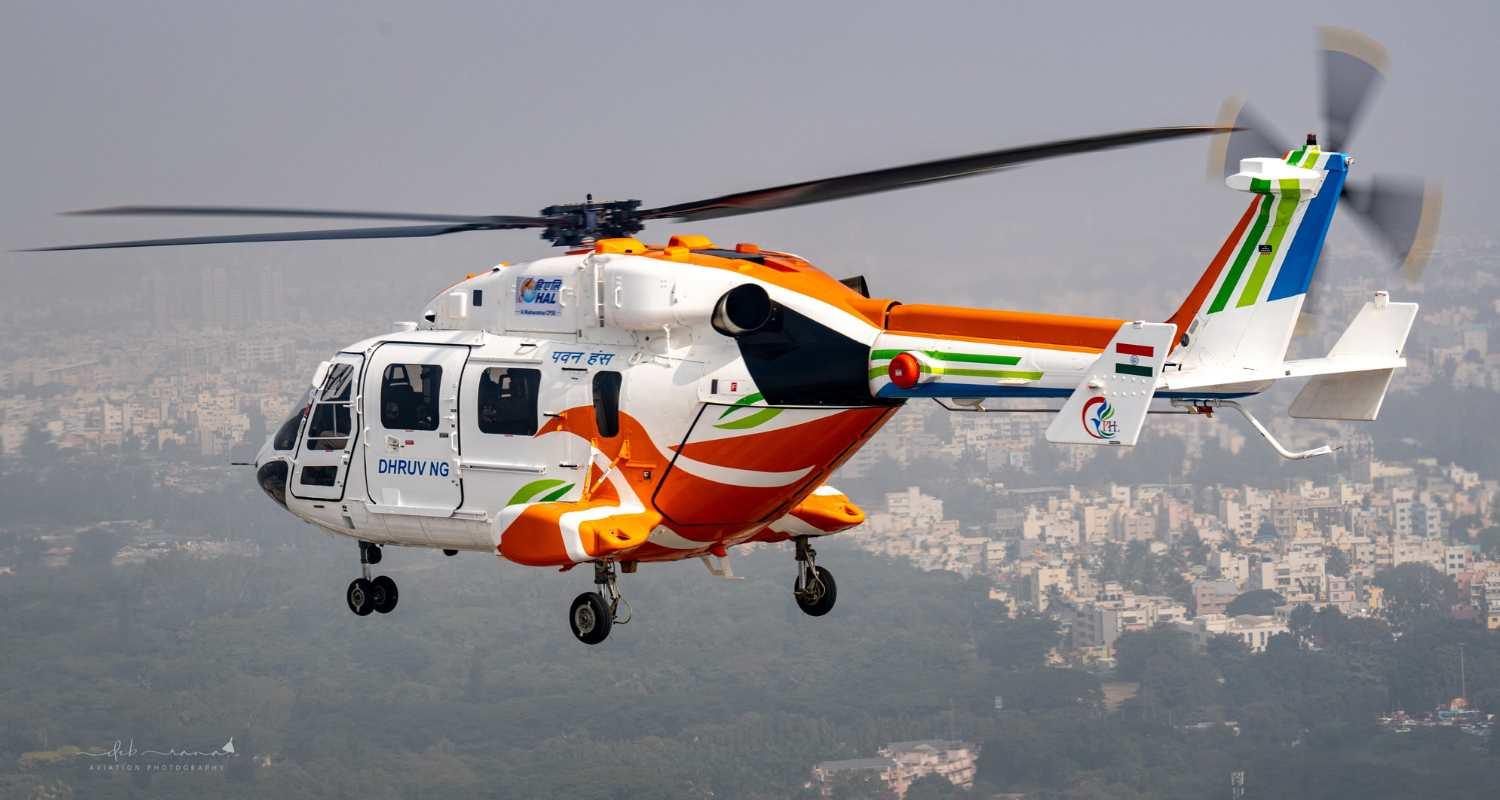
India’s indigenous, next-generation, multi-role civil helicopter Dhruv NG took its maiden (first) flight on Tuesday. Calling Dhruv NG the symbol of India’s capability, the Union Minister Ram Mohan Naidu flagged off the HAL-made helicopter.
‘Aarti’ was also performed by Naidu before Dhruv NG roared into the Indian skies.
What’s new in Dhruv?
Designed and manufactured by Hindustan Aeronautics Limited (HAL) to meet the requirements of the civil aviation market, the helicopter boasts modern features in terms of ride quality as well as safety. It includes a world-class civil-certified glass cockpit and a modern avionics suite for superior situational awareness, they said.
“It is a sophisticated 5.5-tonne, light twin-engine helicopter engineered to master the diverse and demanding requirements of the Indian terrain, specifically upgraded to meet the rigorous demands of the global civil aviation market,” said a press release statement.
It is equipped with twin "Shakti 1H1C" engines, providing enhanced power ratings and the advantage of internal maintenance capabilities within the country. Talking about the safety and reliability, Dhruv NG incorporates crashworthy seats, self-sealing fuel tanks, and a proven TPUJAWIN engine configuration for high redundancy. Also, it has advanced vibration control systems to ensure a smooth ride, tailored for VIP and medical transport.
Listing its features, the officials said maximum take-off weight of the next generation civil helicopter is stated to be 5,500 kg, with a maximum speed of around 285 km/h, range of around 630 km (with a 20 minute reserve), endurance of around three hours and 40 minutes, service ceiling of around 6,000 metres (high-altitude capable), and internal payload of around 1,000 kg.
The Dhruv NG features a highly configurable cabin (7.33 cubic metres) adaptable for various civilian roles. For VIP/VVIP transport, it has luxury furnishings for four to six passengers, with a maximum capacity of 14 passengers. As for its Helicopter Emergency Medical Service (Air Ambulance) role, the helicopter is equipped with a layout for four stretchers along with a doctor and attendant. Its specialised roles include offshore operations, law enforcement, and disaster relief (SAR).
Post Dhruv NG’s inaugural flight, Naidu addressed the gathering, calling the moment a ‘very important milestone in Indian aviation history’. He further praised and congratulated the entire HAL workforce, from designers and engineers to technicians, for the success of Dhruv NG.
He said HAL had long functioned like a bicycle with one dominant wheel — defence, but was now evolving into a balanced organisation riding on two equal wheels — defence and civil aviation.
"This is an especially proud moment for me as the civil aviation minister," he said while emphasising that the Dhruv-NG was not just a machine but a symbol of India's capability, confidence and commitment to Aatmanirbhar Bharat (self-reliant India), and a changing moment in the country’s aerospace manufacturing.
Before its take-off from HAL, the minister joined the pilot in the cockpit to gain first-hand insight into the helicopter's advanced systems and features.
He also termed the handing over of the type certificate by the Directorate General of Civil Aviation (DGCA) for the indigenous Shakti engine as a "defining moment" for the civil aviation sector.
"With its state-of-the-art avionics and best-in-class powerful engine, the Dhruv NG has emerged as a platform for several domestic operators. I am pleased to note that a contract for the supply of 10 helicopters to Pawan Hans for deployment with ONGC is also under finalisation," Naidu said.
The Government of Karnataka is also showing keen interest, and the Border Security Force has also expressed interest in acquiring these helicopters, he added.
"It is estimated that we will add over 1,000 helicopters in the next 10 to 15 years, enabled by the regional connectivity UDAN scheme, driven by the Prime Minister's mission to make aviation more inclusive, democratic and impactful," he added.
Speaking about the helicopter, HAL Chairman and Managing Director D K Sunil said the engine has been built by HAL and has gone through a formal civil certification procedure.
"It is now civil-certified," he said, adding that the certification would enable wider civilian deployment of HAL helicopters, and added, "It will be very competitive because we produced the engine, we produced the aircraft. So obviously, we are going to be very cost-competitive. It has an indigenous content of about 65 per cent, so a lot of stuff is made within the country. So definitely it will be cheaper. Going forward, we see that there is a market easily for about 1,000 helicopters of this type in the country, so it is going to be good revenue.”

 Follow us