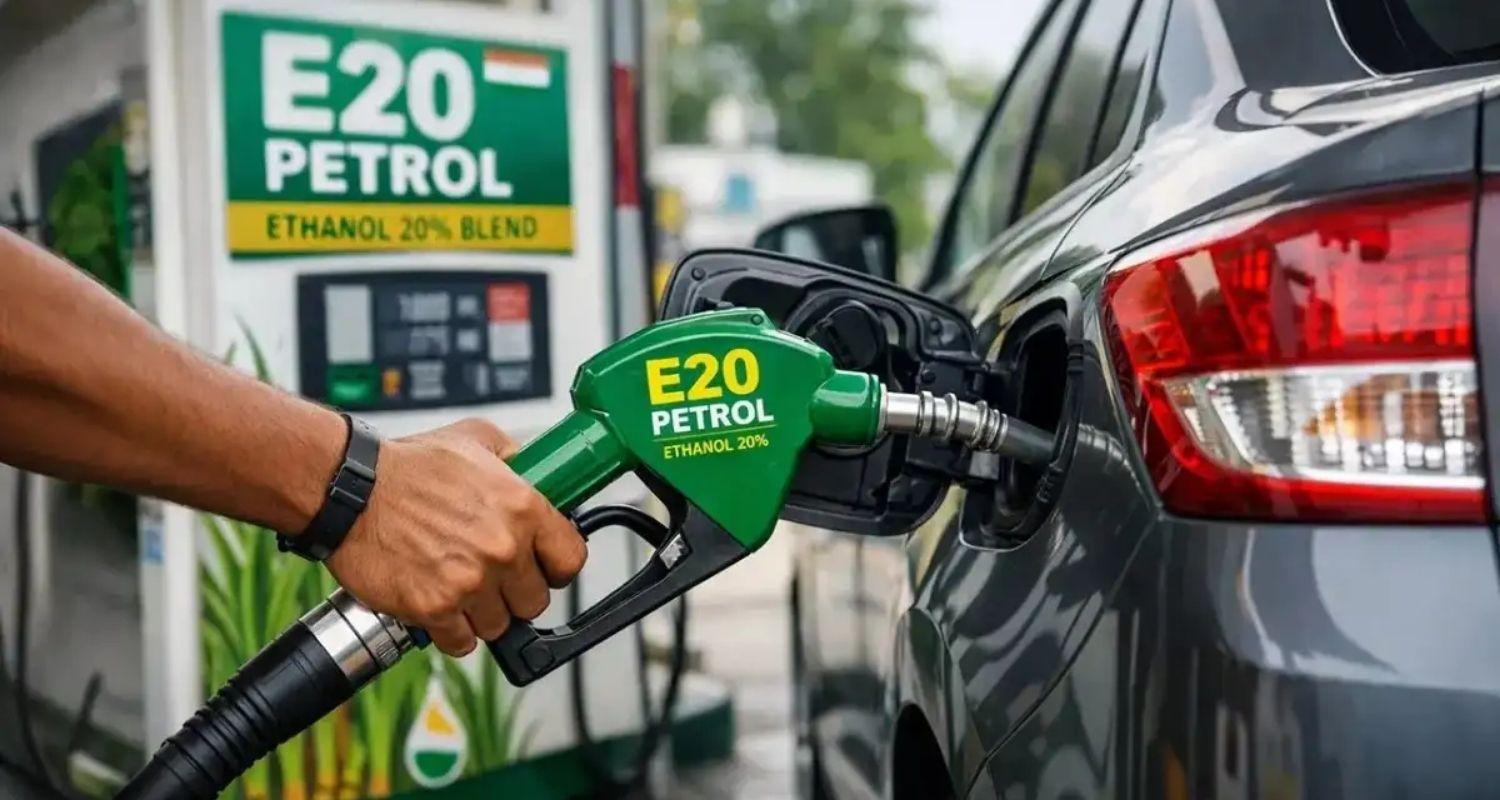
The Union government on Monday firmly rejected concerns that India's ambitious target of blending 20 per cent ethanol with petrol could threaten food security or place additional pressure on the country's water resources, asserting that the programme is being implemented through a carefully regulated "waste-to-wealth" approach.
In a detailed written reply to the Rajya Sabha, Minister of State for Petroleum and Natural Gas Suresh Gopi said the Ethanol Blended Petrol (EBP) Programme had not affected the availability of food crops or India's food security.
The minister said the government's open-ended procurement system gives the highest priority to supplies for the Public Distribution System (PDS), the National Food Security Act (NFSA), Other Welfare Schemes (OWS) and prescribed national buffer stocks.
"Only surplus foodgrains, as determined by the Department of Food & Public Distribution after meeting all food security requirements and maintaining prescribed buffer stocks, are permitted for ethanol production," the written reply stated.
Gopi said the ethanol programme follows a "waste-to-wealth" model by utilising surplus agricultural produce, damaged foodgrains, broken rice and grains unfit for human consumption. The government is also promoting second-generation (2G) ethanol made from agricultural residues.
Addressing concerns over water consumption, the minister highlighted the growing use of maize as an ethanol feedstock. He said maize, which is considered significantly less water-intensive than traditional feedstocks such as sugarcane, accounted for around 37 per cent of the ethanol blending basket in the 2025-26 Ethanol Supply Year (ESY), compared with zero per cent in 2021-22.
The government said the shift was part of a broader effort to diversify the raw materials used in ethanol production and promote comparatively less water-intensive crops.
An expert committee constituted by the Ministry of Agriculture and Farmers Welfare examined the water requirements of various ethanol feedstock crops in 2024. The committee's recommendations are being considered while implementing the programme, the reply said.
The government is also promoting water-use efficiency through micro-irrigation, drip irrigation and other conservation measures under the Pradhan Mantri Krishi Sinchayee Yojana.
Gopi further said the ethanol programme had not adversely affected retail food inflation. According to the government, only surplus sugar is diverted for ethanol production, while annual retail sugar price increases have remained around 2.5 per cent compared with the 2024-25 sugar season.
Also read: Private banks pull Sensex down 443 points
The reply also said the diversion of surplus Food Corporation of India (FCI) rice had no impact on retail food inflation as such supplies are considered only after food security requirements and prescribed buffer stocks have been fulfilled.
On environmental safeguards, the Centre said ethanol production facilities are required to comply with strict ecological norms. Molasses- and grain-based distilleries are required to follow the Zero Liquid Discharge (ZLD) system, under which process water is recycled and reused to prevent the release of liquid effluents.
The government also noted that modern ethanol plants require approximately 3 to 5 litres of processed water to produce one litre of ethanol. The production framework increasingly relies on damaged foodgrains, broken rice and agricultural residues, particularly for 2G ethanol.
The minister said the government had adopted a balanced approach to the EBP Programme to ensure that food security, water sustainability and farmers' interests remained central to the policy. The Centre's response reaffirmed its position that India's transition towards cleaner fuels can be pursued without compromising the country's nutritional requirements or ecological stability.

 Follow us