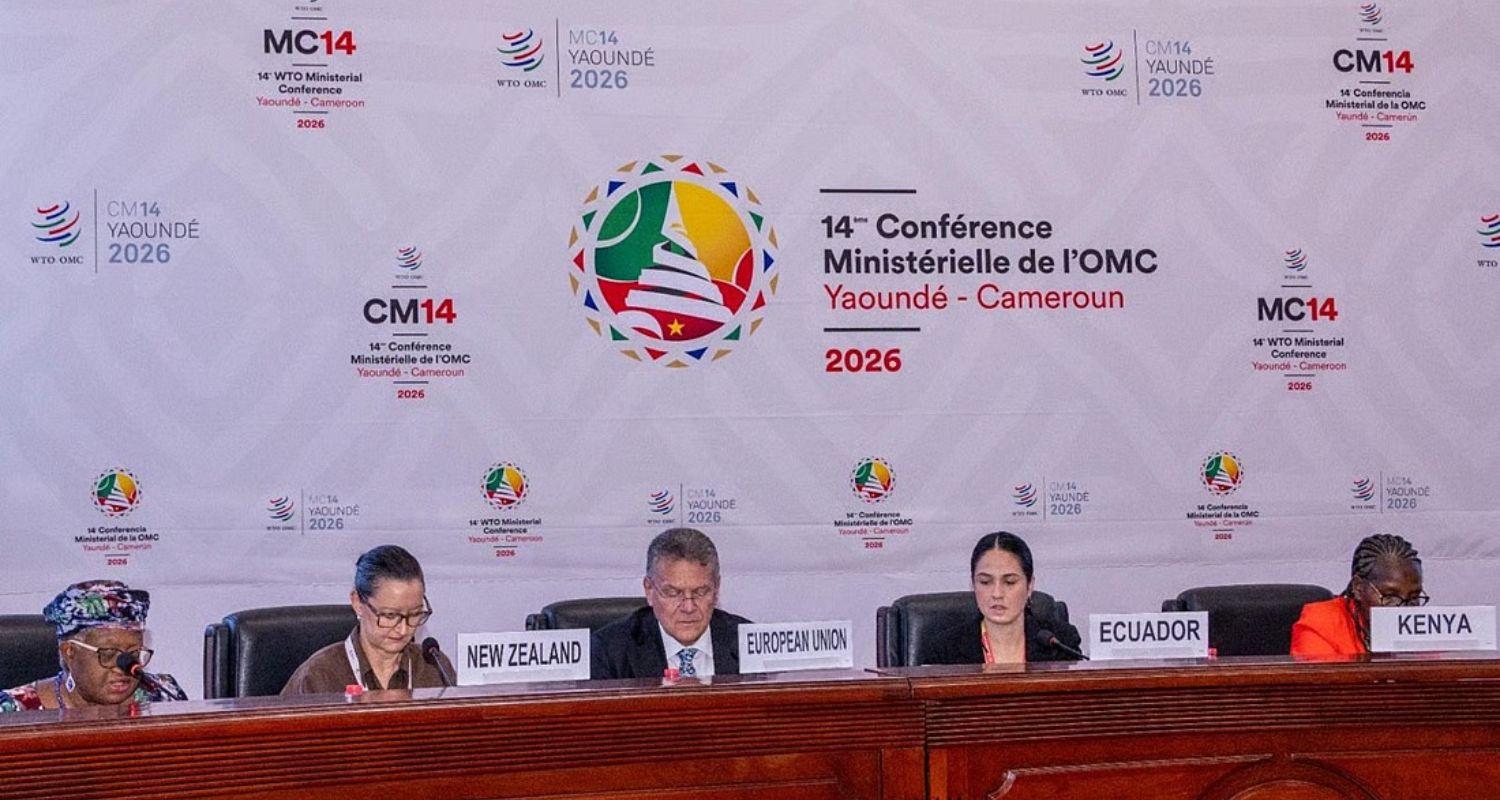
The WTO ministerial conference in Yaounde, which concluded on Monday, failed to reach any agreement on key issues, including the extension of the moratorium on e-commerce and reforms of the global trade body.
The 14th ministerial conference (MC), which concluded in the early hours on March 30 in the capital city of Cameroon, could not reach a consensus on a moratorium on non-violation complaints under the Agreement on Trade-related Aspects of Intellectual Property Rights (TRIPS).
Talks on the e-commerce import duty moratorium reached a deadlock between Brazil and the US. While some member countries agreed to a four-year extension, Brazil was negotiating for two years, but the US was pushing for a longer duration of five years.
In May 1998, WTO members agreed for the first time not to impose customs duties on electronic transmissions for two years, a moratorium that has been extended biennially since then. Its expiry would open the door to imposing tariffs on e-commerce. E-commerce moratorium expires for the first time in 26 years.
The 14th Ministerial Conference (MC14) of the World Trade Organization (WTO) began on March 26 in the capital city of Cameroon. Though the talks were scheduled to end on March 29, they were slightly extended and concluded on March 30.
Cameroon’s Minister of Trade Luc Magloire Mbarga Atangana, the Chair of MC14, said that trade ministers worked to conclude as many issues as possible across various areas of negotiation during the four-day meeting.
However, he said “we ran out of time” with regard to several outstanding issues, such as the WTO's work programme on electronic commerce and the continuation of the existing moratoriums on customs duties for electronic transmissions and non-violation complaints under the Agreement on Trade-related Aspects of Intellectual Property Rights (TRIPS).
Director-General Ngozi Okonjo-Iweala suggested that members use the draft texts developed over the four days of ministerial discussions to finalise agreements on outstanding issues in Geneva at the next General Council (GC) meeting. GC is the second-highest decision-making body of the WTO after the MC.
She welcomed the progress in discussions on a work programme for advancing ongoing talks on WTO reform, the decision on advancing work on further disciplines on harmful fisheries subsidies, and other issues.
The WTO, in a statement, said ministers agreed to continue engaging in negotiations on fisheries subsidies, aiming to make recommendations to the 15th Ministerial Conference.
The Ministerial Conference, held every two years, is the highest decision-making body of the WTO. Nearly 2,000 trade officials, including more than 90 ministers, attended the MC14. It was only the second time the MC was held in Africa. The MC10 was held in Nairobi in 2015.
In a social media post, Commerce and Industry Minister Piyush Goyal said: “Going forward, India will continue to engage with WTO members on issues of critical importance for the global trade landscape, transparently, constructively and in good faith!”
Also read: ‘WTO divided over e-commerce moratorium on customs duties’

 Follow us