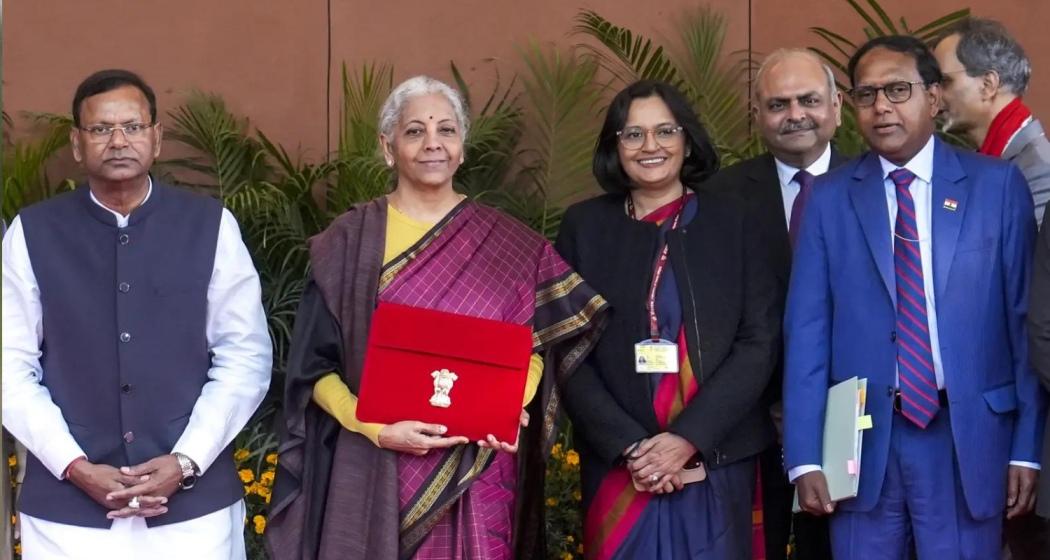
Finance Minister Nirmala Sitharaman on Sunday presented a ₹53.47 lakh crore Union Budget for 2026-27 in Parliament, a 7.7 per cent increase over the current fiscal, prioritising infrastructure expansion, defence modernisation, artificial intelligence-led growth and domestic manufacturing while maintaining fiscal discipline amid market volatility.
The fiscal deficit for 2026–27 has been pegged at 4.3 per cent of GDP, or ₹16.95 lakh crore, lower than the 4.4 per cent target for the current year. The government has projected economic growth of around 7 per cent in the coming financial year.
Prime Minister Narendra Modi described the Budget as strengthening India’s reform journey and accelerating the push towards becoming the world’s third-largest economy.
The total expenditure for 2026–27 has been estimated at ₹53.47 lakh crore, compared to a revised estimate of ₹49.64 lakh crore for the current fiscal. Non-debt receipts are projected at ₹36.5 lakh crore, with net tax receipts estimated at ₹28.7 lakh crore.
“To finance the fiscal deficit, the net market borrowings from dated securities are estimated at ₹11.7 lakh crore. The balance financing is expected to come from small savings and other sources. The gross market borrowings are estimated at ₹17.2 lakh crore,” Sitharaman said in her Budget speech.
The government aims to continue reducing debt levels, with the debt-to-GDP ratio estimated at 55.6 per cent in 2026-27, down from 56.1 per cent in the revised estimates for 2025–26.
Infrastructure remains major focus
Infrastructure remained central to the government’s economic strategy. Sitharaman announced a new dedicated freight corridor between Dankuni and Surat, the addition of 20 national waterways, and a coastal cargo promotion scheme aimed at shifting freight from road to inland and coastal routes.
The Budget also proposed developing Tier II and Tier III cities as City Economic Regions, supported by high-speed rail connectivity, logistics upgrades and targeted urban investments to reduce pressure on major metros and promote balanced regional growth.
Manufacturing, semiconductors get fresh push
Manufacturing received renewed support through incentives for semiconductor fabrication under India Semiconductor Mission (ISM) 2.0, along with electronics components, biopharma, construction equipment, sports goods and rare earth magnets.
The government announced plans to revive 200 industrial clusters, expand chemical parks and container manufacturing, and rationalise customs duties to lower costs for aircraft components, microwave parts, seafood processing inputs and aerospace materials.
To address financing constraints, the Budget proposed a ₹10,000-crore SME Growth Fund to expand equity access for micro, small and medium enterprises. Mandatory use of the Trade Receivables Discounting System (TReDS) for CPSE procurement and credit guarantees for invoice discounting were announced to improve liquidity.
A new “Corporate Mitras” framework aims to help MSMEs manage compliance at lower cost.
Defence allocation rises sharply
The defence budget increased to about ₹7.85 lakh crore from ₹6.81 lakh crore last year, reflecting a rise of nearly 15 per cent. Capital outlay for defence was pegged at around ₹2.31 lakh crore, up from ₹1.80 lakh crore, underscoring a sharper focus on modernisation and indigenous defence production amid continuing security challenges.
Taxes, compliance and market reaction
On the tax front, Sitharaman announced a reduction in Tax Collected at Source on overseas tour packages and remittances for education and medical treatment under the Liberalised Remittance Scheme to 2 per cent from 5 per cent. Interest awarded by motor accident tribunals to individuals will be exempt from income tax, and the new Income Tax Act will come into force from April 1, 2026.
Markets fell sharply after the Budget, driven by a hike in Securities Transaction Tax on futures and options and changes to the taxation of share buybacks, now to be treated as capital gains.
While the Budget drew praise from the Prime Minister and senior BJP leaders, the Congress and other Opposition parties criticised it as “lacklustre” and lacking meaningful reforms for the poor.
What gets cheaper
The Budget proposes lower customs duties or tariff rationalisation on the following goods and services, which are expected to translate into price relief for consumers:
-
Personal-use imported goods
-
Seventeen drugs and medicines used in cancer treatment
-
Drugs, medicines and Food for Special Medical Purposes (FSMP) for seven rare diseases
-
Leather products, including footwear
-
Textile garments
-
Seafood products
-
Overseas tour packages
-
Lithium-ion cells used in batteries
-
Solar glass
-
Critical minerals
-
Biogas-blended compressed natural gas (CNG)
-
Aircraft manufacturing components
-
Microwave ovens
-
Foreign education expenses
The government has also indicated tariff reductions on select imports from partner countries, which is expected to further soften prices in the domestic market.
What gets costlier
Higher duties or levies proposed in the Budget may push up prices in the following categories:
-
Alcohol
-
Cigarettes
-
Components used in nuclear power projects
-
Minerals such as iron ore and coal
-
Stock options and futures trading
-
Penalties linked to misreporting of income tax

 Follow us