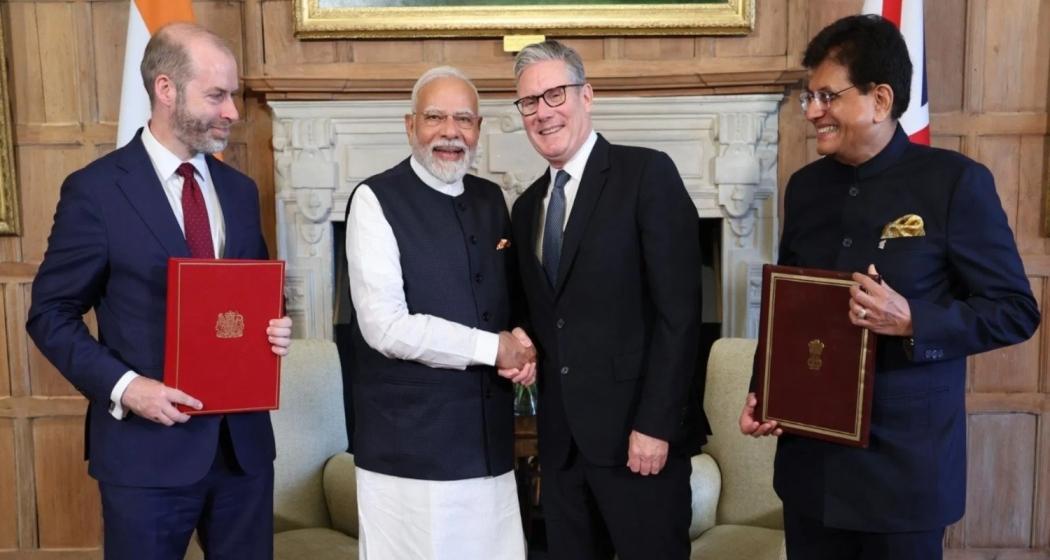
India and the United Kingdom are likely to implement their Comprehensive Economic and Trade Agreement (CETA) in April 2026, a government official said on Saturday, after the pact signed in July last year moved closer to completion of the ratification process in the British Parliament.
India and the UK signed the agreement on July 24, 2025, under which 99 per cent of Indian exports will enter the British market at zero duty, while India will reduce tariffs on select British goods, including cars and Scotch whisky.
“We are expecting the pact to be implemented from April this year,” the government official said.
The two sides have also signed a Double Contributions Convention (DCC) to prevent temporary workers from paying social security contributions in both countries simultaneously. The official indicated that both agreements are expected to come into force in parallel.
The trade pact requires approval from the UK Parliament before it can be operationalised. In India, such agreements require clearance from the Union Cabinet. Once ratified by the British Parliament, the agreement will be implemented on a mutually agreed date.
Also read: India, EU organic food firms upbeat about FTA
The House of Commons held a debate on the India-UK CETA earlier this week. Chris Bryant, Minister of State in the Department for Business and Trade, described the agreement as a “momentous achievement”, stating that it goes “well beyond India's precedent in opening the door for UK businesses”.
The British Parliament is currently ratifying the pact through debates in both the House of Commons and the House of Lords, along with scrutiny by relevant committees.
The agreement aims to double bilateral trade, currently valued at USD 56 billion, between the world’s fifth and sixth largest economies by 2030.
India has opened its market to a range of UK consumer goods, including chocolates, biscuits and cosmetics. In return, Indian exporters are expected to gain enhanced access to the UK market for textiles, footwear, gems and jewellery, sports goods and toys.
Under CETA, tariffs on Scotch whisky will be reduced from 150 per cent to 75 per cent immediately, and further lowered to 40 per cent by 2035. Import duties on automobiles will be brought down to 10 per cent over five years from the present level of up to 110 per cent, under a gradually liberalised quota system.
Indian manufacturers will, in turn, gain access to the UK market for electric and hybrid vehicles within a quota framework, marking a significant opening in a key segment of the automotive trade.

 Follow us