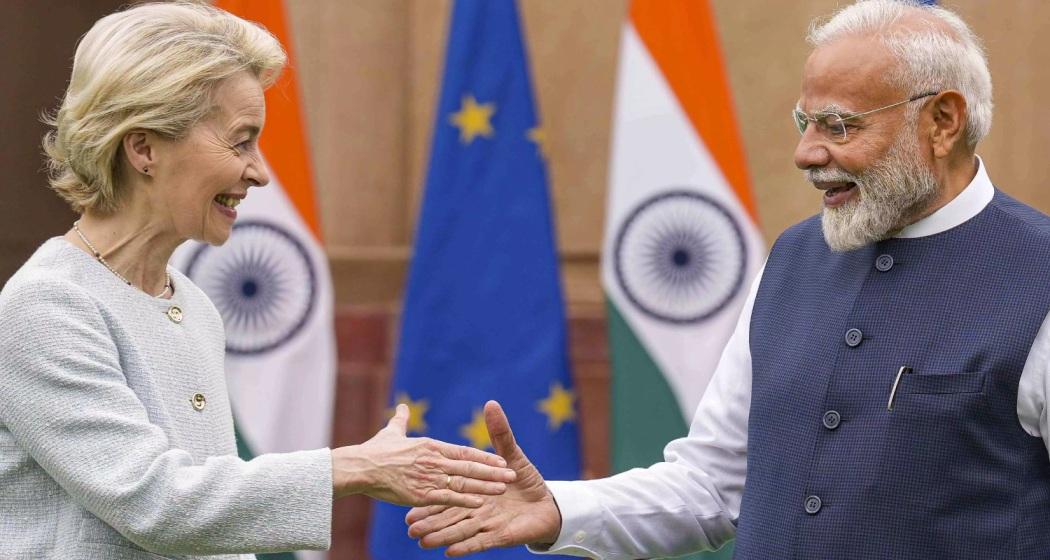
India and the European Union are close to finalising a long-pending free trade agreement, with negotiations in the capital entering a decisive phase as New Delhi offers steep tariff cuts on European cars and both sides signal readiness to seal a politically significant pact shaping trade, investment and supply chains.
Senior EU leaders are in New Delhi for high-level engagements, with both sides working to resolve the final set of outstanding issues. An agreement in principle could be announced shortly, marking the most concrete progress in talks first launched nearly two decades ago.
A key breakthrough has been India’s tariff offer on automobiles. Import duties on European cars, which currently peak at 110 per cent, are proposed to be cut to about 40 per cent immediately for a limited number of models. Over time, tariffs on select premium vehicles could be reduced further to around 10 per cent.
Negotiators have closed several technical chapters, leaving only a small number of politically sensitive matters unresolved. The momentum reflects a rare convergence of economic and strategic priorities on both sides.
Also read: Successful India makes world stable: EU chief
India is seeking improved access to the European market for textiles, garments, gems and jewellery, engineering goods and processed food products, sectors that have lost competitiveness following recent changes in EU tariff rules.
For the European Union, the agreement is aimed at securing more resilient and diversified supply chains, with India viewed as a long-term economic partner offering scale, stability and sustained growth.
Beyond automobiles, the agreement is expected to ease market access for Indian exporters, encourage European investment in manufacturing and clean energy, and expand consumer choice in India. However, domestic industries dependent on tariff protection are likely to press for transition periods and safeguards once detailed schedules are released.
Negotiations on the India–EU FTA began in 2007 but stalled in 2013 over differences on market access, labour standards, rules of origin and regulatory norms. Talks resumed in June 2022, with recent political backing giving fresh impetus to conclude the pact.

 Follow us