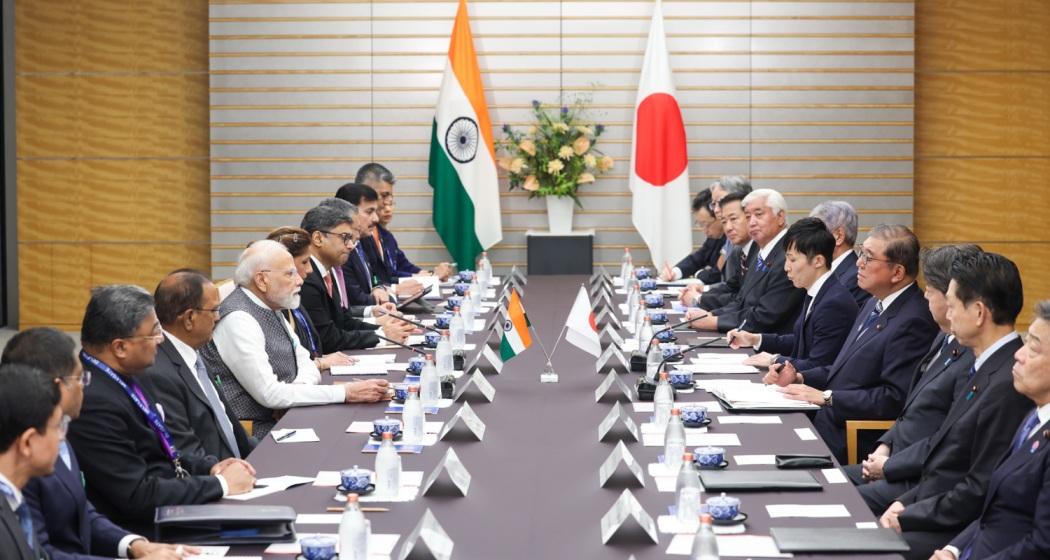
The next phase of India-Japan economic engagement is expected to be driven largely by collaboration between Japanese mid-sized enterprises, or Chuken, and India’s dynamic mid-sized manufacturing firms, according to a joint report by the Federation of Indian Chambers of Commerce and Industry (FICCI) and Shardul Amarchand Mangaldas & Co (SAM & Co).
Titled ‘India-Japan Economic Partnership: Partnering for a Secure, Innovative, and Sustainable Future’, the report highlights how these “Chuken-to-Chuken” collaborations can deepen technological exchange, enhance production capabilities, and shift the bilateral relationship from traditional supplier models towards co-creation.
Many Indian mid-sized companies already serve as tier-1 and tier-2 suppliers to global manufacturers. Backed by robust engineering expertise, international certifications, and growing R&D capacity, these firms are well-positioned to partner with Japanese companies aiming to diversify supply chains and strengthen manufacturing cooperation in the Indo-Pacific region.
The report identifies several high-potential sectors for future collaboration. In semiconductors and electronics, India’s fast-growing market and strong policy incentives complement Japan’s upstream technology strengths, enabling joint development of OSAT/ATMP facilities, power semiconductors, and integrated supply chains.
In automotive, EVs, and mobility, India’s expanding domestic EV ecosystem aligns with Japan’s advanced technologies, EV components, and battery systems. Pharmaceuticals and healthcare offer further scope, combining India’s generics and production expertise with Japan’s innovation-driven ecosystem for APIs, vaccines, digital R&D, and regulated market manufacturing.
Also read: FTAs open $200-bn market for textile sector: Minister
India’s MedTech sector, supported by medical device parks and production-linked incentives, also presents collaboration opportunities with Japan’s high-tech device manufacturers. In clean energy, India’s rapid renewable expansion, including 262.7 GW of capacity, matches Japan’s goals in hydrogen, ammonia, and grid-scale storage.
The defence, shipbuilding, and infrastructure sectors also feature prominently. India’s industrial corridors and maritime infrastructure complement Japan’s electronics, sensor, marine engineering, and high-speed mobility expertise. Digital and financial services partnerships are expanding in AI-driven lending, payments, and GCC market development.
The report notes that Japan is India’s fifth-largest investor, with cumulative FDI of USD 45.69 billion and over 1,500 Japanese companies operating in India. The ongoing global supply chain realignment, geopolitical and climate-linked risks, and economic security imperatives reinforce the strategic rationale for closer India-Japan collaboration.
With India’s macroeconomic resilience, large consumer base, infrastructure growth, and policy reforms, and Japan’s global technological leadership, both countries are poised to co-create resilient, innovation-led, and sustainable supply chains for the next decade.

 Follow us