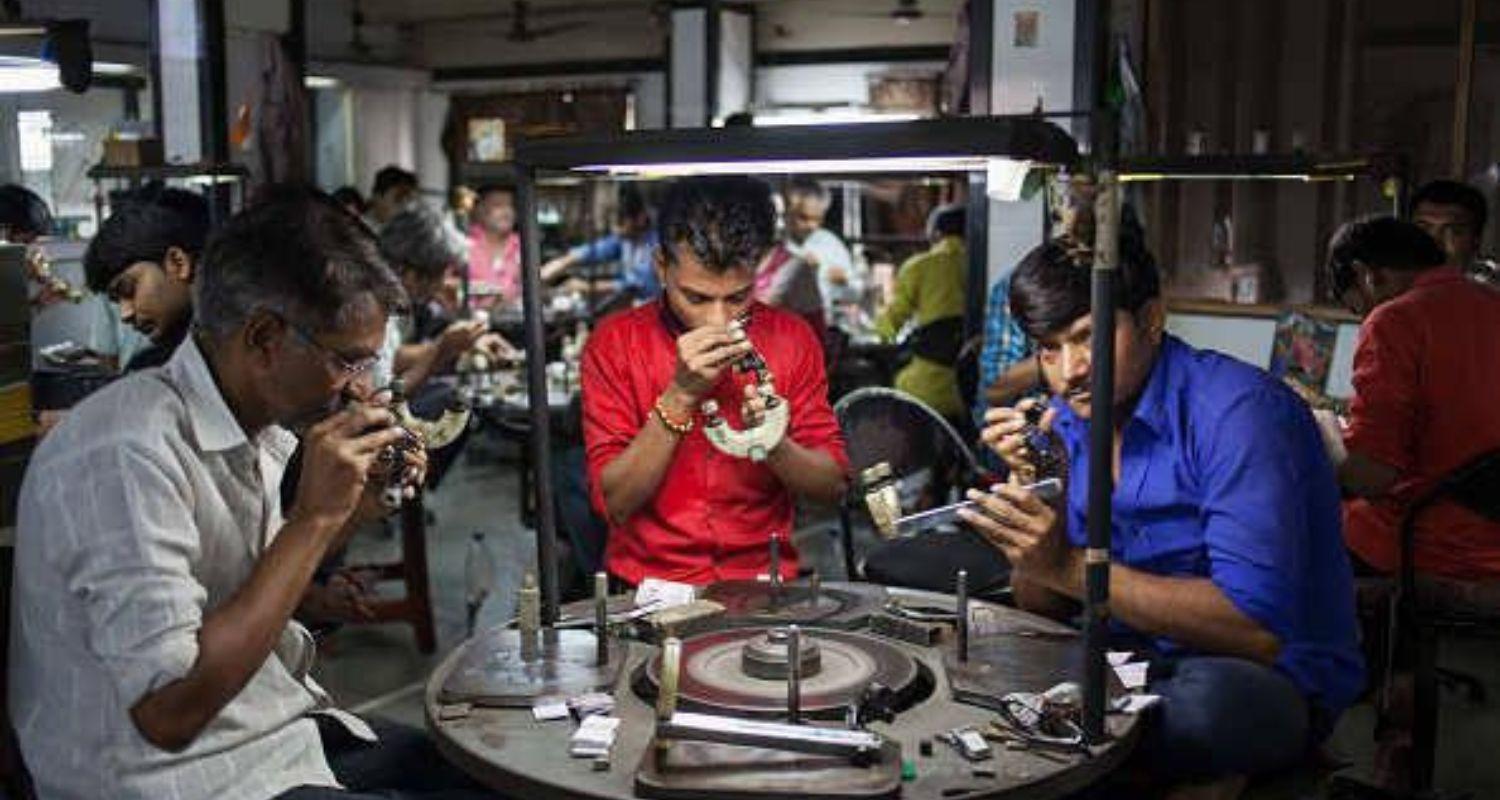
Surat, known as the diamond city, is grappling with its most severe recession in the diamond industry in over five decades. A sharp decline in global demand for diamonds has caused a significant economic downturn, leaving thousands jobless and the industry reeling from its effects
The meticulous tasks of diamond cutting and polishing employ approximately 17 lakh people in Surat and other parts of Gujarat. In Surat alone, 11 lakh workers depend on processing rough diamonds for their livelihoods.
However, the ongoing crisis has led to the closure of 90% of smaller diamond units, which typically operate with two or three emery wheels. Over 2 lakh workers have lost their jobs, while wages in operational factories have fallen by 20% to 50%.
Decline in exports, worker suicides deepen crisis
The Diamond Workers’ Union Gujarat (DWUG) has reported that financial strain has triggered a mental health crisis among workers. Over the past year, 45 diamond workers in Surat have taken their own lives, and the union’s helpline has received over 3,000 distress calls from workers seeking assistance.
DWUG Vice President Bhavesh Tank noted an increasing number of complaints about salary reductions and job losses, adding that wages have dropped by nearly 50% in some cases. “Reduced wages, coupled with rising inflation, have made it increasingly difficult for workers from low-income backgrounds to sustain their families,” he said.
Dinesh Navadia, chairman of the Indian Diamond Institute (IDI), stressed the urgent need for government intervention. “The diamond sector significantly contributes to government revenue. A support scheme for workers is imperative during such challenging times,” he said, urging industry organisations to step in to assist affected workers.
India’s diamond exports, which reached an impressive ₹1.80 lakh crore in 2022, dropped to ₹1.43 lakh crore in 2023 and further plummeted to ₹1.02 lakh crore by October 2024. The figure is expected to close at around ₹1.15 lakh crore by the end of 2024.
The prices of finished diamonds have fallen over the past two years, but rough diamond prices have remained stable, resulting in significant losses for traders. In response, major players such as De Beers and Russia’s Alrosa have announced price reductions of 10% to 15% for rough diamonds.
Navadia compared the current crisis to the 2008 recession, which lasted seven to eight months. “This situation is far more severe. Factory production has halved, and the ongoing war and closed markets in China have worsened the situation,” he noted.
“Factory production has declined by 50%, and natural diamond prices have dropped significantly,” he said.
Gautam Adani says the decline in exports is a 'wake-up call'
Billionaire Gautam Adani, speaking at the 51st Gem and Jewellery Awards in Jaipur, called the decline in India’s jewellery exports a "wake-up call."
He described India, with its 26.5% share in the global diamond market, as a "jewel in the crown" of the cut-and-polished diamond sector. However, he voiced concern over the recent 14% decline in exports, calling it more than just a statistic.
Adani pointed to the recognition of lab-grown diamonds as real diamonds by the US Federal Trade Commission, saying that artificially made diamonds are a "market disruptor," as they cost a lot less than natural diamonds.
He emphasised the potential of lab-grown diamonds as a cost-effective and ethical alternative to natural diamonds. "A future where we design diamonds with specific details—cut, colour, clarity, and carat weight—is not far-fetched," he remarked.
“Technological advancements such as artificial intelligence, 3D printing, and material science will soon enable India to design its own diamonds with precision,” Adani added.
“These trends challenge us to rethink what we produce and to build deeper emotional connections with changing consumer behaviours,” he said.
Despite the severe downturn, there is cautious optimism within the industry. A veteran diamond company owner, reflecting on 60 years in the trade, said, “I have spent the past 60 years in the diamond industry. This marks the first time in six decades that I have witnessed such a downturn. The current circumstances are challenging, yet I remain optimistic for a brighter future ahead."
The government has the option to offer financial support to diamond workers. However, these professionals are currently unregistered. The industry operates at full capacity during periods of growth,”he said.



 Follow us