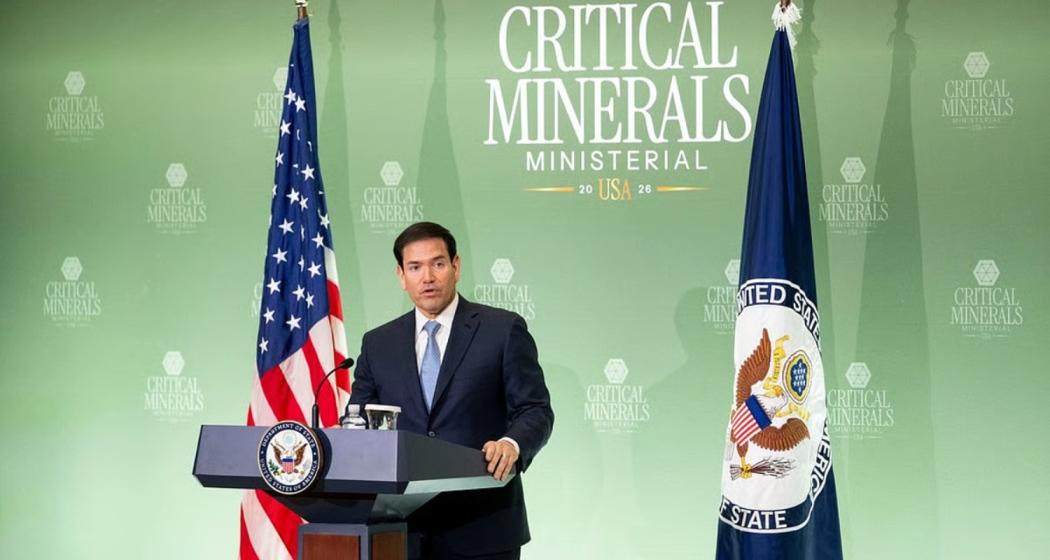
The United States plans to create a critical minerals trading bloc with its allies and partners to counter China’s dominance over key resources essential for defence, clean energy and high-technology manufacturing, the Trump administration announced on Wednesday.
Vice President J D Vance said the recent US-China trade confrontation had exposed the vulnerability of Western economies to China’s control over critical minerals used in products ranging from fighter jets to smartphones, making coordinated action imperative. The proposal envisages a preferential trade zone among allied nations, supported by tariffs to maintain minimum prices and shield producers from undercutting by cheaper Chinese supplies.
“We want members to form a trading bloc among allies and partners, one that guarantees American access to American industrial might while also expanding production across the entire zone,” Vance said at the opening of a conference hosted by Secretary of State Marco Rubio and attended by officials from dozens of European, Asian and African countries.
The initiative follows Beijing’s tightening of export controls on rare earths after the imposition of sweeping US tariffs last year. Although Washington and Beijing later reached a truce to roll back some trade restrictions, Chinese limits on critical minerals remain stricter than before President Donald Trump returned to office.
The meeting took place amid broader strains between the US and some of its allies over Trump’s territorial assertions, including remarks on Greenland and Venezuela. Despite these tensions, the administration signalled that it is keen to rebuild cooperation on issues it considers vital to national security. While major allies such as France and the United Kingdom attended the talks, Greenland and Denmark did not.
Also read: India supports new critical minerals bloc to de-risk supply chain
Administration officials said several countries had already expressed interest in joining the proposed bloc, which would aim to stabilise prices, provide access to financing and reduce dependence on China. “Everyone here has a role to play, and that’s why we’re so grateful for you coming and being a part of this gathering that I hope will lead to not just more gatherings, but action,” Rubio said.
Vance accused China of flooding global markets with cheap minerals to deter investment elsewhere before later tightening supply. “Our goal within that zone is to create diverse centres of production, stable investment conditions and supply chains that are immune to the kind of external disruptions that we’ve already talked about,” he said.
Experts cautioned that enforcement would be challenging. Ian Lange, an economics professor at the Colorado School of Mines, said preventing companies from sourcing cheaper Chinese materials outside the bloc could prove difficult, particularly beyond defence manufacturing.
Alongside the diplomatic push, Trump announced Project Vault, a strategic US rare earths stockpile backed by a USD 10 billion loan from the Export-Import Bank and nearly USD 1.67 billion in private capital. The government has also invested USD 1.6 billion in USA Rare Earth and spent close to USD 5 billion over the past year to boost domestic mining.
China currently controls about 70 per cent of global rare earth mining and 90 per cent of processing capacity. Japan, the European Union and Mexico separately announced plans to coordinate with Washington on price floors and trade policies to build supply chains outside China. Meanwhile, the US House approved legislation to accelerate mining on federal land, which now awaits Senate consideration.

 Follow us