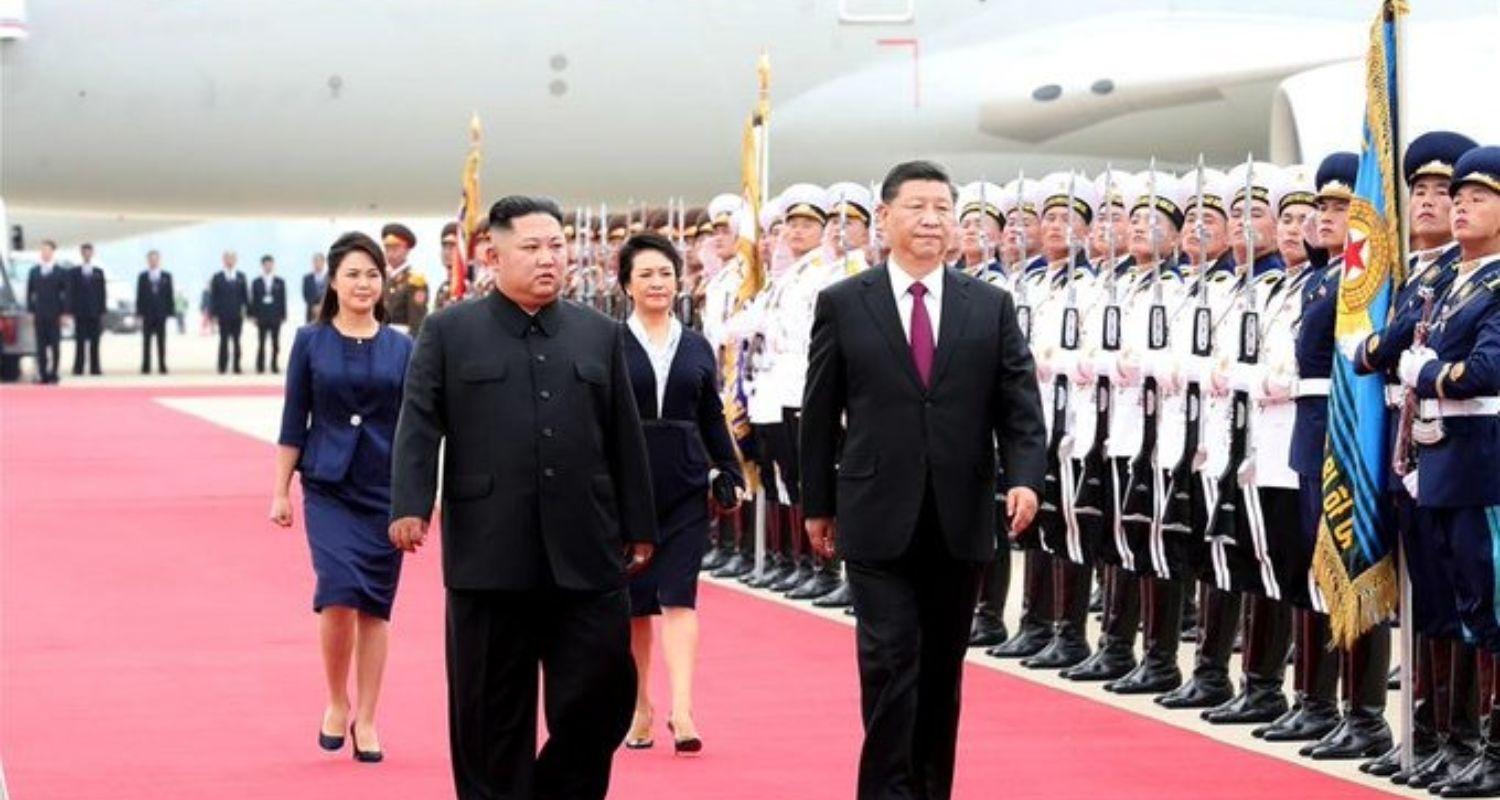
China’s President Xi Jinping has arrived in North Korea for a two-day state visit on Monday. This is his first official visit to the country in nearly seven years, following Beijing’s hosting of Kim Jong Un earlier this year.
Xi hailed the “invincible friendship” with Pyongyang as he landed in the capital. China has been North Korea’s major trading partner for the past four decades and remains a key source of diplomatic and economic support for the country under successive international sanctions.
Military officers lined the red carpet as an Air China plane carrying Xi landed— it was his first visit since 2019.
A large banner reading “We warmly welcome Comrade Xi Jinping” and hailing the two countries’ “unbreakable friendship” was displayed below Chinese and North Korean flags at the airport.
Xi wrote: “No matter how the times change or how the international situation evolves, the traditional friendship between China and North Korea is always invincible.”
The Chinese leader last met Kim Jong Un in September 2025 in China during the 80th anniversary commemorations of the end of World War II.
While Donald Trump had said during his visit to China that he and Xi shared a common understanding on the denuclearisation of North Korea, little progress has been made on the political or diplomatic front regarding Pyongyang’s nuclear or missile programmes.
A day earlier, North Korean leader’s sister and senior official Kim Yo Jong stated that the country would not engage in any nuclear or missile negotiations.
North Korea remains deeply embedded in China’s military and security architecture — the only country in such a position.
South Korean President Lee Jae-myung said his country should not abandon the goal of denuclearisation. “We should not give up on the goal of denuclearisation because we cannot pursue nuclear armament ourselves,” he said.
Lee added that South Korea would not seek to acquire atomic weapons to counter Pyongyang, warning it could trigger a dangerous domino effect.
“If South Korea were to pursue nuclear armament, do you really think Japan would stand still? Or Taiwan? Everyone would end up going nuclear, and the entire region would turn into a nuclear flashpoint.”
He noted that South Korea could not withstand the global sanctions such a move would invite, given its heavy dependence on exports. “We simply cannot afford to become like North Korea. We cannot survive under such sanctions.”
The Xi-Kim meeting is being closely watched in Washington and across the region. It is expected to have significant implications for geopolitics, security, and economic prosperity in an area defined by hostile neighbours.
Also read: North Korea rules out negotiations on nuclear programme

 Follow us