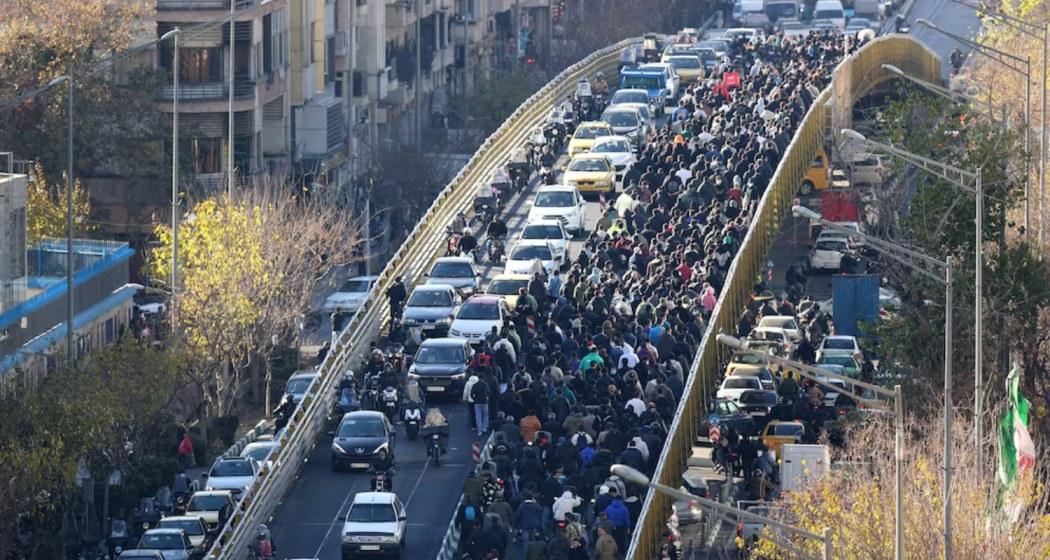
Violence surrounding week-long protests in Iran over the country’s worsening economy has killed at least two more people, taking the death toll to 10, as demonstrations spread across multiple provinces with no sign of easing, authorities said on Saturday.
Fresh fatalities were reported amid heightened political tension after US President Donald Trump warned Tehran that if it “violently kills peaceful protesters,” the United States “will come to their rescue.” While Trump did not clarify how Washington might intervene, his remarks drew an immediate and angry response from Iranian officials, who threatened retaliation against American troops stationed in the Middle East.
The protests, now in their second week, are the most significant Iran has witnessed since 2022, when the death of 22-year-old Mahsa Amini in police custody sparked nationwide unrest. However, the current demonstrations have yet to reach the scale or intensity of those protests, which were triggered by Amini’s detention over not wearing her hijab, or headscarf, in accordance with official rules.
According to Iranian media reports, the latest deaths marked an escalation in violence. In Qom, a major religious centre and home to the country’s leading Shiite seminaries, a grenade explosion killed a man overnight. Security officials alleged that the man was carrying the grenade with the intention of attacking people in the city, located about 130 kilometres south of Tehran.
Also read: Protests in Iran against ailing economy turn deadly, 7 dead
Videos circulating online from Qom appeared to show fires burning in the streets during the night, though the footage could not be independently verified.
A second death occurred in the town of Harsin, roughly 370 kilometres south-west of Tehran, in Kermanshah province. A member of the Basij, the volunteer paramilitary wing of Iran’s Revolutionary Guard, was killed in a combined gun and knife attack. Demonstrations have now spread to more than 100 locations across 22 of Iran’s 31 provinces.
Iran’s civilian administration, led by reformist President Masoud Pezeshkian, has sought to signal a willingness to engage with protesters. Pezeshkian has acknowledged, however, that his ability to address the crisis is limited as the national currency continues to slide. The Iranian rial has depreciated sharply, with one US dollar now costing around 1.4 million rials, a development that helped ignite the initial protests.
Although the demonstrations were rooted in economic grievances, protesters have increasingly chanted slogans against Iran’s theocratic system. The government has struggled to stabilise the economy in the months following its June conflict with Israel, during which the United States also carried out strikes on Iranian nuclear sites.
In recent days, Tehran has said it has halted uranium enrichment at all facilities, a move widely seen as an attempt to signal openness to renewed negotiations with Western powers aimed at easing sanctions. However, no talks have materialised so far, with both Trump and Israeli Prime Minister Benjamin Netanyahu warning Iran against rebuilding its nuclear programme.

 Follow us