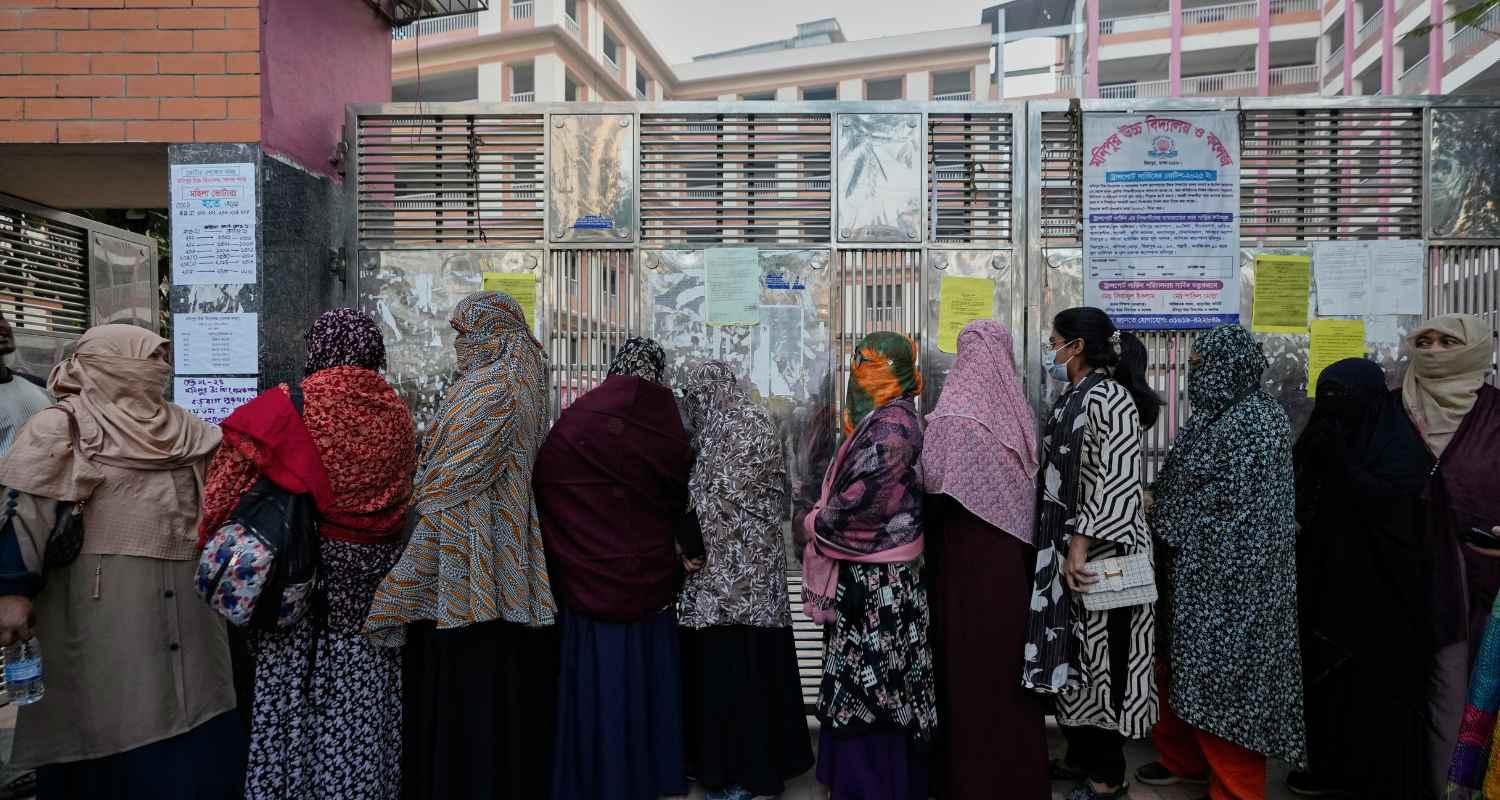
Voting began in Bangladesh on Thursday morning for the crucial general election—the first since the ouster of prime minister Sheikh Hasina after massive nationwide protests in August 2024. Voting began in 299 out of 300 parliamentary constituencies across the neighbouring country at 7:30 am (local time) and will continue until 4:30 pm. Due to the death of a candidate, voting in one constituency has been cancelled.
The counting of votes is expected to begin shortly after the voting concludes.
The 13th parliamentary elections are being held simultaneously along with a referendum on a complex 84-point reform package. The Election Commission has made elaborate security arrangements, deploying nearly 1 million security personnel—the largest-ever in the country's electoral history.
The contest is mainly between the Bangladesh Nationalist Party (BNP) and its once ally, Jamaat-e-Islami, in the absence of Hasina's now-disbanded Awami League. Chief Adviser Muhammad Yunus' interim government disbanded the Awami League last year and barred it from contesting the polls.
A total of 1,755 candidates from 50 political parties and 273 independents are contesting the election. The BNP has fielded the highest number of 291 candidates. There are 83 female candidates.
Yunus, who has promised to quickly transfer power to the elected government, has urged the political parties, candidates, and other concerned parties to maintain restraint, tolerance, and democratic behaviour on the polling day.
In a televised address to the nation on the eve of the polling, Chief Election Commissioner AMM Nasir Uddin called upon the voters to cast their votes freely. He urged political parties, candidates, and voters to maintain a peaceful and cordial environment.
He said representatives from 45 countries and organisations, including election management bodies and international institutions, were observing the polls.
Election Commissioner Abdur Rahmanel Machud said nearly 9,00,000 law enforcement personnel had been deployed to ensure security during the election.
Authorities have deployed Armoured Personnel Carriers (APCs) and Rapid Action Teams (RATs) across key areas of the capital. Police said they have provided a list of risk-prone polling centres to the EC, which showed that out of 2,131 polling centres in Dhaka, 1,614 were risk-prone. However, the army said they had identified two centres in Dhaka city as "risky".
For the first time, drones and body-worn cameras are being used for election security.
EC data showed that first-time voters made up some 3.58 per cent of the nearly 127 million voters. In another first, nearly 8,00,000 expatriate Bangladeshis, who had registered with the poll body, will be able to vote through an IT-based postal ballot system.

 Follow us