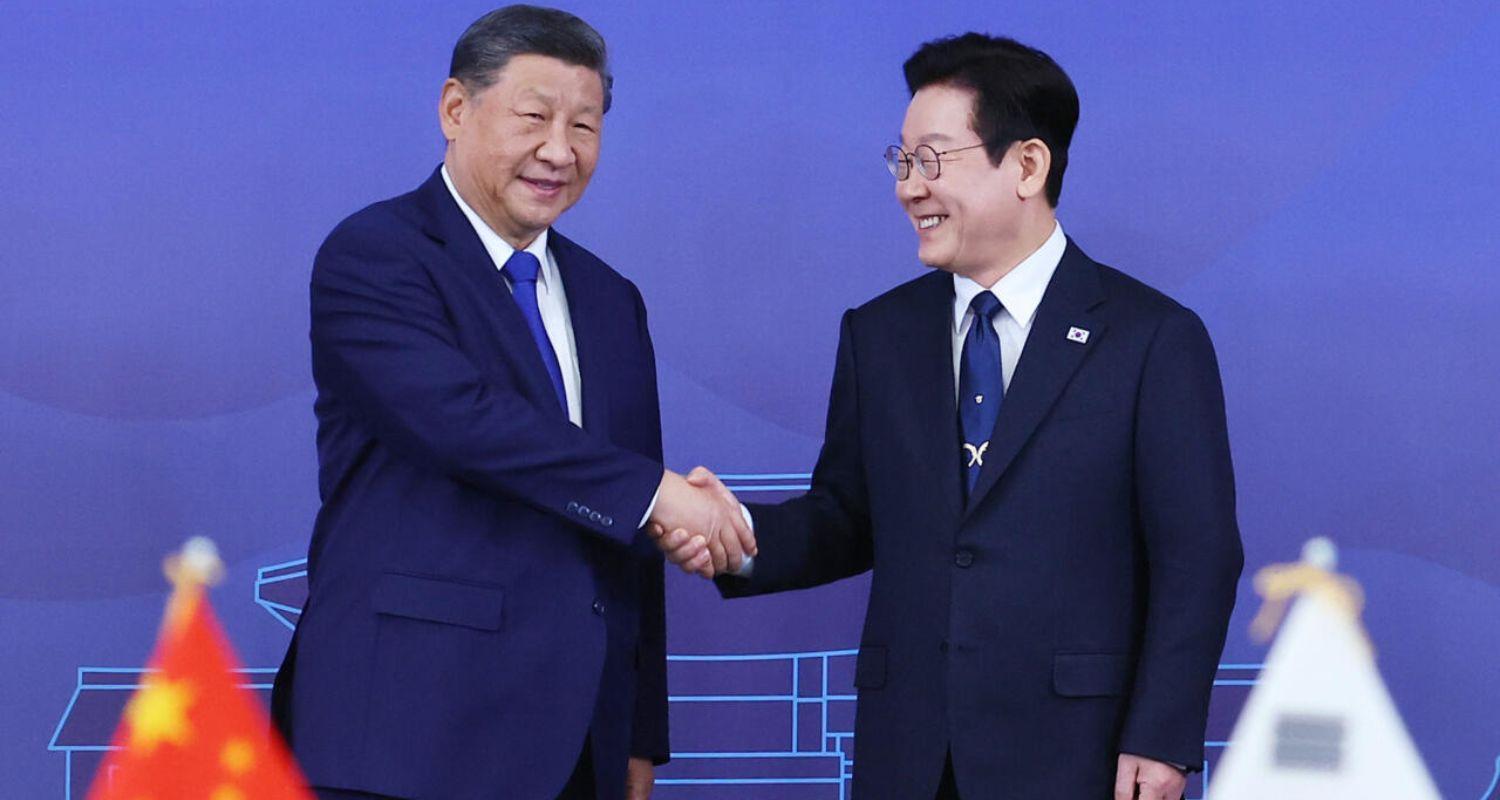
South Korean and Chinese leaders held their summit in Beijing on Monday to discuss issues ranging from economic cooperation and supply chains to peace on the Korean peninsula. President Lee Jae-myung, who arrived in China on Sunday on his first state visit to the neighbouring country since taking office in 2022, met Chinese President Xi Jinping to strengthen ties between the two nations.
South Korea, which hosts major US military presences, is trying to defuse tensions with North Korea which tested several ballistic missiles on Sunday hours before Lee's departure. The two leaders exchanged views on matters of cross-border investment, specifically regarding the digital economy and trade in key minerals.
China is South Korea's biggest trade partner, as several of its top conglomerates, like Samsung and Hyundai Motor, operate major production facilities in the country.
Lee and Xi had last held an official meeting in November 2025 at the Asia-Pacific Economic Cooperation (APEC) summit in Peru. During that meeting, the two leaders were warm, describing bilateral ties as mutually beneficial with Xi calling the two countries "inseparable partners" who have contributed to each other's economic development.
Former US Trade Representative for China Affairs, Jeff Moon, said, "South Korea is just one of many countries seeking reassurances of access to rare-earth supplies, so the Chinese have probably developed a standard approach. That includes a licensing process that verifies that all Chinese rare earths will be used for civilian purposes and not for military uses.”
Past restrictions by China on critical mineral supplies to Seoul followed US arms sales, including THAAD deployment in 2017. Analysts estimated that Beijing’s earlier retaliation caused billions of dollars in losses to South Korea’s retail and tourist sectors.
On Sunday, just before Lee departed for China, North Korea launched ballistic missiles into the waters off its eastern coast. South Korea’s national security office convened an emergency meeting in response to the launch, which Seoul said saw missiles fly around 900 kilometres.
North Korea has a pattern of carrying out such military actions, seen as provocative by South Korea, Japan and the US, at times when high-level diplomatic engagements are scheduled.
Also read: China calls South Korea’s ban on DeepSeek trade weaponisation

 Follow us