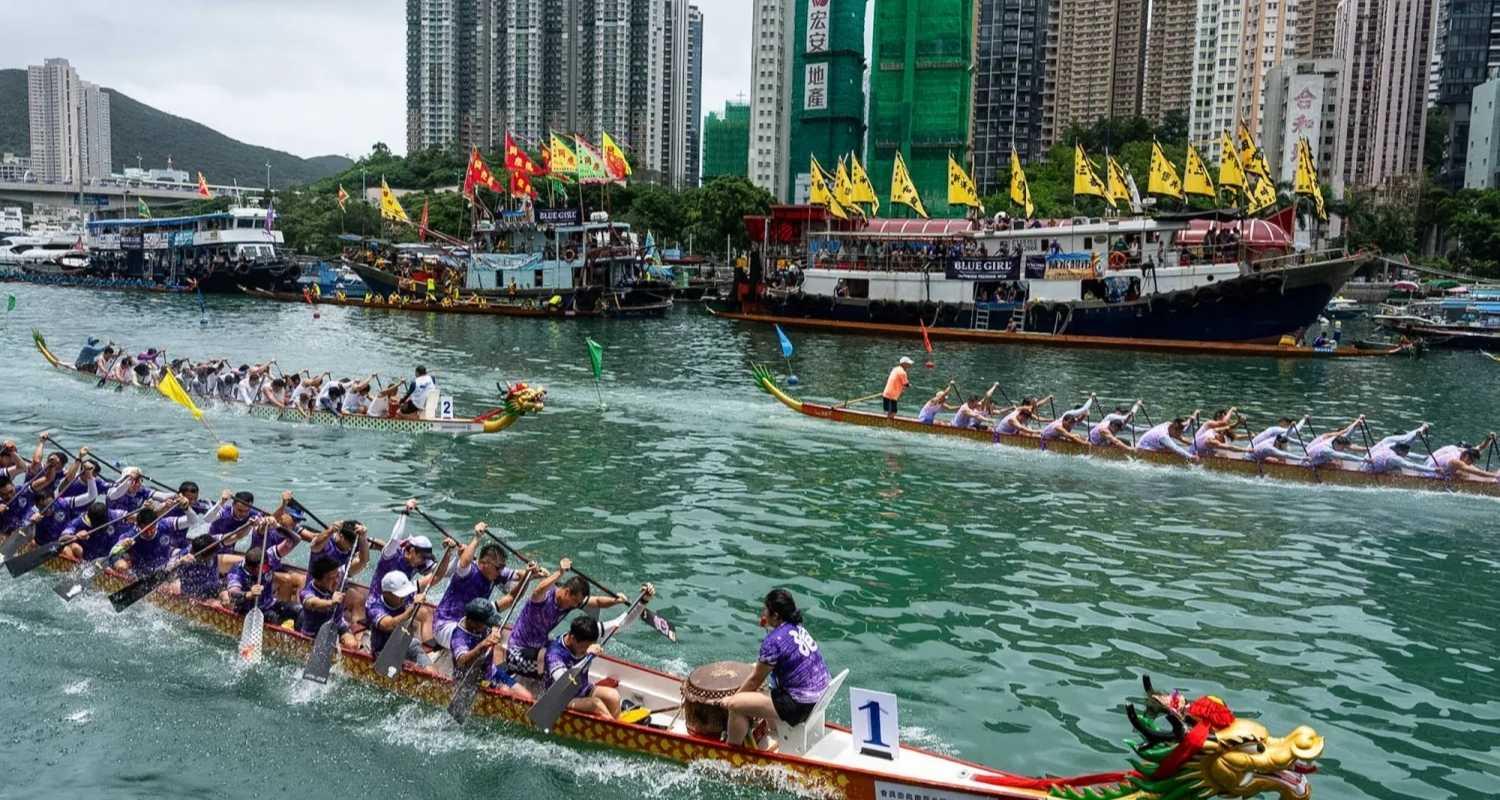
The Dragon Boat Festival was marked with vibrant celebrations across mainland China, Hong Kong and Taiwan on Friday, as communities came together for traditional boat races, lion dances and a variety of cultural events.
With a history spanning more than two millennia, the festival is most widely recognised for its dragon boat competitions. However, its roots extend deep into Chinese culture, drawing on historical traditions as well as ancient beliefs surrounding health, protection and harmony between humans and nature.
“The Dragon Boat Festival is probably the richest and most diverse of all traditional Chinese festivals,” said Liu Xiaofeng, a history professor at Tsinghua University. “Different regions developed their own customs and rituals over time, many of which are linked to ideas associated with the summer solstice and the balance between yin and yang,” he explained.
The festival is most closely associated with the ancient poet and statesman Qu Yuan, who, according to legend, drowned himself more than 2,000 years ago. Folklore says local residents rushed out in boats to search for him and threw rice into the river to prevent fish from consuming his body. This story is believed to have inspired both the dragon boat races and the tradition of preparing rice dumplings.
Also read: Indian jurist Bimal Patel elected ITLOS judge
In Beijing, a three-day dragon boat competition features men's, women's and mixed-team events over distances of 100, 200 and 500 metres. Teams representing Beijing, Tianjin, Hebei, Shanxi and Guangdong are taking part in races throughout the holiday period.
Accompanied by the booming rhythm of drums, crews paddled in perfect synchronisation, propelling their elaborately decorated boats through the water as enthusiastic spectators lined the banks to cheer them on.
Many families also celebrated the occasion at home, gathering to enjoy “zongzi,” the traditional sticky rice dumplings wrapped in bamboo leaves that are synonymous with the festival. Festivities in the Chinese capital are scheduled to continue through June 21 along the historic Grand Canal, one of Beijing's most prominent cultural landmarks.
“The competition helped strengthen our team spirit,” said participant Li Maoshan after Friday's races. “It also provided an opportunity for us to showcase perseverance, determination and the value of hard work.”
In Hong Kong, dragon boat races attracted large crowds, with some participants adding a playful touch to the celebrations by wearing colourful costumes, including outfits inspired by the popular Chinese mythological figure and Taoist deity Ne Zha.
The annual festival once again highlighted the enduring appeal of one of China's oldest traditions, blending sport, culture and community spirit in celebrations observed across the region.

 Follow us