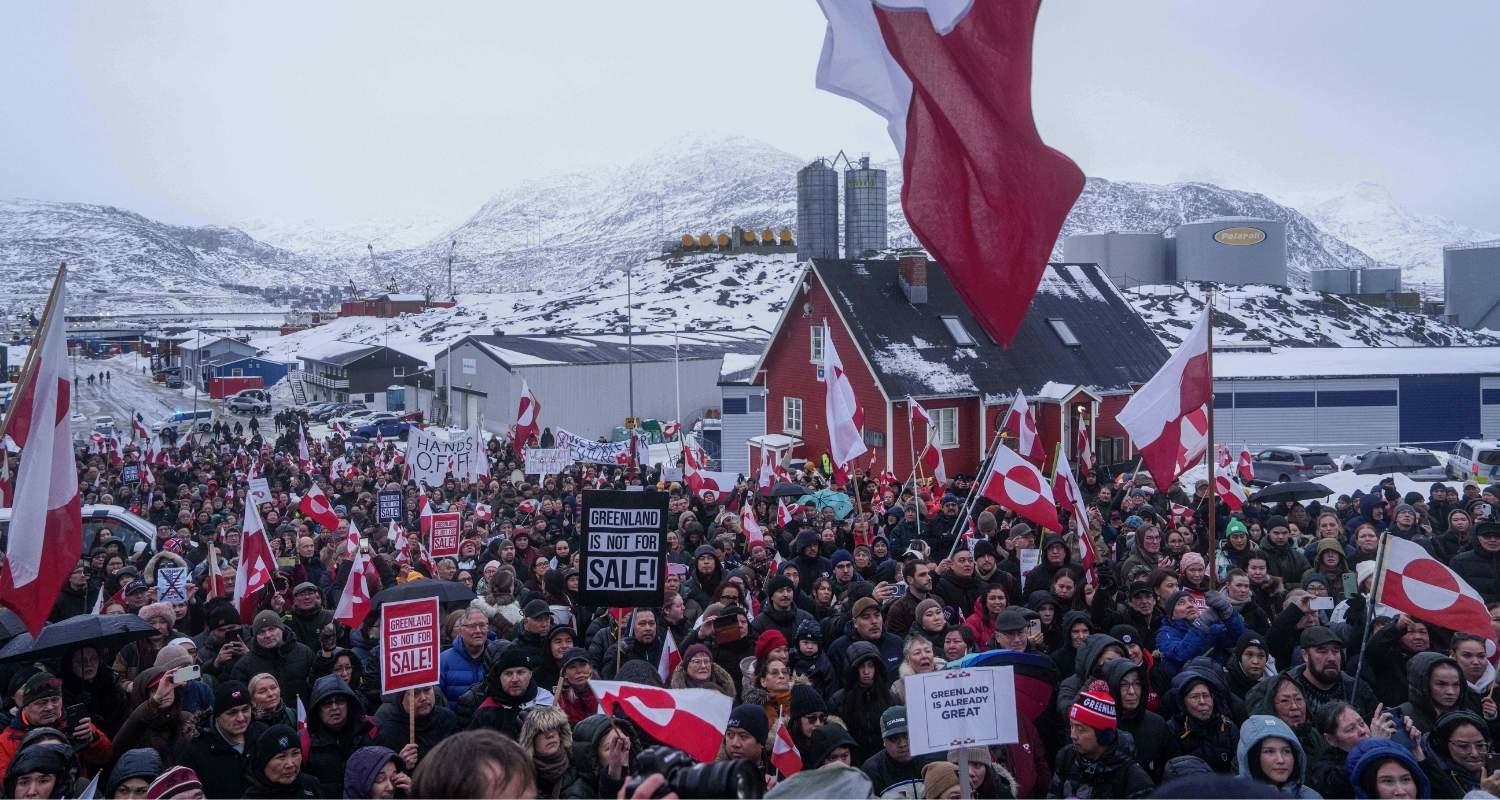
The European Union is considering retaliatory sanctions against the United States in response to consistent threats by US President Donald Trump to impose tariffs on countries who oppose his ambition to control Greenland.
The bloc is said to be preparing to reinstate its suspended €93 billion ($108bn) package of reciprocal tariffs on US imports, should Trump impose new trade levies, although it views reciprocal tariffs as a last resort while still prioritising a diplomatic solution to the issue.
Following an emergency meeting of ambassadors on Sunday, EU member states signalled strong solidarity with Denmark and Greenland, but decided against immediately activating the Anti-Coercion Instrument (ACI) – a tool so powerful it has been dubbed the “trade bazooka”.
Tensions between the United States and the EU escalated on Saturday after Trump announced a 10 per cent tariff, effective February 1, on imports from eight European countries whose troops have been sent to the self-governing Danish territory.
The targeted nations are Denmark, Norway, Sweden, France, Germany, the Netherlands, the UK and Finland for opposing his bid to acquire Greenland. Trump said that these 10 per cent tariffs could rise to 25 per cent by June 1 in the absence of a deal.
Also Read: Tariffs risk ‘dangerous downward spiral’, warns EU
The EU has two levels of potential countermeasures, with the most immediate being the €93-billion retaliation package, prepared last year in response to Trump’s earlier tariff threats. The idea was shelved after a tentative US-EU trade deal reached last summer.
EU diplomats told international news agencies that this package could “automatically come back into force on February 6” if no agreement was reached.
This would be followed by secondary measures under the ACI, which allows the bloc to restrict market access, investment and intellectual property rights. The instrument was designed specifically to counter coercion tactics by major economic powers.
French President Emmanuel Macron, a vocal critic of Trump’s economic policies, has called for the tariff package’s activation, describing Trump’s threats as unacceptable. “He will ask, in the name of France, for the activation of the Anti-Coercion Instrument,” his office stated on Sunday.
In addition, European Council President, Antonio Costa, has convened an extraordinary summit of EU leaders for Thursday, January 22, to coordinate a united stance. The bloc is “ready to defend itself against any form of coercion”, Costa said.

 Follow us