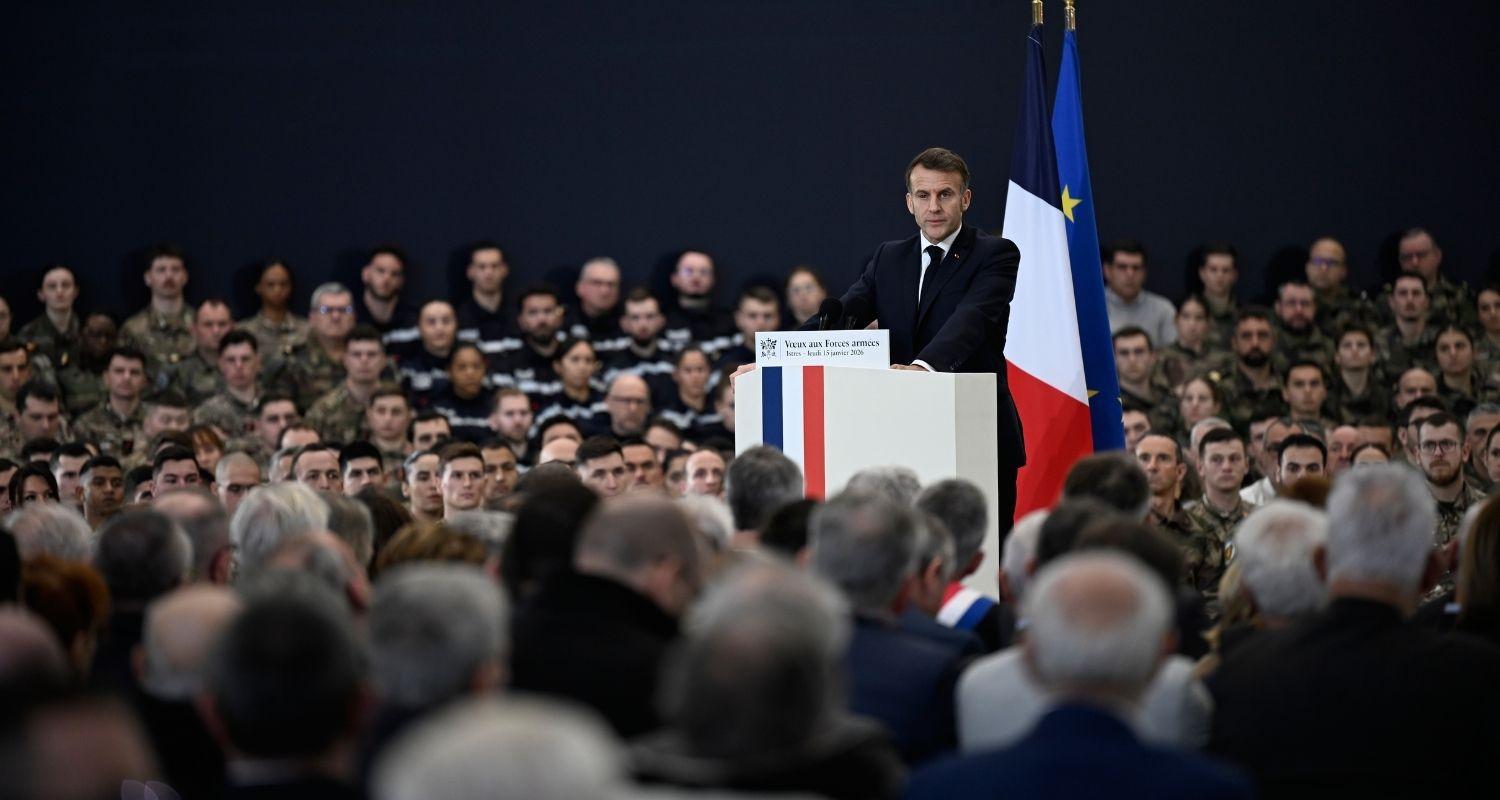
French President Emmanuel Macron on Thursday stressed on the need for the European Union (EU) to stock up on new long-range weapons to maintain the balance of power in the West.
“We are within range of these missiles,” Macron told soldiers in a speech at the Istres-Le Tubé Air Base, referring to long-range missiles, which he said can be procured through the European Long-Range Strike Approach (ELSA) initiative.
“The initiative that we launched, known as ELSA, makes perfect sense when we have just observed for the second time the firing of a very long-range missile, known as Oreshnik,” Macron said.
The French premier’s comments come on the heels of the recent use of the Oreshnik missile by Russia on Ukraine’s Lviv repair facility for aviation.
“If we want to remain credible, we Europeans – and especially France, which has certain technologies – must acquire these new weapons that will change the balance of power in the short term,” he said.
Also Read: Macron condemns US visa ban on EU officials
“With our German and British partners in particular, we must make strong progress on these long-range strike capabilities… to increase our credibility and support our nuclear deterrence,” Macron added.
The ELSA programme was launched in 2024 by France, Germany, Poland, and Italy (later joined by Sweden, the UK, and the Netherlands), and aims to leverage shared European costs and industrial capabilities to develop conventional long-range strike capabilities similar to the Oreshnik.
Russia first fired the Oreshnik, which experts describe as an “unstoppable missile”, at a target in the city of Dnipro in November, 2024.
Russian President Vladimir Putin has claimed the Oreshnik has no equal globally, comparing its power to a “falling meteor”. The missile system carries multiple homing warheads capable of hitting several targets while travelling at Mach 10 (ten times the speed of sound).
The missile entered mass production in 2025, and has been deployed in Belarus, a close ally of Moscow.
The EU is growing increasingly concerned about Russia’s latest technological advancements, particularly in the realm of its military capabilities. There are also gnawing fears among the EU leadership that Russia could launch a surprise attack on NATO members.
However, Kremlin has dismissed such claims as unfounded, stating that it has no intentions of aggression, and that the West undermines Russian security and sovereignty in Ukraine.

 Follow us