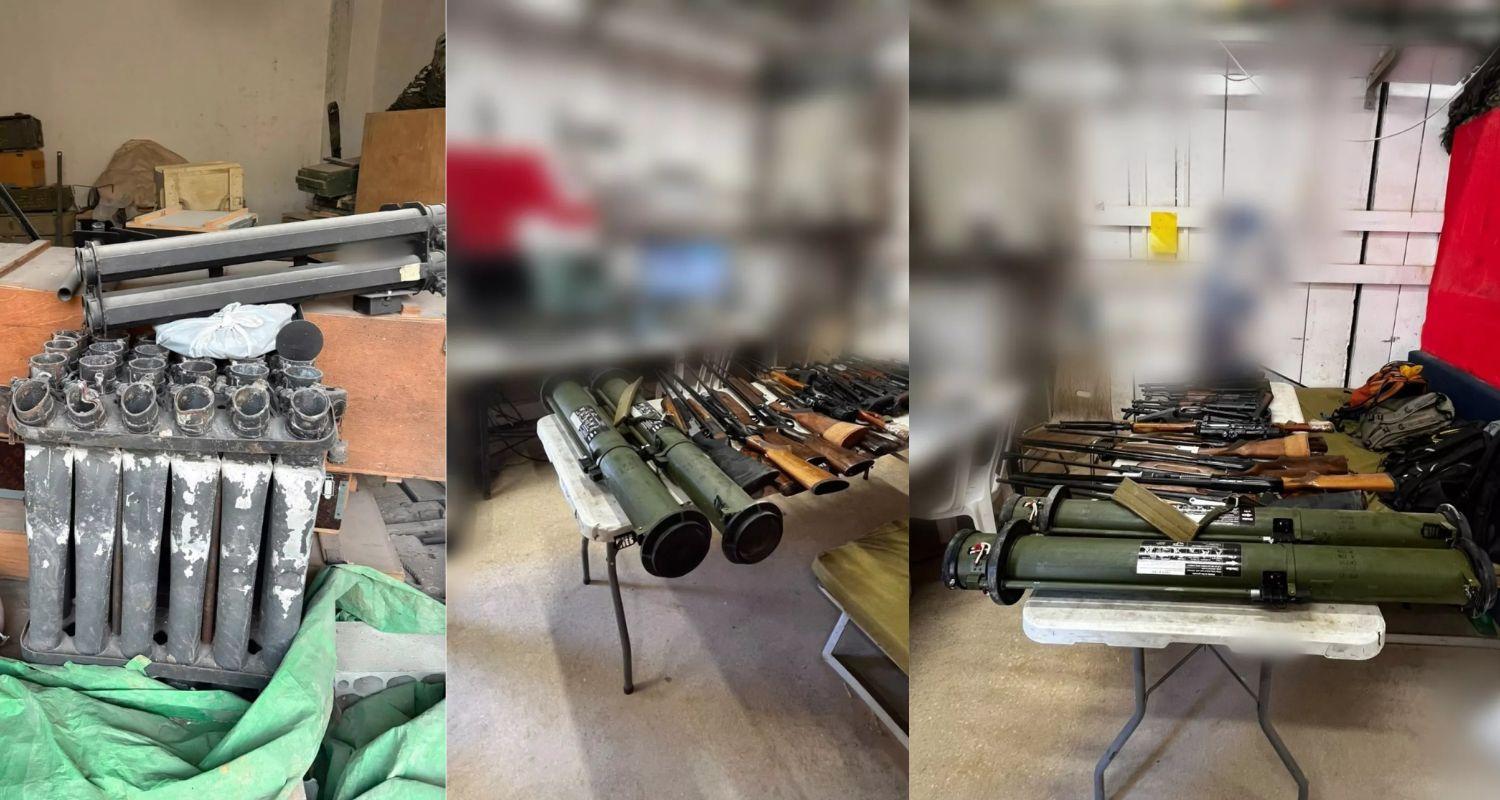
The Israel Defence Forces (IDF) announced that troops operating in southern Lebanon have successfully located a weapons storage facility allegedly utilised by Hezbollah alongside underground infrastructure.
In a post on X, the IDF stated that soldiers uncovered a major weapons cache containing Kalashnikov rifles, anti-tank rockets and diverse military equipment stored inside the facility.
“Additionally, IDF soldiers dismantled an underground tunnel that spans over dozens of meters in the Srobbin area,” the military stated, noting that the subterranean passage “was utilised by Hezbollah to carry out terror attacks against IDF soldiers”. Kalashnikov rifles, anti-tank rockets, additional military equipment and a weapons storage facility that stored Hezbollah launchers and rockets were recovered.
Additionally, IDF soldiers dismantled an underground tunnel that spans over dozens of meters in the Srobbin area. The operations are part of ongoing military efforts by the IDF to dismantle Hezbollah’s cross-border militant infrastructure and secure northern communities.
Last week, the IDF said that it dismantled several key underground tunnels beneath the Beaufort Ridge in southern Lebanon during a “limited activity” in the area of the security zone, as US-brokered Israel-Lebanon talks are set to resume in Rome in August.
The IDF said the tunnel network served as a central command centre for Hezbollah, from where its commanders managed combat operations and directed fire toward Israeli troops and civilians.
According to the IDF, the underground network consisted of several levels and had been constructed over two decades. The IDF also said that it served as a central command centre for Hezbollah's Bader Unit in southern Lebanon and was “planned and funded by the Iranian terrorist regime”.
It claimed that the network posed a threat to northern Israel as it was located approximately six kilometres from Metula and the Galilee Panhandle. “Over the course of the war, dozens of UAVs, explosive devices, and anti-tank missiles were launched from this infrastructure toward Israeli civilians and IDF soldiers,” the IDF said.
This comes as the seventh round of United States-mediated Lebanon-Israel talks began in Rome on Tuesday with the aim of establishing new “pilot zones” in southern Lebanon from which Israeli forces will begin withdrawing, and the Lebanese army will assume control.
The opening day of the latest negotiations in Rome focused on border issues and mechanisms to verify the implementation of security arrangements, a senior Lebanese official told Anadolu News Agency on Tuesday.
“The first day of the seventh round of negotiations with Israel concluded, with the afternoon discussions divided into two meetings, one military and one political,” the official said.
At the political meeting, the two sides discussed the border issue with Lebanon presenting its position, the official told Anadolu News Agency. During the military meeting, participants discussed mechanisms to verify implementation of the security arrangements, including an Israeli withdrawal, Hezbollah’s weapons as well as the third party responsible for overseeing the process.
“Lebanon has not yet received responses from Israel's political leadership regarding its commitment to the ceasefire,” the official told Anadolu News Agency.
This week’s round marks the second time Rome has hosted the negotiations, which are currently scheduled to last three days. Five previous rounds were also held in Washington as part of a US-mediated negotiating process.

 Follow us