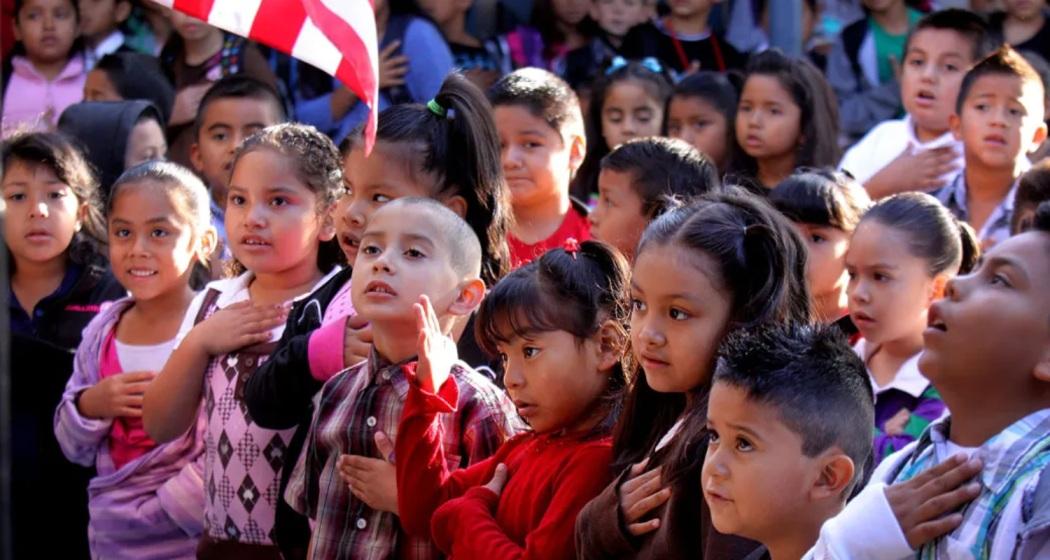
President Donald Trump’s latest move to tighten immigration policies in the United States has left immigrant families grappling with uncertainty about sending their children to school.
With the administration rescinding a long-standing policy that prevented federal immigration arrests at sensitive locations such as schools, churches, and hospitals, fears have heightened.
Carmen, an immigrant from Mexico, expressed deep concern after learning that the Trump administration had lifted these protections.
“Oh, dear God! I can’t imagine why they would do that,” she said.
Carmen, who lives in California, plans to take her two grandchildren, aged 6 and 4, to school the following day unless she receives confirmation from school officials about their safety.
“What has helped calm my nerves is knowing that the school stands with us and promised to inform us if it’s not safe at school,” she added, speaking on condition of anonymity out of fear of targeting by immigration authorities.
The reversal of the policy, which has protected “sensitive locations” for decades, has sparked widespread anxiety. Many immigrant families, even those who are in the US legally, are contemplating the risks involved in allowing their children to attend school.
Schools across the country are struggling to reassure parents, with several districts already witnessing an increase in calls from concerned families.
In states like California, educational officials have offered guidance to schools on state laws limiting local cooperation with immigration enforcement.
However, not all districts have provided reassurances, leaving some families feeling vulnerable. Daniela Anello, the head of D C Bilingual Public Charter School in Washington DC, voiced shock at the announcement, calling it “horrific.”
“It’s ridiculous,” she said. “There’s no such thing as hiding anyone. It doesn’t happen, hasn’t happened.”
An estimated 733,000 school-aged children are undocumented in the US, according to the Migration Policy Institute. Many more have US citizenship but have parents who are undocumented, increasing their vulnerability.
While fears of raids did not materialise on the administration’s first day, the rapid changes in immigration policies have created an atmosphere of confusion and unease.
School systems nationwide are watching closely for impacts on student attendance, with educators expressing concern over the long-term implications.
Officials at Georgia Fugees Academy Charter School, which serves refugees and immigrants, report that even students legally residing in the country are hesitant to attend school due to heightened fears surrounding immigration crackdowns.
“We don’t want our school to be targeted,” said Luma Mufleh, the school’s Chief Operating Officer. “We’ve accelerated our exam schedule so students won’t miss critical tests, but the uncertainty remains.”
The Trump administration has framed its latest actions as part of a broader effort to crack down on those who they perceive as avoiding arrest by hiding in sensitive locations.
The Department of Homeland Security stated: “Criminals will no longer be able to hide in America’s schools and churches to avoid arrest.”
Yet, critics argue that these policies are creating an atmosphere of fear that undermines the safety and rights of immigrant families.
Across the country, schools are finding themselves at the centre of a national debate on immigration enforcement, with some districts taking a firm stance against cooperating with federal authorities.
Iris Gonzalez, an undocumented immigrant from Guatemala living in Boston, sees schools as one of the few safe spaces left for her family.
Despite her legal driving licence, she worries about getting stopped by immigration officials. “What if they stop me?” she wonders.
“I don’t sleep,” Gonzalez said. “There’s a lot of uncertainty about how to look for work, whether to keep driving and what’s going to change.”
Carmen’s story reflects a wider struggle faced by immigrant families who feel increasingly threatened by the new policies.
Her family fled Michoacán state in Mexico, a region plagued by drug violence, and sought refuge under the previous administration’s asylum programme.
With Trump shutting down programmes like the CBP One app, which processed asylum requests, the future remains uncertain for many like her.
“My biggest fear is that we don’t have anywhere to go back to,” Carmen said. “It’s about saving our lives. And protecting our children.”

 Follow us