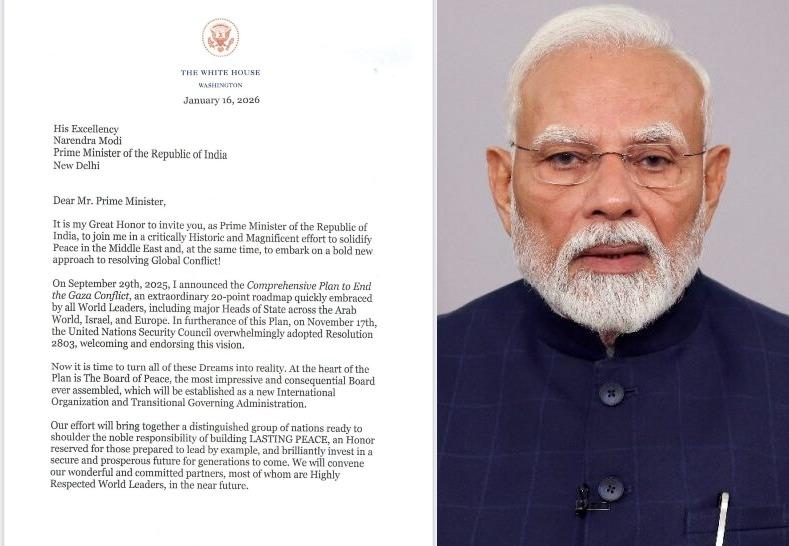
Even as the White House has sent official invite to India, there is no word yet from India whether Prime Minister Narendra Modi will accept President Donald Trump’s invitation to join his "Board of Peace"’ to oversee disarming of Hamas, technocratic governance and reconstruction of the enclave reduced to rubble by Israeli bombardments.
In the letter addressed to Prime Minister Narendra Modi, Trump said, “It is my Great Honor to invite you, as Prime Minister of the Republic of India, to join me in a critically historic and Magnificent effort to solidify Peace in the Middle East and, at the same time, to embark on a bold new approach to resolving Global Conflict!”
Trump referred to his September 29 announcement of a comprehensive plan to end the Gaza conflict, saying, “Now it is time to turn all of these Dreams into reality. At the heart of the Plan is The Board of Peace, the most impressive and consequential Board ever assembled, which will be established as a new International Organization and Transitional Governing Administration.”
“Our effort will bring together a distinguished group of nations ready to shoulder the noble responsibility of building LASTING PEACE, an Honor reserved for those prepared to lead by example, and brilliantly invest in a secure and prosperous future for generations to come. We will convene our wonderful and committed partners, most of whom are Highly Respected World Leaders, in the near future.”
Pertinently, Trump has extended invitations to some 60 countries for the initiative.This is the second phase of the 20-point US peace plan that took effect from October 10, last year. While the plan brought in a ceasefire and the release of Israeli hostages, the first phase has been tardily implemented with the IDF not following the agreed proposals.
The observers say the proposal puts India in a tight spot, as the US-led initiative sidesteps the United Nations and places Washington firmly in the driver’s seat of a post-war political arrangement. At a time when India is hoping to repair its ties with the US — battered last year by Trump’s tariffs and his pivot to Pakistan — further antagonising Washington with negotiations for a bilateral trade agreement underway, would not help India’s cause. Avoiding the perception of distancing from Washington at a sensitive time will not go down well with Trump.
At the same time, it goes against India’s long-held belief on reforming and strengthening multilateral institutions like the UN. Despite disappointment with the UN in its current avatar, India does believe that conflict resolution cannot be based on ad-hoc coalitions shaped by great-power interests.

 Follow us