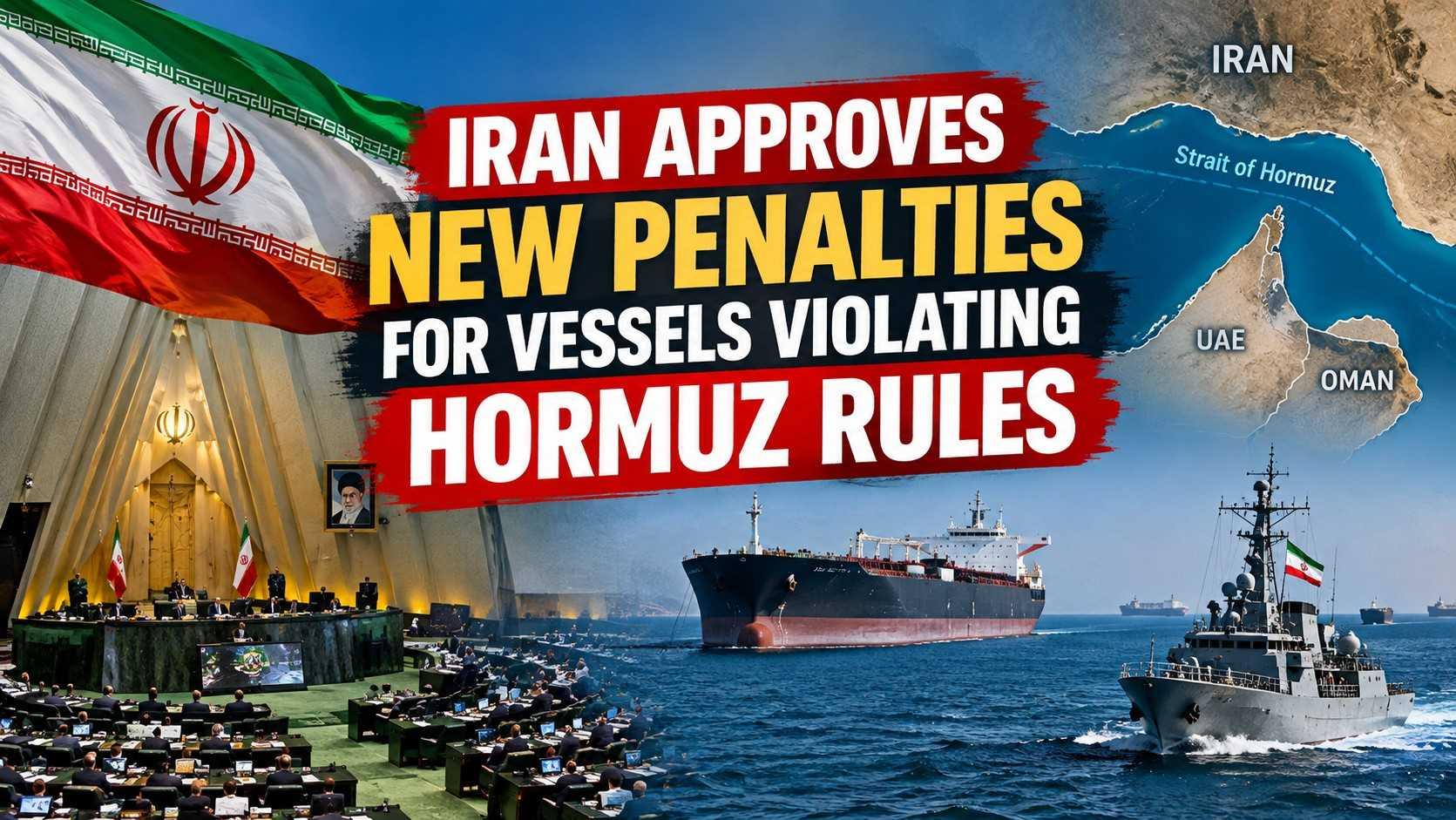
Iran’s Parliament National Security and Foreign Policy Commission has approved three provisions proposing penalties for vessels that breach the country’s transit regulations in the Strait of Hormuz.
The provisions form part of Articles 13, 14 and 15 of the proposed “Strategic Action to Ensure Security and Development of the Strait of Hormuz” bill, which was cleared by the commission on Tuesday. The legislation has not yet become law.
Under Article 13, Iranian authorities would be empowered to confiscate 20 per cent of the cargo carried by a violating vessel or recover an equivalent amount in financial terms, in addition to penalties available under Article 5 of Iran’s Islamic Penal Code.
The vessel could also be temporarily detained by Iranian maritime forces until the prescribed penalties and fines have been paid.
The proposed law calls for specialised judicial arrangements to enforce the regulations. Iran’s Judiciary would be required to establish dedicated court branches staffed by judges and specialists in maritime law and the international law of the sea.
Article 14 would impose domestic accountability on individuals and legal entities whose actions or negligence result in the law being delayed, only partly implemented or not implemented. Such violations would attract Grade 5 punishments under Article 19 of the Islamic Penal Code.
The same article includes a supplementary provision asserting Iran’s legal sovereignty over the Strait of Hormuz. Implementation of the proposed framework would be overseen by Iran’s General Staff of the Armed Forces.
Article 15 requires the military high command to provide a comprehensive implementation report to the National Security and Foreign Policy Commission every three months. The submission could be made directly or through Iran’s Ministry of Defence.
The commission must complete the bill before it can be placed before the full Parliament for a vote. It would then require consideration by the Constitutional Council.
The parliamentary initiative comes as control and security in the Strait of Hormuz have become central issues in the ongoing confrontation between Iran and the United States during the wider conflict in West Asia.
Speaking at the 81st session of the UN General Assembly on Tuesday, US President Donald Trump referred to American naval operations escorting oil shipments through the waterway. He said the flow of oil through the Strait of Hormuz had risen during the conflict.
“I want to thank the UN Security Council for voting overwhelmingly to pass a resolution condemning Iran’s despicable terrorist attacks on commercial shipping. The United States Navy has recently escorted more than 1 billion barrels of oil out of the Strait of Hormuz, and more oil is flowing than at any point since the start of the war. We’re taking 22, 25, 30, 32 and 37 ships out, respectively, every single day, every single night,” Trump said.
Trump also warned that he could resort to military action against Iran if a peace agreement was not reached, although he said he believed a deal was possible.
“But I have a big decision to make. Will a deal be made with Iran that lets them rebuild and create a far greater country than it ever was before? Maybe one of the greatest in the Middle East or even the world. Or do I annihilate the Islamic Republic and do it quickly, never giving them a chance to kill and destroy people and countries again? But I believe we’ll make a deal right after the election, because it doesn’t make sense for them not to,” he added.
Tensions were also visible inside the UN General Assembly hall when members of Iran’s delegation left after Trump began discussing US military operations against Tehran. Only a lower-level staff member remained to follow the proceedings.
The proposed legislation therefore places specific emphasis on regulating shipping through the Strait of Hormuz, defining penalties for violations and creating institutional mechanisms to enforce the measures.

 Follow us