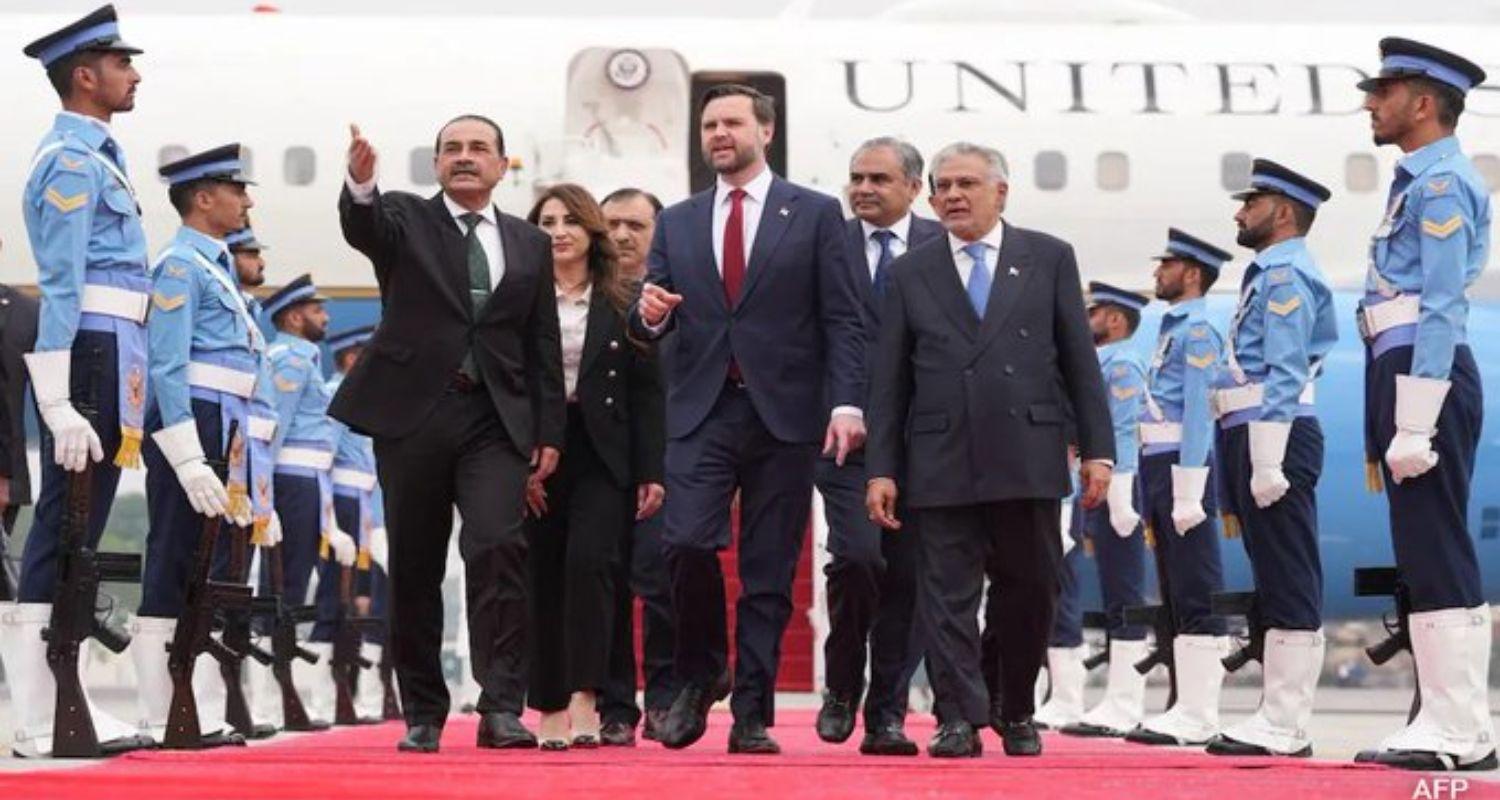
A US government aircraft carrying several high-ranking officials touched down in Islamabad on Saturday afternoon, signalling the start of critical negotiations with Iran. These talks, as reported by Reuters, are aimed at brokering an end to a six-week conflict that has sent shockwaves through the Middle East and the global economy.
The American delegation, according to Pakistani sources, is a heavyweight team featuring Vice President JD Vance alongside special envoy Steve Witkoff and adviser Jared Kushner. Their arrival followed that of the Iranian contingent, which reached the Pakistani capital in the early hours of Saturday. Led by parliamentary speaker Mohammad Bagher Ghalibaf and Foreign Minister Abbas Araghchi, the Iranian team is seeking a resolution to the hostilities involving both the US and Israel.
According to the media, both sides are scheduled to hold preliminary, separate meetings with Pakistan’s Prime Minister Shehbaz Sharif. Once all the diplomatic niceties are taken care of, the first round of indirect negotiations will begin. The government of Pakistan has also expressed its desire for fruitful dialogue, reminding the world of its commitment to bringing about a "sustainable solution" to the standoff.
However, the road to a deal already looks fraught with difficulty. Before the formal sessions even began, Mohammad Bagher Ghalibaf indicated that progress depends on specific commitments regarding Lebanon and the unblocking of frozen Iranian assets. He asserted that Washington had previously agreed to such terms and insisted those assurances be honoured, though he noted that Tehran remains open to a "genuine agreement" that respects Iran's rights.
In characteristic fashion, US President Donald Trump adopted a far more combative stance. Taking to social media ahead of the talks, he claimed that Iran "has no cards" and accused the nation of using international waterways as leverage. In a blunt post, he remarked that the only reason the Iranians were in a position to negotiate at all was through US indulgence. Vice President Vance offered a slightly more diplomatic, if firm, perspective, stating that while he hoped for a positive result, the American team would not be "receptive" to any attempts at manipulation.
The sheer scale of the diplomatic effort is evident in the numbers; the Iranian delegation comprises some 70 members, including economic and security experts, while a US advance team of roughly 100 is already on the ground. Therefore, a huge security lockdown has been initiated in Islamabad, where thousands of soldiers and paramilitaries have taken to the streets. It has been revealed by Talal Chaudhry, a junior interior minister, that a “multi-layered” security system has been implemented to secure this important summit.
This summit comes after a delicate two-week-long ceasefire during which the US and Israel did not attack Iran’s land, but many potential points of crisis still exist. Iran has been imposing restrictions on oil exports from the Strait of Hormuz, and the conflict between Israel and Hezbollah in Lebanon seems to be far from resolution. Indeed, Israeli strikes killed 13 Lebanese state security members on Friday, prompting retaliatory rocket fire from Hezbollah.
Beyond a simple cessation of hostilities, Tehran is pushing for significant concessions, including the lifting of sanctions and formal recognition of its authority over the Strait of Hormuz, where it intends to collect transit fees. Demands for wartime compensation are also expected to be on the table. With both sides seemingly miles apart on these fundamental issues, Pakistani officials involved in the logistics suggested it was "too early to say" if a breakthrough is imminent, noting that negotiators have been instructed to either secure a firm deal or walk away entirely. The coming days in Islamabad will likely decide whether the region finds a path to stability or descends back into a wider war.
Also read: 'World’s biggest reset', hints Trump before peace talks with Iran

 Follow us