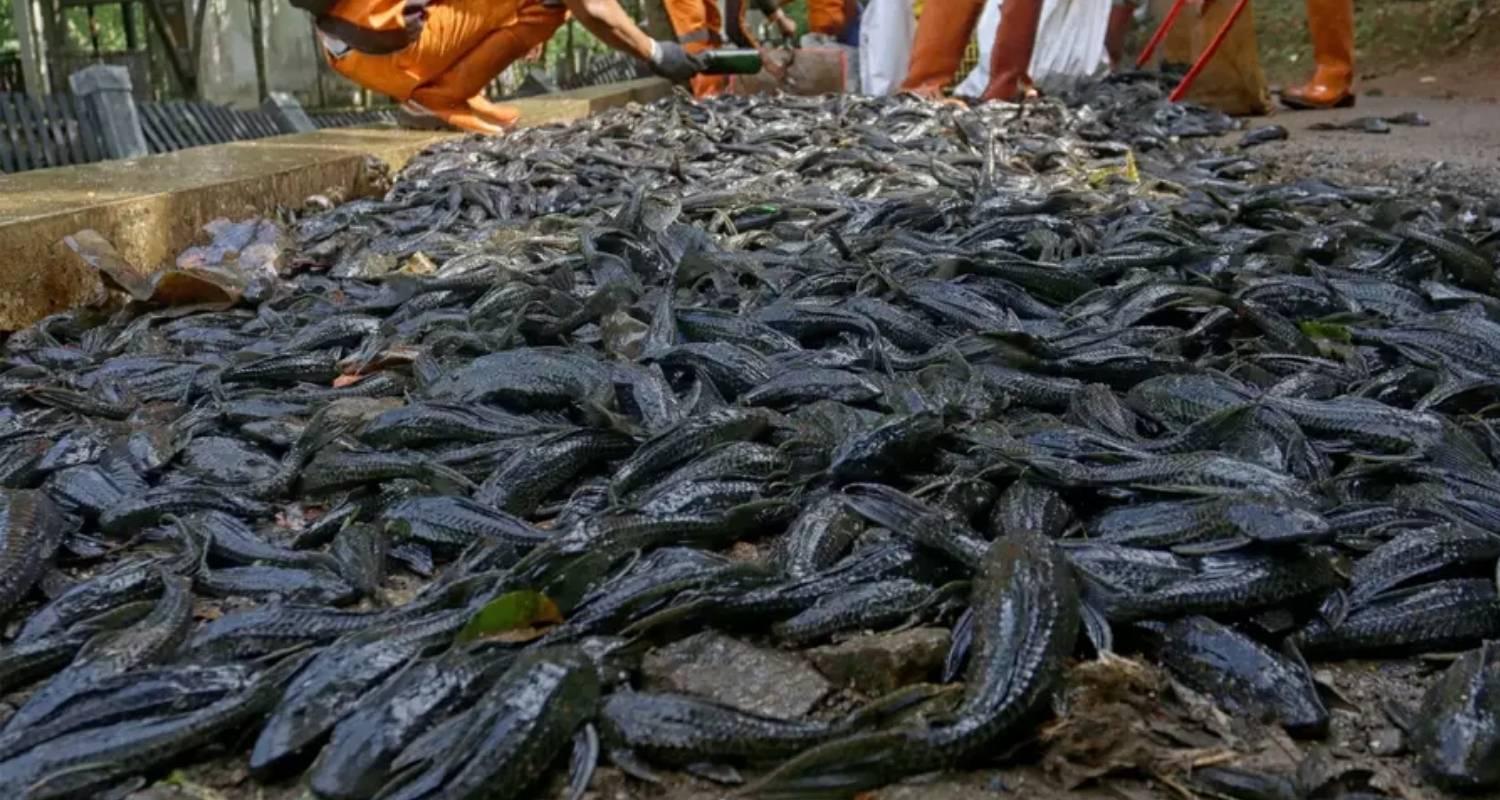
Cheers erupted across Jakarta on Friday as residents, municipal workers, and environmental volunteers pulled heavy nets of invasive fish from a reservoir, launching a large-scale effort to curb the spread of so-called “janitor fish.” Authorities aim to remove at least 10 tons (9 metric tons) of the species from the city’s waterways, hoping to restore ecological balance to the Ciliwung River and draw renewed attention to worsening water quality.
From the polluted riverbanks to concrete-lined canals cutting through the city’s skyline, the dark, armored bodies of the fish cling to walls beneath the murky water, giving them an almost prehistoric appearance.
Commonly known as janitor fish — or suckermouth catfish from the genus Pterygoplichthys — and locally called “sapu-sapu,” these species are not native to Indonesia. They were originally imported for aquariums because of their algae-eating habits but were later released into the wild, where they thrived in Jakarta’s polluted rivers. Capable of growing up to 50 centimetres and living for 10 to 15 years, their population has expanded rapidly.
Experts have repeatedly warned that invasive species like these can disrupt freshwater ecosystems, especially in densely populated urban centers. Dian Rosleine of the Bandung Institute of Technology noted that janitor fish are highly adaptable and can survive in heavily polluted environments where native species cannot. “These fish are biological indicators of poor water quality,” she explained.
Once a source of clean water flowing from the mountains of West Java, the Ciliwung River now runs through crowded neighborhoods, carrying untreated domestic waste and industrial discharge. Its natural banks have largely been replaced by concrete barriers, and during dry periods, warmer and slower water creates ideal conditions for invasive species to dominate.
In response, city authorities have launched a coordinated removal campaign targeting the fish across Jakarta’s waterways. The initiative, ordered by Governor Pramono Anung, began last week and spans all five administrative regions of the capital. Hundreds of personnel — including firefighters, disaster response teams, and local residents — have already removed more than seven tons of fish within days.
Friday’s cleanup in Ciracas, East Jakarta, at a reservoir roughly six meters deep, attracted curious onlookers as crews hauled in about 320 kilograms of fish. Red barrels filled with wriggling catches lined the site, offering visible proof of the operation’s scale.
East Jakarta Mayor Munjirin warned that the fish population has surged while preying on native species, adding that their burrowing habits also damage riverbanks and embankments. He described the operation as the start of a long-term effort, with ongoing monitoring and removal planned.
Also read: Japan's Murakami to publish first new novel in three years
However, the approach has drawn scrutiny. The Indonesian Ulema Council (MUI) raised concerns about animal welfare, cautioning that burying the fish alive would violate ethical principles in Islamic teachings. In response, officials pledged that all fish would be killed before disposal.
Authorities are also considering how best to utilize the removed fish. Although they are edible in some regions, concerns about heavy metal contamination in Jakarta’s waters mean they are unlikely to be approved for consumption locally. Alternatives under review include converting them into animal feed or fertilizer. Governor Anung suggested exploring models like those used in Brazil, where the fish are processed into charcoal for economic use.
Despite the масштаб of the cleanup, experts emphasize that removal alone will not solve the problem. Without improvements in wastewater treatment and pollution control, the river could quickly revert to its current state.
“The Ciliwung River needs full rehabilitation, and that remains our biggest challenge,” Rosleine said. “If we address only the symptoms without tackling the root causes, the solution will not last.”

 Follow us