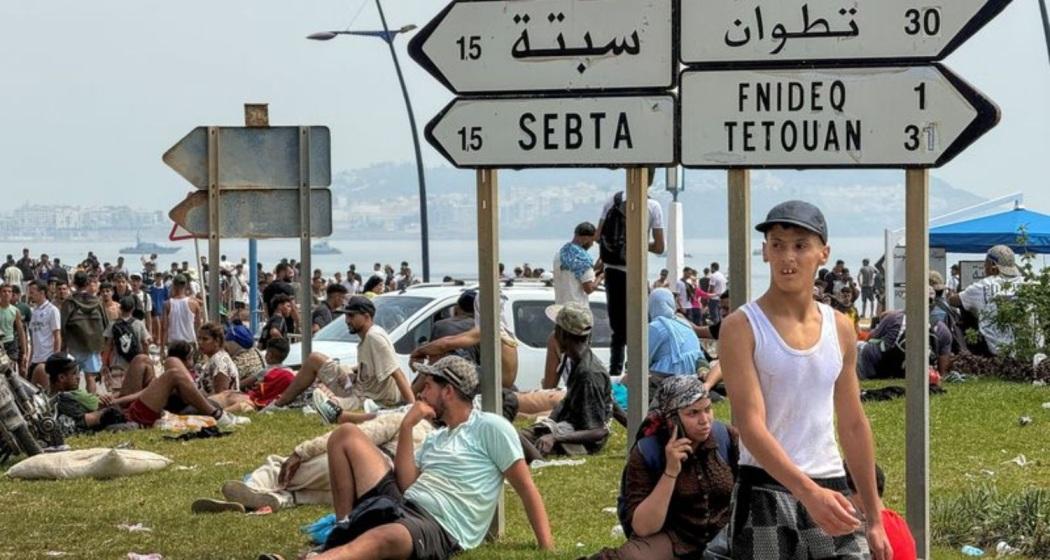
Spain said on Friday it had reversed a huge rush of migrants into a Spanish enclave in North Africa with most of the more than 50,000 people who had crossed the border by land and sea already heading back voluntarily.
The Spanish government’s representative in Ceuta said 57 bodies had been recovered on the Spanish side of the border and that there could be additional casualties on the Moroccan side. It said some drowned and some were crushed while trying to climb the breakwater that holds the border fence.
Spain's Interior Ministry said around 50,000 people had crossed the border since Thursday morning, and estimated that 48,300 had returned by Friday afternoon. Juan Jesus Vivas, head of Ceuta’s local government, said as many as 60,000 people had pushed across over the past couple of days.
Moroccan forces beat back crowds with batons and tear gas at the gates to Ceuta, trying to prevent more from entering the tiny Spanish territory that juts on a spit of sandy land into the Mediterranean from Morocco. The rush on the border caused division in Europe, where leaders of fellow European Union states called for Spain to contain the incident.
Italy said it was suspending the European Union’s border-free Schengen arrangements with Spain, a measure set to affect people travelling by plane or boat between the two countries. Madrid said the move violated EU treaties.
At the enclave’s border, Moroccan police in riot gear were seen using tear gas to disperse some of the people amassed near the fences. Water cannon trucks were deployed and the charred remains of a bus and seven cars could be seen from clashes with the crowds. On the other side, Spanish military vehicles lined up along sections of the border as dozens of migrants watched from a hilltop in Morocco, unable to cross.
Several hundred people could be seen returning to Morocco through border posts and holes in the fence with some saying they could not find food or shelter in Ceuta.
“Honestly, I don’t even know why I came, and now I’m going back,” a young Moroccan man, who said he was from Tangier, said. “I haven't eaten since lunch yesterday, even though I brought some money with me ... What we're doing is neither good nor enjoyable.”
Ayman, a 20-year-old hairdresser from the port city of Larache who only gave one name, said he had crossed on Wednesday after a five-hour swim. “There was no food inside Ceuta and we were kicked out badly by the Spanish army,” he said.
Violation of territorial sovereignty: Spanish PM
Spanish Prime Minister Pedro Sanchez travelled to Ceuta on Friday, where he was greeted with insults from protesters. He called the mass crossing “a violation of Spain's territorial sovereignty” and said the authorities were speeding up the repatriation of those who had entered illegally, with full cooperation from Morocco.
Ceuta and Melilla, Spanish autonomous cities in northern Morocco, have the European Union’s only land borders with Africa. Both periodically experience surges in attempted crossings by migrants seeking to reach Europe, but the scale of Thursday’s rush appeared unprecedented.
Right-wing parties around the continent blamed the incident on Spain’s comparatively lax migration policies, including an amnesty granted to hundreds of thousands of unauthorised migrants this year. Spain summoned the Italian ambassador to protest earlier comments by Italian Foreign Minister Antonio Tajani, who claimed Spain's amnesty policy had “encouraged human trafficking”.
US President Donald Trump, a long-time critic of Spain's Socialist-led government, told a cabinet meeting the Ceuta crossings “look like an invasion”, adding: “That same thing’s going to happen to us if the Republicans don't get elected, except worse,” referring to the upcoming midterm elections.

 Follow us