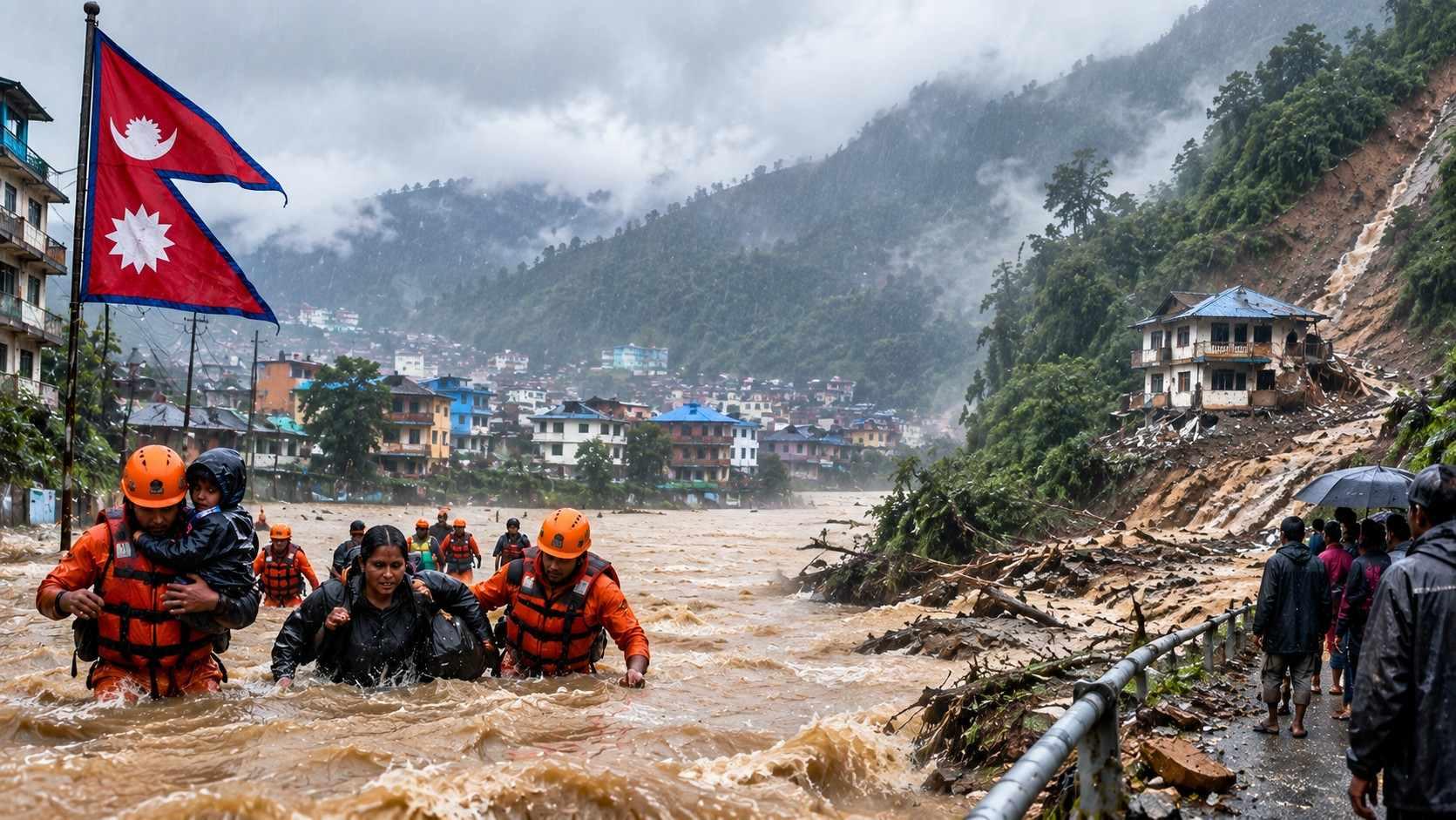
Continuous rainfall since Thursday has killed at least 14 people in Nepal, with flooding, inundation and landslides affecting several parts of the country. Authorities have issued alerts as the situation worsens in multiple districts.
The Narayani River crossed the warning threshold of 9 metres on Sunday morning, prompting authorities to caution residents living along its banks in central Nepal. Several highways leading to Chitwan, a key junction for travel across the country, remain blocked because of landslides at different points.
Figures from the National Disaster Risk Reduction Management Authority showed that six people had died in rain-related incidents by Saturday evening. Four more deaths were subsequently recorded in a landslide in Myagdi District on Sunday morning.
Bharat Kumar Pun, chairperson of Annapurna Village Council, confirmed that four people had died in the landslide. He said landslides in several locations were obstructing search and rescue efforts, while persistent heavy rain was further worsening conditions.
Another landslide in neighbouring Baglung District claimed four lives, according to local official Prem Bahadur Gharti Magar, deputy chairperson of Nishikhola Village Council. The incident took place on Sunday morning in Ward Number 3 of Hardra, where the victims were buried under debris.
The Kaligandaki River, which flows through the district, has swept away houses and bridges, cutting off road links in the affected areas.
Security forces have launched evacuation operations in several districts following flooding and the threat of further inundation. Thousands of residents are being moved to safer locations.
The latest disaster occurred about a month after the Bhotekoshi floods, which have so far killed more than 1,400 people and left over 6,000 missing.
The Bhotekoshi flood struck riverside settlements in Rasuwa district on the morning of August 26, corresponding to Bhadra 10, 2083, and quickly affected neighbouring Nuwakot and Dhading.
The disaster also caused extensive damage to infrastructure. Eight operational hydropower projects with a combined capacity of 281 MW and four projects under construction with a capacity of 388 MW were damaged, disrupting 431.1 MW of generation capacity.
Large stretches of the Galchhi–Betrawati–Rasuwagadhi road and the Prithvi Highway were destroyed or severely damaged. The flooding also damaged 48 suspension bridges and 31 motorable bridges.

 Follow us