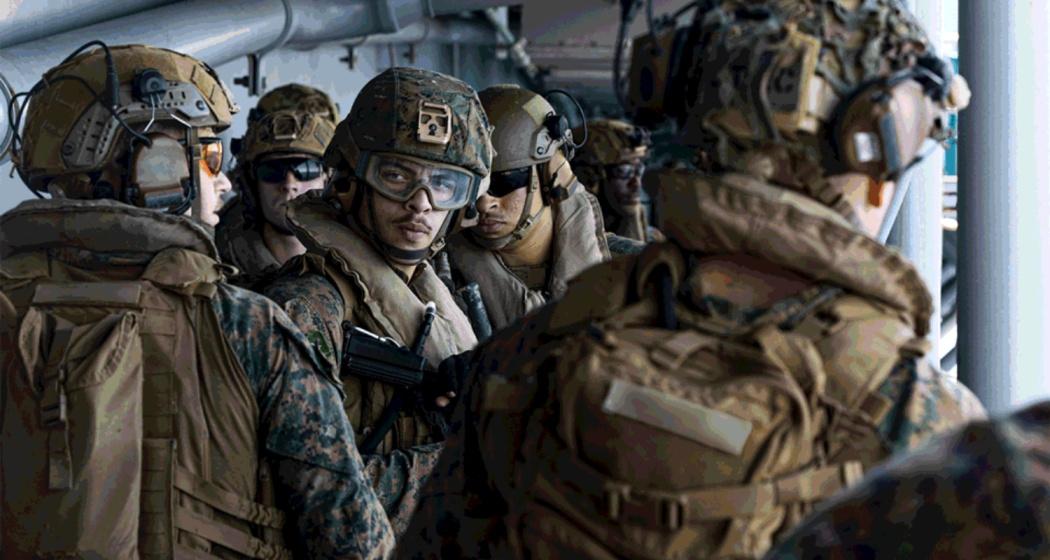
The United States has deployed an additional 3,500 troops to the Middle East as it strengthens its military presence amid the ongoing conflict with Iran and weighs its next strategic steps with the Pentagon is preparing for weeks of limited ground operations in Iran, potentially including raids on Kharg Island and coastal sites near the Strait of Hormuz
US Central Command (Centcom) said the reinforcements, comprising sailors and marines, are part of a unit led by the amphibious assault ship USS Tripoli, which carries around 3,500 personnel along with assault and transport capabilities.
The deployment comes at a time of heightened tensions, with reports suggesting that the Pentagon is preparing for the possibility of weeks-long ground operations in Iran. However, US officials have not confirmed whether troops will be deployed for direct combat on the ground.
Iran has responded sharply to the developments. Parliament speaker Mohammad Bagher Ghalibaf warned that Iranian forces are prepared to retaliate if US troops enter the country.
“Iran’s forces are waiting for American soldiers to enter on the ground so they can rain fire upon them,” he said, according to Iranian state media.
Marking 30 days since the conflict began, Ghalibaf also accused the US of mixed signalling. “The enemy signals negotiation in public, while in secret it plots a ground attack,” he said.
The Pentagon furthermore is preparing a range of military options, including limited ground operations and a possible “final blow” against Iran, even as the Islamic Revolutionary Guard Corps (IRGC) has threatened retaliatory strikes on American-linked targets in the region.
Strategic choke points in focus
Other options include operations around the Strait of Hormuz, a vital global energy corridor through which a substantial share of the world’s oil supply passes.
US planners are also examining the possibility of targeting islands such as Larak and Abu Musa, which are key to Iran’s control over regional shipping routes. Intercepting vessels carrying Iranian oil is another measure under consideration.
More aggressive scenarios involve deeper ground incursions to secure highly enriched uranium from nuclear facilities, though these carry significantly higher risks.
“This is not last-minute planning. It’s been war-gamed,” a former defence official said.
Forces build-up and operational risks
American deployments have intensified, with thousands of troops, including Marine units and elements of the 82nd Airborne Division, positioned across the region. The build-up is designed to allow flexibility for escalation or de-escalation depending on political decisions.
However, analysts warn that any ground operation would expose US forces to drones, missile strikes and resistance from entrenched Iranian forces.
“You’ve got to provide cover. Seizing it is not difficult. Protecting your guys once they are there is,” a former official noted, underlining the risks of holding strategic positions.
IRGC issues threat to US-linked institutions
Amid escalating tensions, the IRGC has warned of retaliatory strikes on American universities operating in the Gulf region, alleging that US and Israeli forces targeted Iranian academic institutions.
“American universities in the region could be targeted unless Washington issues an official condemnation of the bombings by noon on Monday, March 30,” the IRGC said in a statement.
It urged staff and students to evacuate campuses and advised people to stay at least one kilometre away from such institutions.
Several US-linked universities, including those in Qatar and the United Arab Emirates, could be at risk if the conflict intensifies.
Conflicting signals, rising stakes
While US President Donald Trump has publicly stated that he is not deploying ground troops, officials suggest that options remain open if diplomacy fails.
Iran has warned of “unlimited” retaliation in the event of further attacks, raising fears that even limited operations could trigger a wider regional conflict.
With forces in place and multiple scenarios under consideration, the evolving situation signals a critical phase in the conflict, with decisions in the coming weeks likely to shape its trajectory.

 Follow us