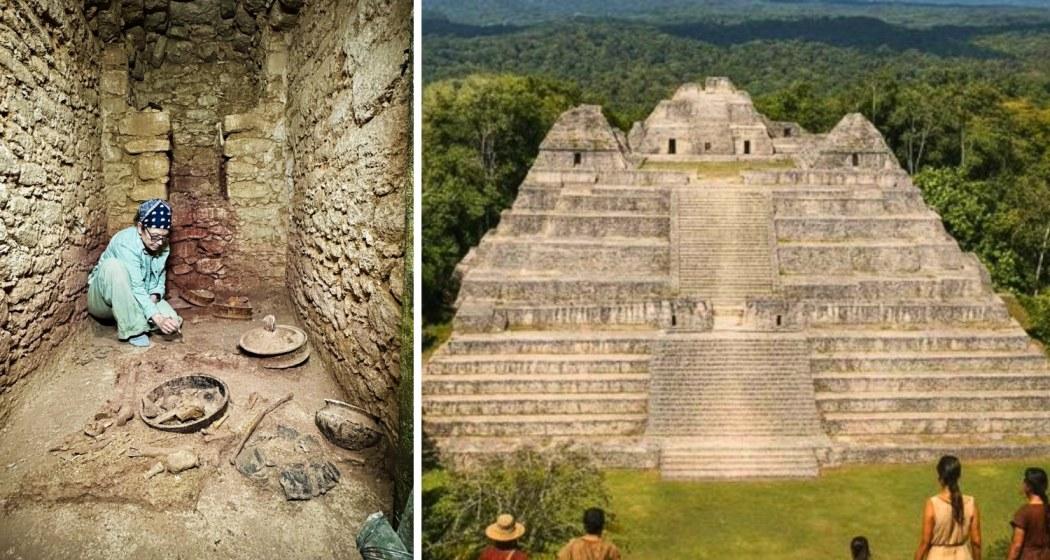
Archaeologists excavating the ancient Mayan city of Caracol in Belize have discovered a royal tomb believed to belong to Te K’ab Chaak, the city’s earliest known ruler, dating back to around AD 350. The find, made deep within Caana – Caracol’s tallest and most imposing ceremonial structure – has been hailed as one of the most significant archaeological breakthroughs in decades.
The tomb, unearthed by veteran archaeologists Arlen and Diane Chase of the University of Houston in collaboration with Belize’s Institute of Archaeology, provides crucial evidence aligning with ancient hieroglyphic records. Te K’ab Chaak’s burial confirms the dynastic origins of Caracol, once one of the most formidable city-states of the Mayan world.
“This is one of our most important finds. We found the first person in the dynasty. That, in itself, in terms of the history of Caracol, is huge,” said Diane Chase.
The ruler’s skeletal remains, aged and toothless at death, lay amidst an array of exquisite offerings that illustrate the power, belief systems and artistry of the early Maya elite. These included jade mosaic death masks, jewellery, clay pots, carved bones, and painted vessels – one notably depicting Ek Chuah, the Mayan god of trade. Scenes of a king receiving tributes and bound prisoners appear on several artefacts, pointing to ritual and political symbolism.
Archaeologists believe one of the jade mosaic masks may represent Te K’ab Chaak himself. Standing approximately 5 feet 7 inches tall in life, his physical stature was modest, yet the ceremonial grandeur surrounding his death affirms his pre-eminence.
Also read: Scientists uncover 'mysterious' 900 feet blue hole in Mexico; origin unknown
The tomb was located within Caana, or the "Sky Place", a towering pyramid that rises 141 feet high – still one of the tallest manmade structures in Belize. Its dominance in the landscape is a testament to Caracol’s architectural and political might during its peak between AD 600 and 800.
Te K’ab Chaak, whose name translates to “Tree Branch Rain God”, emerges from the shadows of history as the founder of Caracol’s royal lineage. Although earlier elite tombs have been discovered at the site – including a richly adorned burial of a noblewoman in 2009 and a multiple cremation chamber containing blades and foreign goods – none until now could be definitively linked to Caracol’s dynastic founders.
Caracol, founded as early as 900 BC, spans more than 75 square miles and rivals other great Maya centres such as Tikal and Calakmul. The newly uncovered tomb marks only the third major royal burial at the site from the Early Classic period.
The discovery not only anchors Caracol’s royal chronology but also illuminates the broader cultural and spiritual practices of the Maya in the fourth century. The presence of artefacts from distant regions suggests extensive trade and ceremonial networks far beyond the city’s core.
For archaeologists and historians, the find is a rare opportunity to connect material remains with written Maya records, offering a tangible link to the foundational figures of one of Mesoamerica’s greatest civilisations.

 Follow us