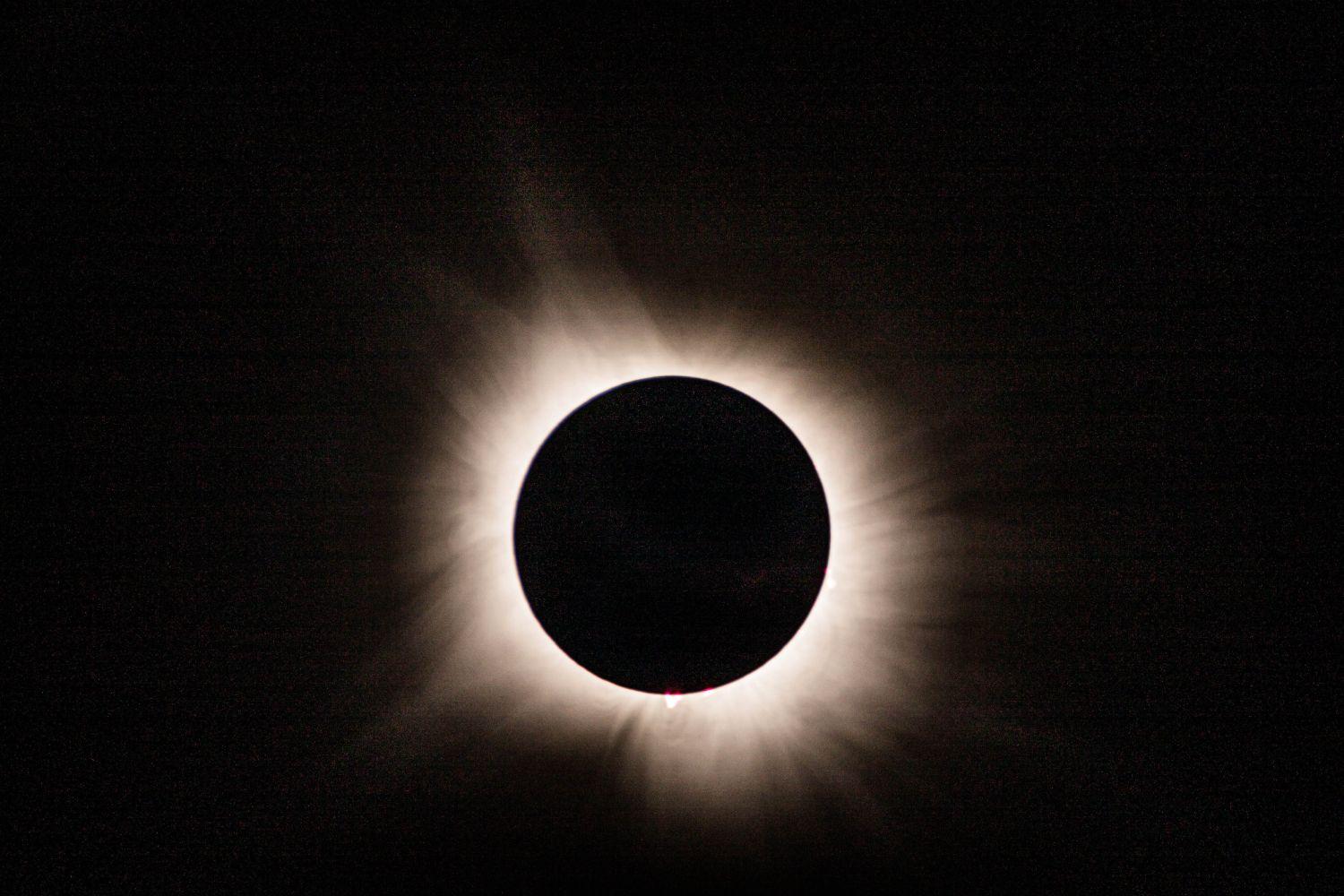
A complete solar eclipse cast a shadow over a swathe of North America, completely darkening the skies.
For over four minutes in certain locations, the moon entirely obscured the sun along a trajectory that began in Mexico, traversed the United States, and extended into Canada.
A rare celestial phenomenon, a total solar eclipse captivated viewers across North America on Monday, marking a once-in-a-lifetime event for many.
The Pacific coast of Mexico was engulfed in complete darkness at 11:07 am local time (1807 GMT) as the Moon's shadow swept across at supersonic speed, traversing the United States before returning to the ocean over Canada's Atlantic coast just under an hour and a half later.
The Moon's umbra, the darkest segment of its shadow, initially touched down approximately 998 kilometres south of the Republic of Kiribati in the Pacific Ocean at 10:09 PM IST. While observers in India missed out on this phenomenon, they can mark their calendars for the next opportunity on March 20, 2034.
The total solar eclipse was only visible in select parts of the United States, Mexico, and Canada, while a partial eclipse could be observed in certain areas of the Caribbean, Colombia, Venezuela, Spain, the United Kingdom, Ireland, Portugal, and Iceland.
Although many individuals were fortunate to witness the eclipse firsthand, cloudy skies obscured the view in numerous locations.
The next total solar eclipse visible across a significant portion of North America is not expected until 2044.

 Follow us