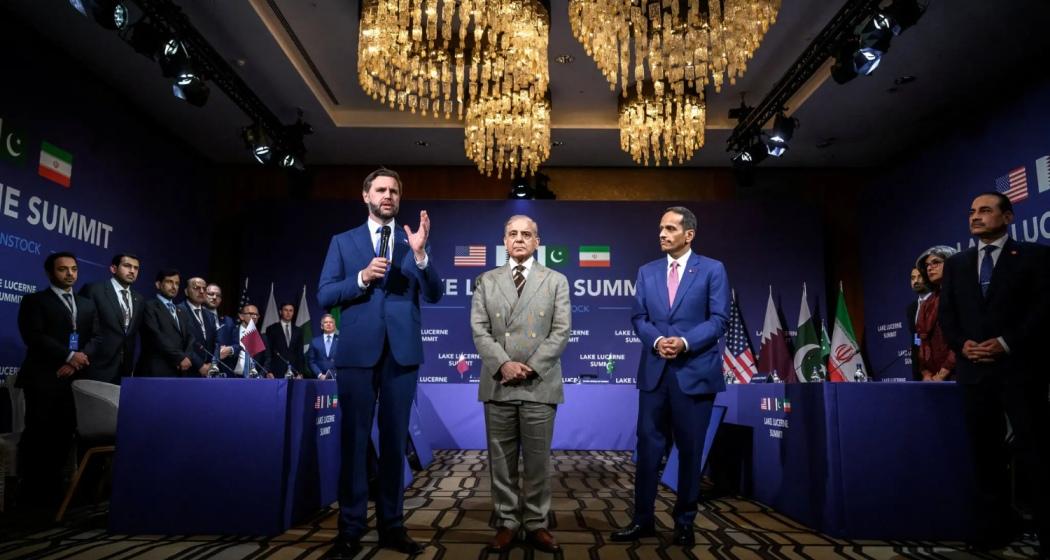
The United States and Iran have agreed on a 60-day roadmap aimed at reaching a final settlement, along with the creation of a de-confliction mechanism to help sustain a fragile ceasefire in Lebanon, according to mediators involved in the talks held in Switzerland.
The first round of high-level negotiations under the June 18 Islamabad Memorandum concluded at the Bürgenstock resort near Lake Lucerne, where mediators Qatar and Pakistan described the outcome as “encouraging progress” and confirmed the establishment of new institutional mechanisms to guide the peace process.
The discussions bring together the United States and Iran under a structured framework intended to reduce tensions and move towards a comprehensive agreement covering multiple areas of dispute, including nuclear-related issues, sanctions and regional security concerns.
Under the understandings reached at the summit, the two sides agreed to set up a High-Level Committee that will provide political oversight of the mediation process and supervise specialised working groups. These groups will focus on nuclear issues, sanctions regimes, monitoring mechanisms and dispute resolution systems.
A key outcome of the talks was the adoption of a 60-day timeline for reaching a final agreement, with technical-level negotiations expected to continue through the week at the same venue.
Also read: Iran-US peace talks enter second day in Geneva amid tensions
The parties also agreed to establish communication channels to reduce the risk of miscalculation in sensitive maritime zones, particularly the Strait of Hormuz, a critical global energy corridor through which a significant share of international oil shipments passes.
In another significant development, mediators announced the creation of a de-confliction cell involving the United States, Iran and Lebanon, facilitated by Qatar and Pakistan. The mechanism is designed to oversee compliance with the cessation of hostilities envisaged under the broader framework and to prevent escalation on the ground.
Iranian Foreign Minister Seyed Abbas Araghchi welcomed the progress, crediting mediation efforts by Qatar and Pakistan for what he described as “major progress” towards ending the conflict. He also noted that certain economic restrictions had been eased and that reconstruction initiatives were being initiated as part of the emerging arrangement.
The joint statement issued by Qatar and Pakistan said that chief negotiators will continue to report to the High-Level Committee, while technical working groups will push forward discussions on implementation details over the coming weeks.
Mediators also highlighted the importance of maintaining direct communication channels between the parties to avoid misunderstandings and ensure safe navigation through strategic maritime routes.
The latest round of talks marks the first structured institutional framework established since the June 18 memorandum and is being seen as an initial but significant step towards stabilising one of the world’s most volatile geopolitical theatres.

 Follow us