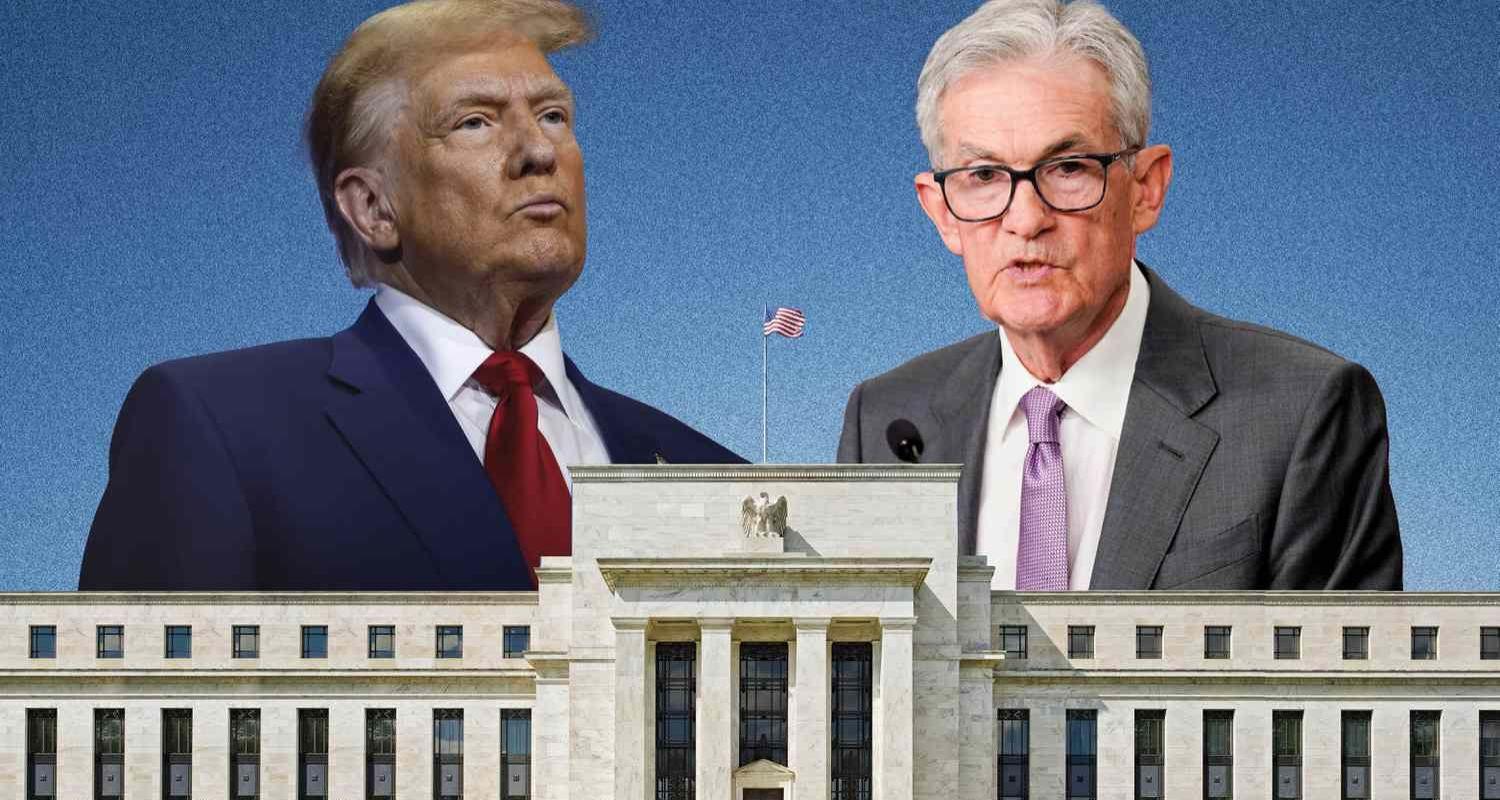
The US stock market, along with the dollar, saw a significant decline as President Donald Trump’s repeated attacks on the head of the US central bank rattled investor confidence in the world’s leading economy.
The benchmark S&P 500 dropped by 2.36 per cent on Monday, marking one of the sharpest single-day falls of the year. The downward momentum continued into Tuesday’s session.
The tech-heavy Nasdaq Composite also slid 2.55 per cent, pulling the index nearly 18 per cent lower compared to the beginning of the year.
Meanwhile, the US dollar weakened considerably, touching a three-year low. At one stage, it fell to 97.923 against a basket of major currencies.
Although government bonds had performed strongly the previous week, they too came under pressure as investors sold off traditional safe-haven assets. Yields on 10-year Treasury notes rose above 4.4 per cent, signalling a shift away from bond holdings.
Asian markets opened broadly lower on Tuesday in response to the turmoil. Japan’s Nikkei 225, Hong Kong’s Hang Seng Index, and Taiwan’s TAIEX declined by approximately 0.8 per cent, 0.6 per cent, and 0.5 per cent respectively.
The market reaction followed Trump’s renewed criticism of Federal Reserve Chair Jerome Powell. The President publicly labelled Powell a “major loser” and “Mr Too Late” on social media for not acting quickly enough to reduce interest rates.
Trump has repeatedly threatened to remove Powell, stating that his dismissal “cannot come fast enough.”
On Friday, Trump’s top economic adviser, Kevin Hassett, confirmed that the administration was actively exploring the possibility of ousting Powell, whose current term is due to end in May next year.
In a recent speech, Powell warned that tariffs could leave the US economy struggling with weak growth, higher inflation, and increased unemployment simultaneously.
He noted that such a scenario would challenge the Federal Reserve’s dual mandate of promoting maximum employment and maintaining stable prices.
“Markets are aware of this dynamic and are concerned that President Trump may attempt to undermine the Fed’s longstanding independence from political influence,” analysts said.
Powell, originally nominated by Trump in 2017 and reappointed by former President Joe Biden, has stated he would not resign if asked and stressed that he can only be removed for just cause.
A 1935 US Supreme Court ruling prohibits the executive branch from dismissing the heads of independent federal agencies such as the Federal Reserve without specific cause.
Nonetheless, the Trump administration has been attempting to overturn this nearly century-old precedent in a Supreme Court case related to its dismissal of officials from the Merit Systems Protection Board and the National Labour Relations Board.
Experts have warned that any effort to sack Powell would almost certainly send fresh shockwaves through the financial markets. It would be seen as an attack on the century-old principle that the Federal Reserve’s policy decisions should remain free from political interference.

 Follow us