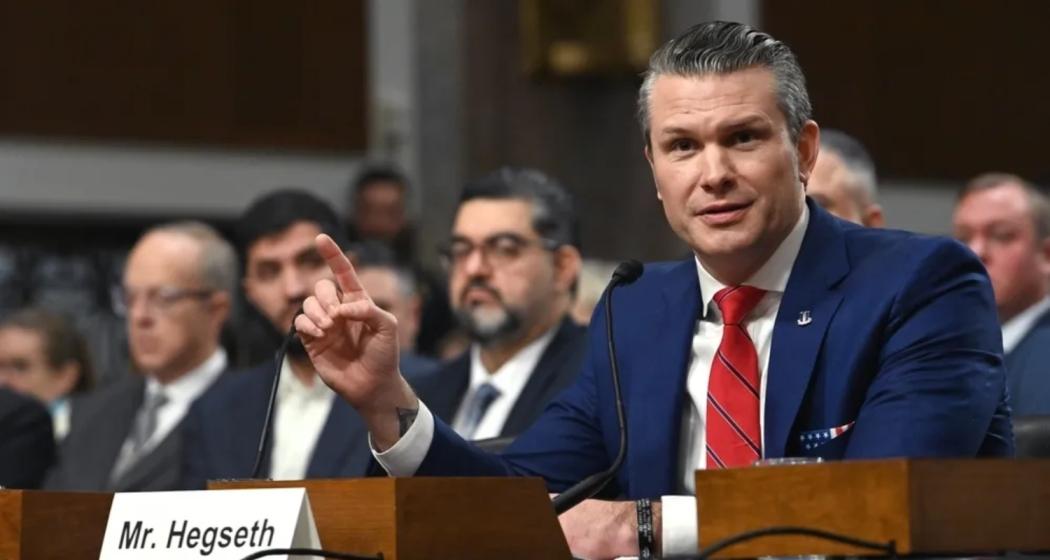
Washington has issued a firm ultimatum to Tehran amid efforts to extend a fragile two-week ceasefire and revive negotiations following a brief but intense conflict. US Defence Secretary Pete Hegseth warned that American forces are fully prepared to resume combat operations if Iran rejects a peace deal, even as a Pakistani delegation led by Asim Munir visited Tehran to facilitate dialogue.
The developments come as the truce, announced by Donald Trump, nears expiry next week, with both sides reportedly considering an extension.
Hegseth said US forces are “maximally postured” and ready to restart military action “at a moment’s notice” if Tehran refuses to negotiate. He stressed that Washington is closely tracking Iran’s military movements and maintaining a naval blockade, while rebuilding its operational strength.
He described earlier strikes as having significantly weakened Iran’s capabilities, including its navy and missile systems, and urged Tehran to “choose wisely” to avoid further attacks on critical infrastructure.
Pakistan steps in to revive stalled talks
Pakistan has intensified its mediation efforts, with Munir and Interior Minister Mohsin Naqvi holding talks in Tehran with senior Iranian leaders, including Mohammad Bagher Qalibaf and Abbas Araghchi.
The visit follows an inconclusive round of US-Iran talks in Islamabad. While Pakistan has kept diplomatic channels open, no dates or venue have been finalised for the next round of negotiations.
The White House has indicated that future talks are likely to be held again in Islamabad, as mediators push for technical-level discussions on key issues such as Iran’s nuclear programme and maritime security.
Uncertainty over next round of negotiations
No firm timeline has emerged for renewed talks. White House Press Secretary Karoline Leavitt said prospects for a deal remain positive, adding that it is in Iran’s interest to meet US conditions.
At the same time, both sides are considering extending the current ceasefire to allow more room for diplomacy. Iranian officials, however, have warned of retaliation if the blockade continues, including threats against US forces and vessels.
The fragile truce has held so far, but the window for a breakthrough appears narrow.
Also read: Trump slams Meloni over lack of support for Iran war
US enforces blockade in Strait of Hormuz
The US Central Command said it has successfully enforced a naval blockade, turning back multiple vessels attempting to leave Iranian ports. At least ten ships were redirected in the first 48 hours.
In one instance, the guided-missile destroyer USS Spruance (DDG-111) intercepted an Iranian-flagged cargo vessel near the Strait of Hormuz and forced it to return.
Washington maintains that the blockade targets Iranian trade while preserving freedom of navigation for other vessels, though Tehran has threatened to disrupt shipping in response.
Oil markets react to shifting signals
Oil prices showed mixed movement, initially falling on hopes of renewed talks before stabilising amid uncertainty. Brent crude hovered around $94-96 per barrel, while US West Texas Intermediate remained near $90-92.
Analysts warn that any escalation or prolonged disruption in the Strait of Hormuz, a key global energy route, could sharply push prices higher. Markets remain sensitive to both diplomatic progress and military developments.
Lebanon rules out talks with Israel
Lebanese President Joseph Aoun has declined to hold direct talks with Israeli Prime Minister Benjamin Netanyahu, despite US efforts to facilitate engagement.
Lebanon conveyed its position during diplomatic exchanges with US officials, indicating it is not prepared for direct dialogue at this stage. The country remains part of the broader ceasefire framework but is unlikely to engage Israel directly in the near term.
US deploys over 10,000 additional troops
The United States is deploying more than 10,000 additional troops to the Middle East by the end of April, including forces aboard the USS George H.W. Bush carrier strike group and the Boxer Amphibious Ready Group.
The move is aimed at strengthening US military posture in the region while maintaining pressure on Iran during negotiations. Officials said around 50,000 troops had already been involved in operations since the conflict began.
Trump announces 10-day Israel-Lebanon ceasefire
US President Donald Trump on Thursday announced that Israel and Lebanon have agreed to a 10-day ceasefire beginning at 5 p.m. EST, following talks in Washington involving Lebanese President Joseph Aoun and Israeli Prime Minister Benjamin Netanyahu.
The development marks the first direct engagement between the two countries in 34 years, with US Secretary of State Marco Rubio and Vice President JD Vance tasked with advancing negotiations towards a lasting peace.
“I just had excellent conversations with the Highly Respected President Joseph Aoun, of Lebanon, and Prime Minister Bibi Netanyahu, of Israel… These two Leaders have agreed that in order to achieve PEACE between their Countries, they will formally begin a 10 Day CEASEFIRE at 5 P.M. EST… It has been my Honor to solve 9 Wars across the World, and this will be my 10th, so let’s, GET IT DONE!” Trump said

 Follow us