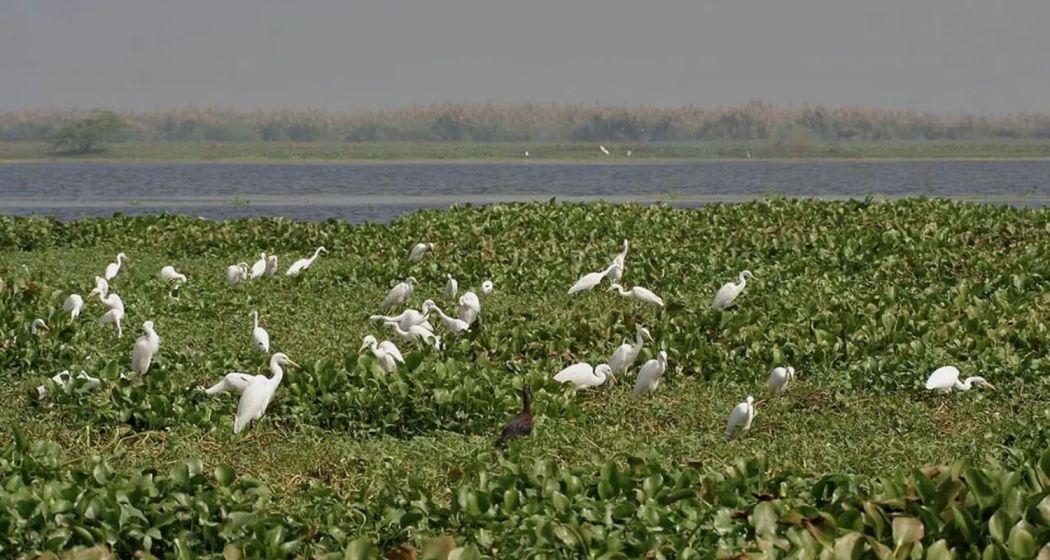
The Andhra Pradesh government is renewing efforts to seek approvals from the Supreme Court and the Central Empowered Committee for excluding 20,000 acres of farmland from the Kolleru Wildlife Sanctuary to support local farmers’ livelihood. The sanctuary regulations have long restricted agricultural activity, which the state government argues has caused hardship to nearly 3 lakh residents.
Nestled between the Krishna and Godavari deltas in Eluru district, Kolleru is one of India’s largest freshwater lakes and a critical wetland ecosystem. Recognised for its ecological significance, it was declared a wildlife sanctuary in 1999 under the Wildlife Protection Act (1972) and later designated a Ramsar site in 2002.
The sanctuary spans 308 sq km at the +5 metre contour level. It supports over 220 bird species, including the spot-billed pelican, painted stork and Siberian crane, and 63 species of fish. The lake also plays a critical role in flood control, carbon sequestration and sustaining the livelihood of local fishing and farming communities.
However, nearly 3 lakh people living around the lake have faced growing hardships due to sanctuary regulations that restrict farming and land use. Chief Minister N Chandrababu Naidu, at an official review meeting held at the State Secretariat in Velagapudi, underscored the need to maintain the ecological health of the lake while ensuring justice for affected residents.
He called for treating drainage water entering the lake, desilting clogged channels and removing encroachments on Upputeru, the outlet draining Kolleru into the sea, to prevent backflow and flooding. Simultaneously, Naidu stressed the need to protect local interests.
“About 20,000 acres of land is caught in this contour dispute. Justice must be ensured for these farmers,” he said, directing officials to prepare a proposal for the Central Empowered Committee and Supreme Court. “Any action plan must safeguard both the environment and the people,” he added.
Officials said the lake, once a pristine ecosystem spread across the Krishna and Godavari delta, is now rapidly deteriorating, clogged with untreated sewage, silt and encroachments due to rampant aquaculture.
“Kolleru must not turn into a cesspool of pollution. Drain water entering the lake should be properly treated. The unchecked release of drains is polluting Kolleru. This must be stopped,” Naidu told officials. “Encroachments on Upputeru must be removed and the silt cleared. All outlets must be completely opened to allow free water flow to the sea,” he said.
A longstanding dispute
The issue dates back to 2014 when the Andhra Pradesh Legislative Assembly passed a resolution, urging the National Board for Wildlife (NBWL) and the Supreme Court-appointed CEC to reduce the sanctuary boundary from the +5 metre contour (308 sq km) to the +3 metre contour (135 sq km).
In 2018, the NBWL recommended the exclusion of 20,000 acres from the sanctuary limits. The move was intended to ease restrictions on farming and fishing activities. The TDP had then endorsed the recommendation. However, the proposal met with stiff resistance. In July 2018, the CEC rejected the NBWL’s recommendation, citing a 2006 Supreme Court order that prioritised the ecological integrity of the sanctuary. The committee advised further consultations before any decision could be made.

 Follow us