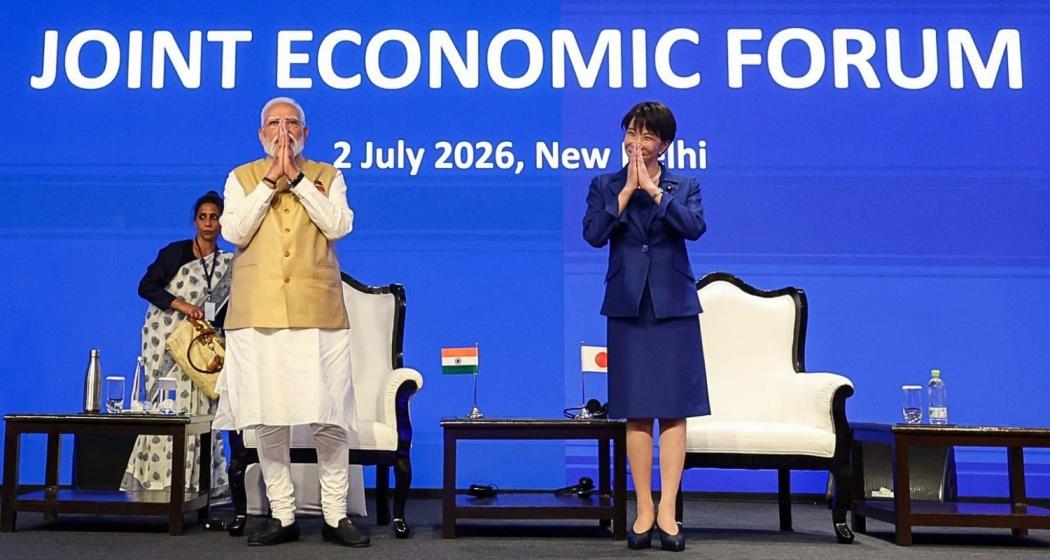
India and Japan on Thursday elevated their Special Strategic and Global Partnership with a series of landmark agreements spanning defence, energy security, maritime cooperation, clean energy and critical technologies, as Prime Minister Narendra Modi and Japanese Prime Minister Sanae Takaichi pledged closer coordination to safeguard a free, open and rules-based Indo-Pacific.
The centrepiece of the summit at Hyderabad House was the signing of the first-ever India-Japan joint defence co-development agreement for the Naval Radio Antenna UNICORN, marking a significant shift in bilateral defence ties from equipment transfers to collaborative technology development.
The two leaders also adopted a joint statement on energy resilience, agreed to strengthen strategic petroleum reserves, expand maritime energy cooperation, launch a major biogas initiative, and deepen collaboration across trade, investment, semiconductor supply chains, critical minerals and emerging technologies.
Addressing a joint press statement after delegation-level talks, Modi described Takaichi's visit as the beginning of "a new chapter" in bilateral relations.
"From automotive to electronics, Japan has made a contribution as an important partner in India's growth story, building an invaluable asset of friendship and trust. And today, with Prime Minister Takaichi's visit, we are starting a new chapter in our Special Strategic and Global Partnership," he said.
Takaichi, describing Modi as her "bigger brother", said India and Japan should combine their respective strengths to become "stronger and more prosperous together" amid an increasingly uncertain global order.
First defence co-development project marks strategic shift
The signing of the agreement to jointly develop the Naval Radio Antenna UNICORN marked the first defence technology project to be co-developed by India and Japan, opening a new chapter in bilateral defence industrial cooperation.
Modi said the project would strengthen regional peace, maritime security and the rules-based international order by enabling the two countries to jointly develop advanced defence technologies.
Also read: India, Japan sign first defence co-development pact
Takaichi announced that a destroyer of the Japan Maritime Self-Defence Force and an Indian Navy warship would undertake a joint exercise. She also proposed expanding naval drills across the Indian Ocean, enhancing maintenance, repair and overhaul (MRO) cooperation, and strengthening defence manufacturing under India's Make in India initiative.
She directed officials to convene the next India-Japan 2+2 Foreign and Defence Ministers' Meeting before the end of this year to accelerate strategic cooperation.
Energy resilience emerges as key pillar of partnership
Energy security figured prominently during the summit, with both governments issuing a separate Joint Statement on Energy Resilience.
India and Japan agreed to deepen cooperation on strategic crude oil stockpiling and petroleum reserve mechanisms by sharing expertise on reserve management, emergency response systems, coordination with producing countries and market stabilisation measures.
The two countries also agreed to strengthen the voice of major energy-consuming nations through greater market information-sharing, cooperation on securing supplies from third countries and exploring upstream energy investments.
Recognising maritime transport as central to energy security, both sides agreed to explore joint investments across the maritime energy transport value chain to improve the resilience and efficiency of oil and gas supply routes.
Foreign Secretary Vikram Misri said the two countries, as responsible powers and major Asian energy consumers, had agreed to work together to strengthen their respective energy resilience through closer institutional cooperation.
The framework will involve Indian oil companies, Indian Strategic Petroleum Reserves Limited (ISPRL), Japan Organisation for Metals and Energy Security (JOGMEC) and the Japan Bank for International Cooperation (JBIC).
Clean energy, green hydrogen and 1,000 biogas plants
The leaders also expanded cooperation in clean energy by reaffirming support for projects involving green hydrogen, green ammonia, solar energy and civil nuclear cooperation.
Among the new initiatives announced was the India-Japan Cooperative Biogas for Growth Initiative, under which around 1,000 biogas plants will be established across India using rural biomass resources to strengthen renewable energy generation and rural livelihoods.
Both governments also agreed to promote decarbonisation technologies and strengthen cooperation in achieving energy transition goals.
Shared vision for Indo-Pacific and economic resilience
The two Prime Ministers reaffirmed their commitment to maintaining a free, open, inclusive and rules-based Indo-Pacific founded on international law, freedom of navigation and unimpeded lawful commerce.
They stressed the importance of secure maritime trade routes and uninterrupted global energy flows while opposing actions that could disrupt commercial shipping or undermine regional stability.
The leaders also agreed to strengthen cooperation in resilient supply chains, semiconductors, critical minerals, digital technologies, artificial intelligence, economic security and advanced manufacturing.
Modi said India and Japan, as the two largest democratic and market economies in the Indo-Pacific, shared a responsibility to promote peace, stability and prosperity across the region.
Referring to his remarks at the recent G7 Summit, he said mutual trust had become the world's most valuable asset amid rising geopolitical uncertainty and noted that the India-Japan partnership had consistently reflected that principle.
Towards the 75th year of diplomatic ties
With India and Japan set to celebrate the 75th anniversary of diplomatic relations in 2027, both leaders agreed to intensify cooperation across trade, investment, science and technology, education, culture and people-to-people exchanges.
Takaichi invited Modi to visit Japan as the two sides committed themselves to taking the Special Strategic and Global Partnership into what both leaders described as a new and more ambitious phase

 Follow us