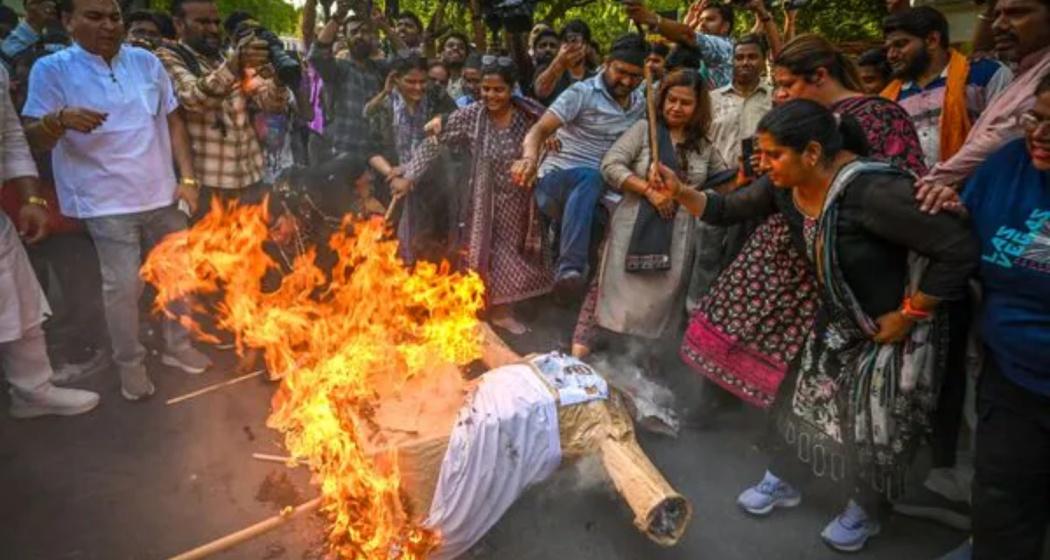
BJP MPs Bansuri Swaraj, Raksha Khadse and Kamaljeet Sehrawat were detained by Delhi Police during a protest march towards Congress leader Rahul Gandhi’s residence on Friday, a day after the Constitution (131st Amendment) Bill on women’s reservation failed to pass in the Lok Sabha.
The protest, organised by BJP leaders and workers, saw participation from several senior figures, including Delhi BJP chief Virendra Sachdeva and MP Manoj Tiwari, as the party accused the Opposition of blocking the legislation that proposed 33 per cent reservation for women in Parliament and state assemblies.
Police deployed water cannons and erected barricades as the march attempted to proceed towards Rahul Gandhi’s residence in central Delhi. The situation escalated briefly as protesters raised slogans and burned an effigy of the Congress leader, triggering police intervention and detentions.
According to official inputs, Union Minister of State Raksha Khadse, BJP MPs Bansuri Swaraj and Kamaljeet Sehrawat were among those taken into preventive custody during the demonstration.
While several senior leaders took part in the protest, including Hema Malini and Delhi Chief Minister Rekha Gupta, there is no confirmation of their detention. Both were present during the march but were not among those detained by police, as per official accounts.
Visuals from the protest site showed BJP women workers raising slogans, holding placards and burning effigies of Rahul Gandhi, while police used water cannons to disperse the crowd near key security barricades.
Govt slams Congress as ‘anti-women’ after quota bill defeat
On the other hand, the Centre on Saturday mounted a sharp attack on the Congress, accusing it of being “anti-women” after the women’s reservation Bill failed to pass in Parliament.
Parliamentary Affairs Minister Kiren Rijiju said the ruling alliance was disappointed but determined to continue efforts to enhance women’s representation in legislatures. He alleged that the Opposition, led by the Congress, had “foiled” the passage of the Bill despite its national importance.
Also read: Govt slams Congress as ‘anti-women’ after quota bill defeat
“It has been established that Congress is anti-women… The Opposition considers it a victory after depriving women of their rights. But the women of the country will teach them a lesson,” Rijiju said at a press briefing concluding the Budget session.
He added that the government had made every possible effort to secure passage of the legislation but could not compel Opposition parties to vote in its favour. “We cannot force anyone physically to support a Bill. The voting process was democratic,” he said.
The ruling party also linked the Opposition’s stand to what it called inconsistency on women-centric reforms, intensifying the political confrontation over the Bill’s defeat.
Priyanka leads Oppn charge as govt move fails
Meanwhile, Congress leader Priyanka Gandhi Vadra mounted a counter-offensive, challenging the government to reintroduce an earlier version of the women’s reservation law in Parliament.
“They should bring the old women’s Bill, the one passed by all parties in 2023, immediately on Monday. Hold Parliament on Monday, bring the Bill and let us see who is anti-women. We will all vote and support it,” she said.
The Opposition has argued that the current Bill is linked to delimitation and a proposed expansion of Lok Sabha seats, which it claims could affect federal balance and representation, particularly of southern states.
The 2023 legislation, formally known as the Nari Shakti Vandan Adhiniyam, had already provided for 33 per cent reservation for women in the Lok Sabha and state assemblies, but its implementation was made subject to future delimitation based on a fresh census.
Opposition parties, including the Congress and regional allies, have maintained that while they support women’s reservation, the structural conditions attached to the current proposal raise concerns over fair representation.
The political sparring over the Bill has now intensified into a wider debate on women’s representation, electoral reforms and federal equity, setting the stage for a prolonged parliamentary confrontation.

 Follow us