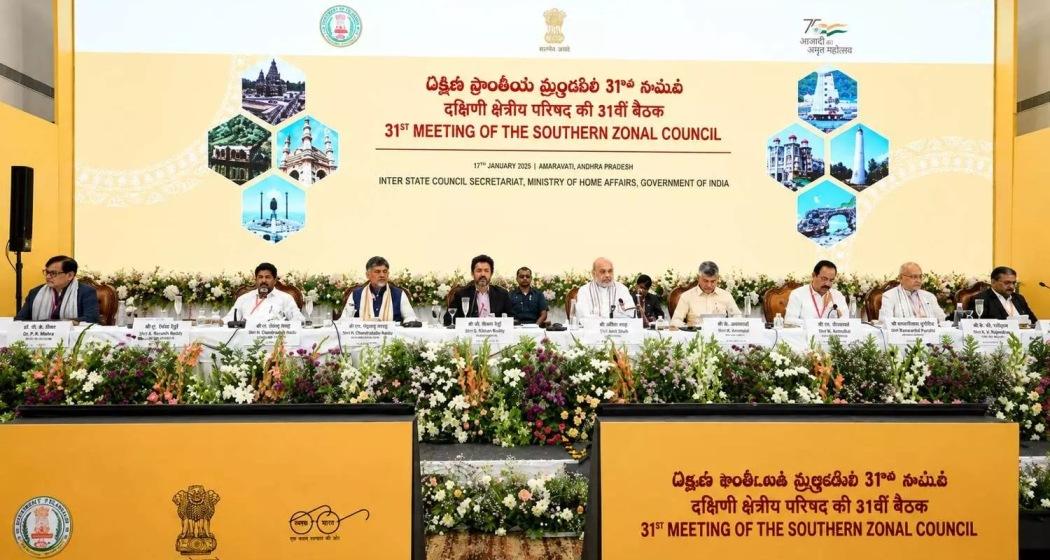
The Southern Zonal Council meeting headed by Union Home Minister Amit Shah in Mahabalipuram, Tamil Nadu on Thursday addressed issues of delimitation, safeguarding of parliamentary representation, NEET, river-water sharing and increased fiscal autonomy.
Senior leaders from southern states demanded greater regional unity and wanted the South to have more political representation, fiscal dispensations, infrastructure and contribution to the Indian economy in political and economic policies.
Tamil Nadu Chief Minister Vijay and Karnataka Deputy Chief Minister DK Shivakumar prominently raised concerns over the possible impact of the upcoming delimitation exercise on the political representation of southern states. Vijay stated that states which have effectively adopted population control policies should not be punished by withholding the representation in Parliament. He tried to ensure the Centre would ensure the collective voice of the South was protected.
Shivakumar had demanded a formal resolution to ensure protection to the representation of the area. He said that 543 Lok Sabha seats should be kept the same for the next 25 years and the process of women reservation should be done while maintaining the same number of seats. He also contended that the economic strength of the states in the South ought to be matched with proper political representation.
The NEET issue was another major point raised by CM Vijay. He had requested exemption from the National Medical entrance exam for Tamil Nadu and suggested that the MBBS, BDS and AYUSH courses admission be based on the marks obtained in class 12. Vijay said NEET is giving a disadvantage to students from rural areas and socially and economically backward sections in the country.
The management of river-water also was a major topic of conversation. Karnataka requested cooperation regarding the proposed Mekedatu project and Shivakumar explained that the project could be of benefit to farmers in Tamil Nadu and Puducherry. He advocated for moving from water-sharing conflicts to more cooperation without compromising the rights of all water-sharing states.
Andhra Pradesh Chief Minister Chandrababu Naidu suggested that the quantum of water be increased in Godavari-Cauvery interlinking arrangement by diverting over 500 TMC. He said that such a project could be a solution for the water needs of Tamil Nadu to be met in the long run and added that it was essential for the four states to cooperate with each other. Naidu suggesting an initiative to connect Ganga and Cauvery rivers in the long run
Meanwhile, Kerala expressed willingness to supply water assistance to Tamil Nadu from the proposed new Mullaperiyar dam if Tamil Nadu agrees to the dam construction. Kerala also had agreed to fund the construction while recommending that Tamil Nadu decide on the design and location of the dam.
Shivakumar also brought to the forefront the grievances of Karnataka on the matter of the share of the central tax. He demanded the restoration of the state's tax share to 4.7 per cent from 3.6 per cent. Karnataka also requested to release ₹5,495 crore of special grants and ₹6,000 crore of state-specific grants suggested by the Finance Commission and more funds from the central government for infrastructure projects.
While Andhra Pradesh pushed the infrastructure agenda, suggesting that Andhra Pradesh, Karnataka and Tamil Nadu be connected through Kuppam by a bullet train, Kerala discussed various issues like financing health care facilities, coastal erosion, connectivity of railways and security between the two states. It also sought permission to utilise funds meant for disaster response and mitigation to protect the coast and rehabilitate families impacted by coastal erosion.

 Follow us