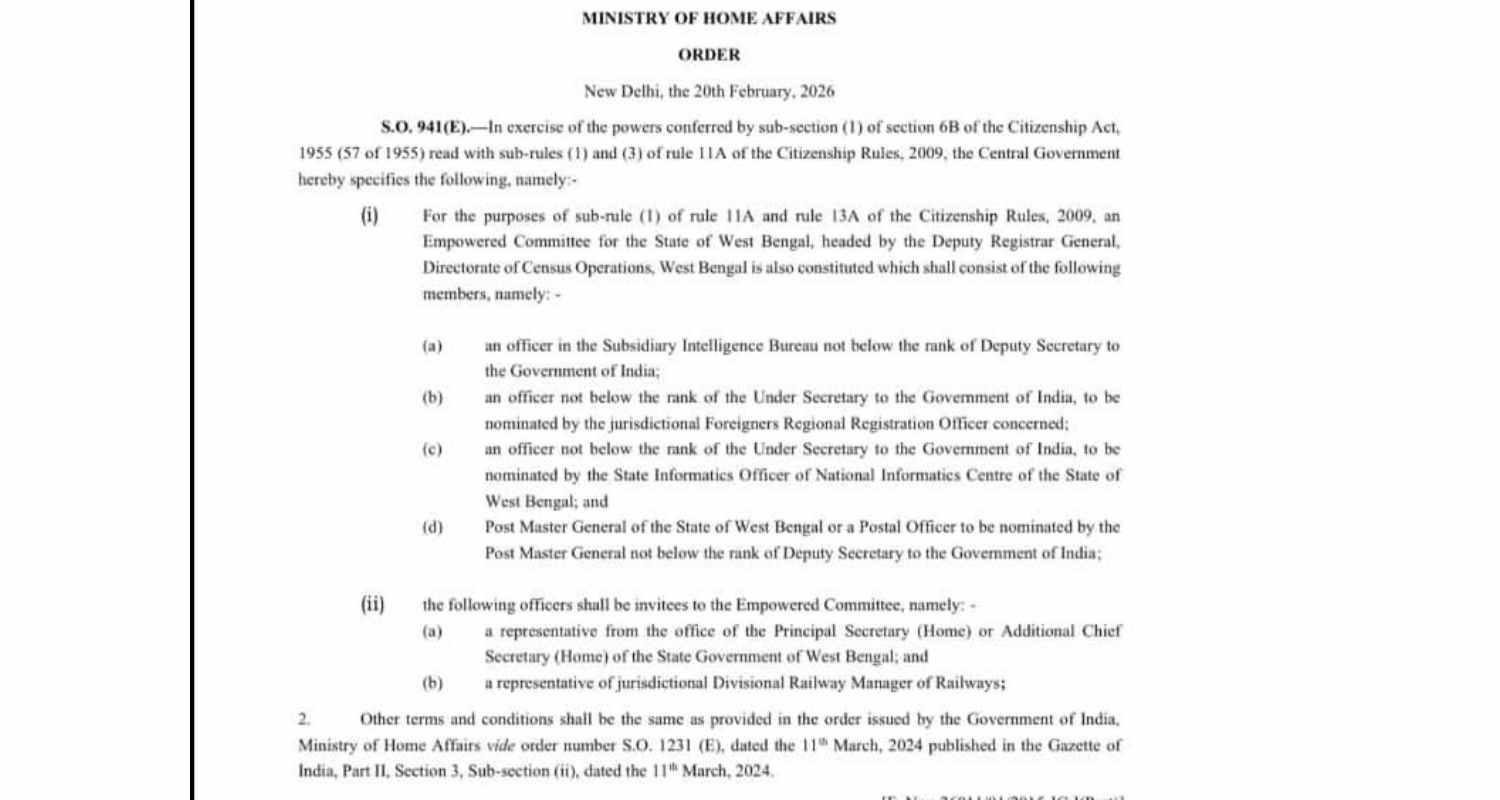
The Ministry of Home Affairs has issued a gazette notification announcing the formation of an ‘Empowered Committee’ in West Bengal to examine and decide on citizenship applications under the Citizenship Amendment Act (CAA), marking a significant step towards implementing the law in the state ahead of the 2026 Assembly elections.
The move comes days after Union Home Minister Amit Shah met Suvendu Adhikari, Leader of the Opposition in West Bengal, who had indicated progress on CAA implementation in the state.
According to the notification issued by Nitish Kumar Vyas, Additional Secretary in the Union Home Ministry, the committee has been constituted under Section 6B of the Citizenship Act, 1955, and the Citizenship Rules, 2009. The panel will scrutinise applications submitted under the CAA and decide whether to grant or reject Indian citizenship.
The Deputy Registrar General of the Directorate of Census Operations, West Bengal, will head the committee. Other members will include an officer of the rank of Deputy Secretary from the Subsidiary Intelligence Bureau, a representative of the Foreigners Regional Registration Office, the State Informatics Officer of the National Informatics Centre in West Bengal, and the Postmaster General or a nominated senior officer from the Postal Department.
Additionally, the Principal Secretary or Additional Chief Secretary of the State Home Department and a nominated representative of the concerned Divisional Railway Manager will participate as invited members during committee meetings.
Officials said the formation of this empowered committee completes the administrative framework required to implement the CAA at the state level, following the nationwide rollout framework announced on March 11, 2024.
The development is being viewed as politically significant, particularly in the context of the upcoming Assembly elections. The CAA has remained a contentious issue in West Bengal, with the ruling All India Trinamool Congress opposing the law and describing it as discriminatory.
The Centre’s move is also expected to impact communities such as the Matua Mahasangha, whose members are among those eligible to apply for citizenship under the CAA.
Under the Citizenship Amendment Act, persecuted non-Muslim migrants—including Hindus, Sikhs, Buddhists, Jains, Parsis and Christians—who entered India from Pakistan, Bangladesh and Afghanistan before December 31, 2014, are eligible to apply for Indian citizenship.
With the empowered committee now in place, the process of reviewing and granting citizenship under the CAA in West Bengal is expected to move forward, adding a new dimension to the political landscape ahead of the state Assembly elections.

 Follow us