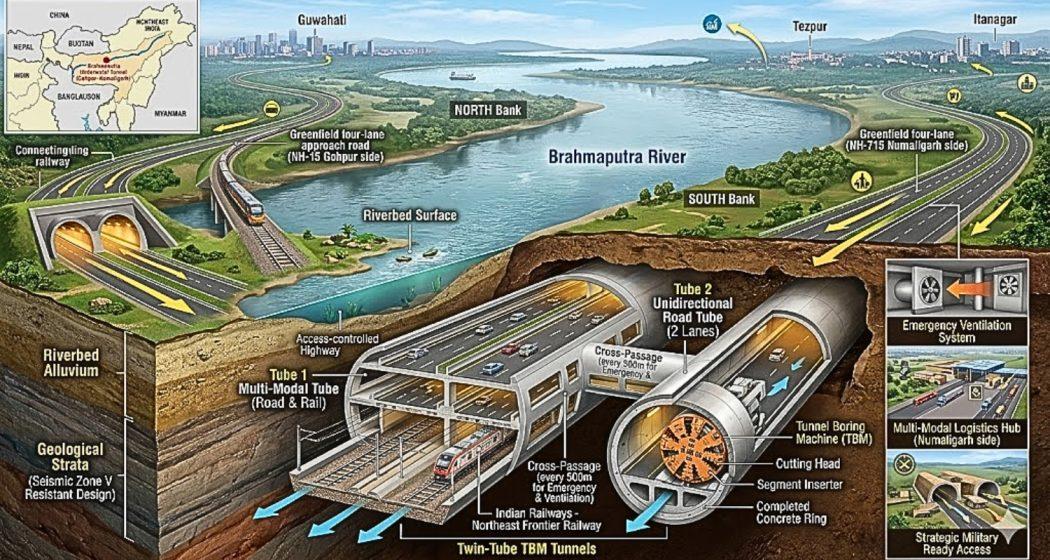
The Cabinet Committee on Economic Affairs (CCEA), chaired by Prime Minister Narendra Modi, on Friday approved the construction of India's first underwater road-cum-rail tunnel beneath the Brahmaputra River in Assam, a major infrastructure project aimed at improving connectivity across the Northeast.
The project will feature a 15.79-km underwater twin-tube tunnel as part of a 33.7-km four-lane access-controlled greenfield corridor connecting Gohpur on National Highway-15 with Numaligarh on National Highway-715.
The total cost of the project has been pegged at Rs 18,662 crore and will be executed under the Engineering Procurement Construction (EPC) model.
Travel time between NE states to reduce
Currently, travellers moving between Gohpur and Numaligarh have to take a 240-km route via the Kaliabhomora bridge near Silghat, a journey that can take up to six hours. The route also passes through Biswanath town and areas adjoining Kaziranga National Park.
The proposed tunnel and corridor are expected to significantly cut travel time and improve transport efficiency in Assam and neighbouring states such as Arunachal Pradesh and Nagaland.
According to the government, the project will facilitate faster passenger and freight movement while lowering logistics costs across the region.
The approved alignment will connect two major national highways — NH-15 and NH-715 — as well as key railway networks, including the Rangia-Murkongselek section under the Rangia Division and the Furkating-Mariani loop line under the Tinsukia Division of the Northeast Frontier Railway.
Officials said the corridor has been designed as a multi-modal transport link integrating 11 economic nodes, three social nodes, two tourist nodes and eight logistics nodes.
The project will also improve access to four major railway stations, two airports and two inland waterway facilities, creating a more efficient transport network for passengers and cargo.
Economic and strategic significance
The government estimates that the construction phase will generate around eight million person-days of direct and indirect employment.
In a statement, the CCEA said the project would play a key role in strengthening regional connectivity, supporting economic growth, facilitating trade and industrial development, and enhancing strategic mobility in the Northeast.
Once completed, the tunnel is expected to become a critical transport link connecting major economic centres and unlocking new opportunities for investment and development in the region.

 Follow us