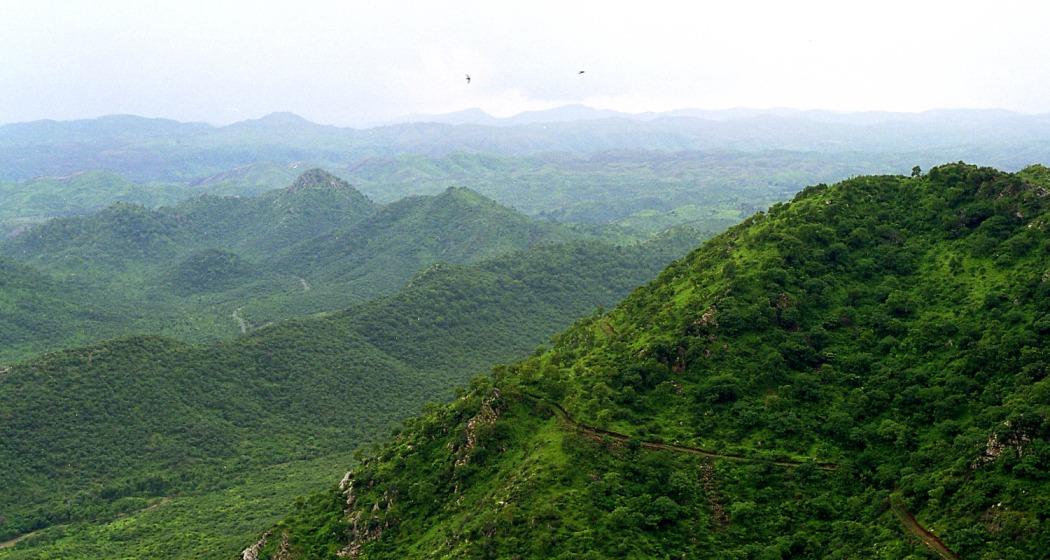
The Centre on Sunday rejected reports suggesting that the definition of the Aravalli hills was altered to permit large-scale mining, asserting that a Supreme Court-approved framework has, in fact, strengthened protection of the mountain range and imposed a freeze on new mining leases.
The government said the Supreme Court has ordered that no new mining leases be granted in the Aravalli region until a comprehensive Management Plan for Sustainable Mining is prepared for the entire landscape. The plan will be drafted by the Indian Council of Forestry Research and Education.
Environment Minister Bhupender Yadav said the court-approved definition would bring more than 90 per cent of the Aravalli region under “protected area”. Speaking to reporters at the Sundarban Tiger Reserve, he said the framework ensures stronger safeguards for the fragile ecosystem.
Responding to controversy over the “100-metre” criterion, the government said the definition of the Aravalli hills and ranges has been standardised across states on the Supreme Court’s directions to remove ambiguity and prevent misuse. Earlier, differing definitions had allowed mining activity dangerously close to hill bases.
Sources in the Environment Ministry said the apex court, while hearing long-pending cases related to illegal mining in the Aravallis, had constituted a committee in May 2024 to recommend a uniform definition. The committee found that only Rajasthan had a formally notified definition, which has been in use since 2006.
Under this definition, landforms rising 100 metres or more above the local relief are treated as hills, and mining is prohibited within the lowest bounding contour enclosing such hills, regardless of the height or slope of landforms inside the contour.
Also read: SC decision puts 60% of Aravalli range at risk
The committee, chaired by the Environment Ministry secretary and comprising representatives from Rajasthan, Haryana, Gujarat and Delhi along with technical bodies, recommended adopting Rajasthan’s definition across all states, along with additional safeguards.
These safeguards include treating hills located within 500 metres of each other as a single range, mandatory mapping of hills and ranges on Survey of India maps before any mining decision, and clear identification of core and inviolate areas where mining is strictly prohibited.
In a background note, the government rejected claims that mining has been permitted in areas below 100 metres, stating that restrictions apply to entire hill systems and enclosed landforms, not just hill peaks or slopes. It said it is incorrect to conclude that all landforms below 100 metres are open for mining.
The Centre said the Supreme Court has accepted the committee’s recommendation to prohibit mining in core and inviolate areas, including protected areas, eco-sensitive zones, tiger reserves, wetlands and areas close to such sites. Limited exemptions will be allowed only for critical, strategic and deep-seated minerals in the national interest.
Existing mines will be allowed to continue operations only if they strictly comply with sustainable mining norms laid down by the committee.
According to the government, district-level analysis across Rajasthan, Haryana and Gujarat shows that legally approved mining currently covers only about 0.19 per cent of the total geographical area of the 37 Aravalli districts. Delhi, which has five Aravalli districts, does not permit any mining.
The Centre said illegal and unregulated mining remains the primary threat to the Aravallis, and the committee has recommended stronger monitoring, enforcement and the use of technology such as drones and surveillance to address the issue.

 Follow us