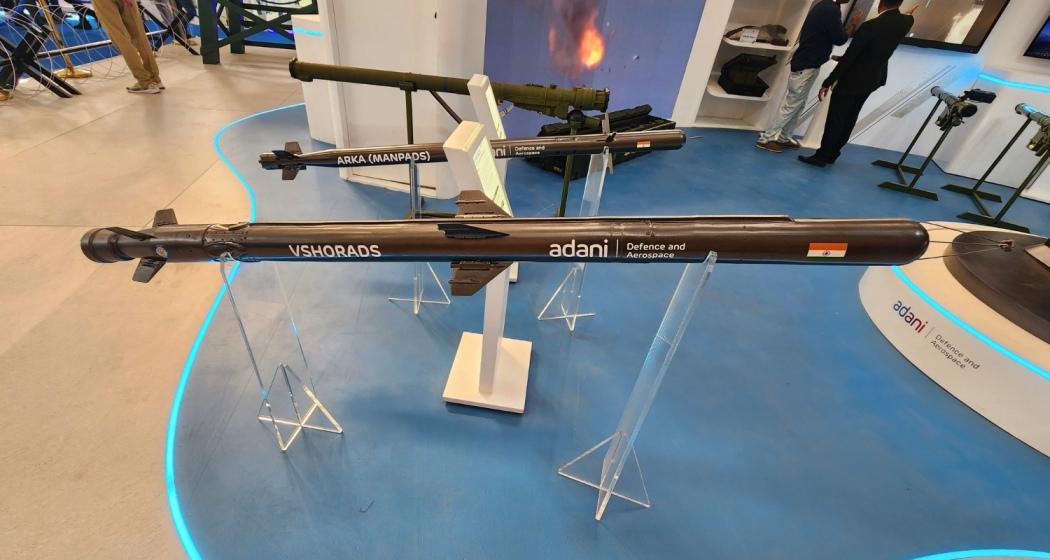
In a landmark overhaul of India's defence manufacturing policy, the Centre is preparing to allow private Indian companies to develop and manufacture advanced missiles, ending the state's near-exclusive control over one of the country's most strategic defence sectors.
The move comes amid growing domestic and international demand for indigenous missile systems, particularly after Indonesia expressed interest in acquiring the Defence Research and Development Organisation's (DRDO) Astra missile. It also reflects the government's broader push to strengthen self-reliance in defence production while expanding exports.
According to reports, the Defence Ministry will soon issue a Request for Proposal (RFP) inviting private firms to manufacture the Astra Mark 2 beyond-visual-range (BVR) air-to-air missile. Major Indian defence manufacturers, including ICOMM, Adani Defence, Bharat Forge, Tata Group and Mahindra Group, are expected to compete for the project.
The decision follows a sharp increase in demand from the Indian armed forces as well as friendly foreign countries, which state-run Bharat Dynamics Ltd (BDL) is currently unable to meet on its own.
Also read: Khalra murder: DSGMC seeks gallantry awards withdrawal for cops
Developed by the DRDO, the Astra Mark 2 has a strike range of 180-200 kilometres and was designed to counter China's PL-15E long-range air-to-air missile, which was supplied to Pakistan ahead of Operation Sindoor. The missile is slated for integration with Tejas Mark 1A, MiG-29, Su-30 MKI and Rafale Marine fighter aircraft, significantly enhancing the Indian Air Force's beyond-visual-range combat capability.
The government's reforms are expected to go beyond Astra. Officials familiar with the development said the next missile likely to be opened to private-sector participation is the Pralay tactical ballistic missile. With a range of about 500 km and speeds of up to Mach 6, Pralay forms part of India's emerging Integrated Rocket Forces alongside the Long-Range Land Attack Cruise Missile (LRLACM), the next-generation BrahMos and the extended-range Pinaka rocket system.
The policy shift comes in the wake of Operation Sindoor, which highlighted the growing importance of stand-off precision weapons in modern warfare. The recent Iran-US conflict has further reinforced the strategic value of missile and air defence systems, prompting India to accelerate efforts to strengthen both its offensive missile arsenal and defensive shield.
Alongside expanding indigenous missile production, India is enhancing its multi-layered air defence network. The fifth S-400 air defence system is expected to arrive in November, while the government is also planning to procure five additional S-400 units from Russia. India and Israel are also jointly developing a long-range surface-to-air missile for naval platforms, as New Delhi seeks to bolster protection against drones, rockets and ballistic missiles from potential adversaries.

 Follow us