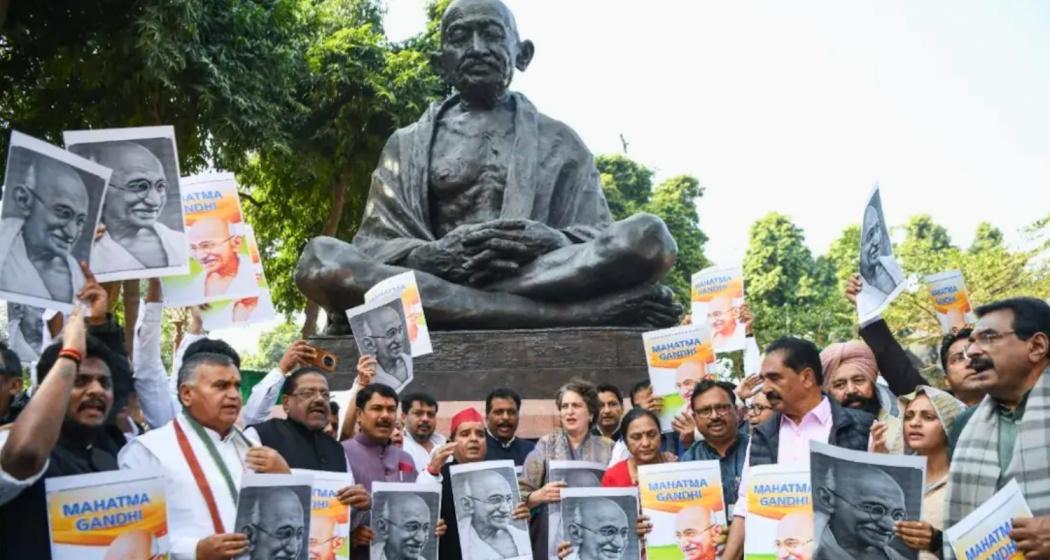
The Congress on Saturday launched its 45-day nationwide campaign, MGNREGA Bachao Sangram, protesting the repeal of the UPA-era rural employment law and its replacement with the VB-G RAM G Act. Press conferences were held across district headquarters to mark the beginning of the agitation, which will continue until February 25.
The party has demanded the withdrawal of the VB-G RAM G Act and the restoration of MGNREGA as a rights-based law in its original form, including the right to work and the authority of panchayats.
“Today, the Indian National Congress is launching the MGNREGA Bachao Sangram with a press conference at each of the District Congress Committee offices across the country,” said party general secretary Jairam Ramesh in a post on X. “The Congress is committed to seeing this struggle through until we secure the restoration of the right to work, livelihood, and accountability that the (Narendra) Modi Government has snatched with its bulldozer demolition of the MGNREGA.”
Also read: Hooda slams BJP for weakening MNREGA
The campaign will include a day-long fast and symbolic protests at district headquarters on January 11. From January 12 to 29, chaupals and mass contact programmes will be organised at all gram panchayats, followed by ward-level peaceful sit-ins on January 30. State-level gheraos of Vidhan Sabhas are scheduled from February 7 to 15, culminating with four major rallies between February 16 and 25.
While previous protests against black farm laws were largely Delhi-centric, the MGNREGA Bachao Sangram will focus on panchayats, blocks, districts, and states nationwide, the party said.
The VB-G RAM G Act, or Viksit Bharat-Guarantee for Rozgar and Ajeevika Mission (Gramin), was passed amid protests in the Rajya Sabha on December 18, 2025, shortly after the Lok Sabha cleared the bill. President Droupadi Murmu gave her assent on December 21, making it an Act guaranteeing 125 days of wage employment per rural household annually.
Congress leaders have pledged to continue their agitation until MGNREGA is restored as a rights-based law, asserting that the VB-G RAM G Act undermines rural employment and grassroots governance.

 Follow us