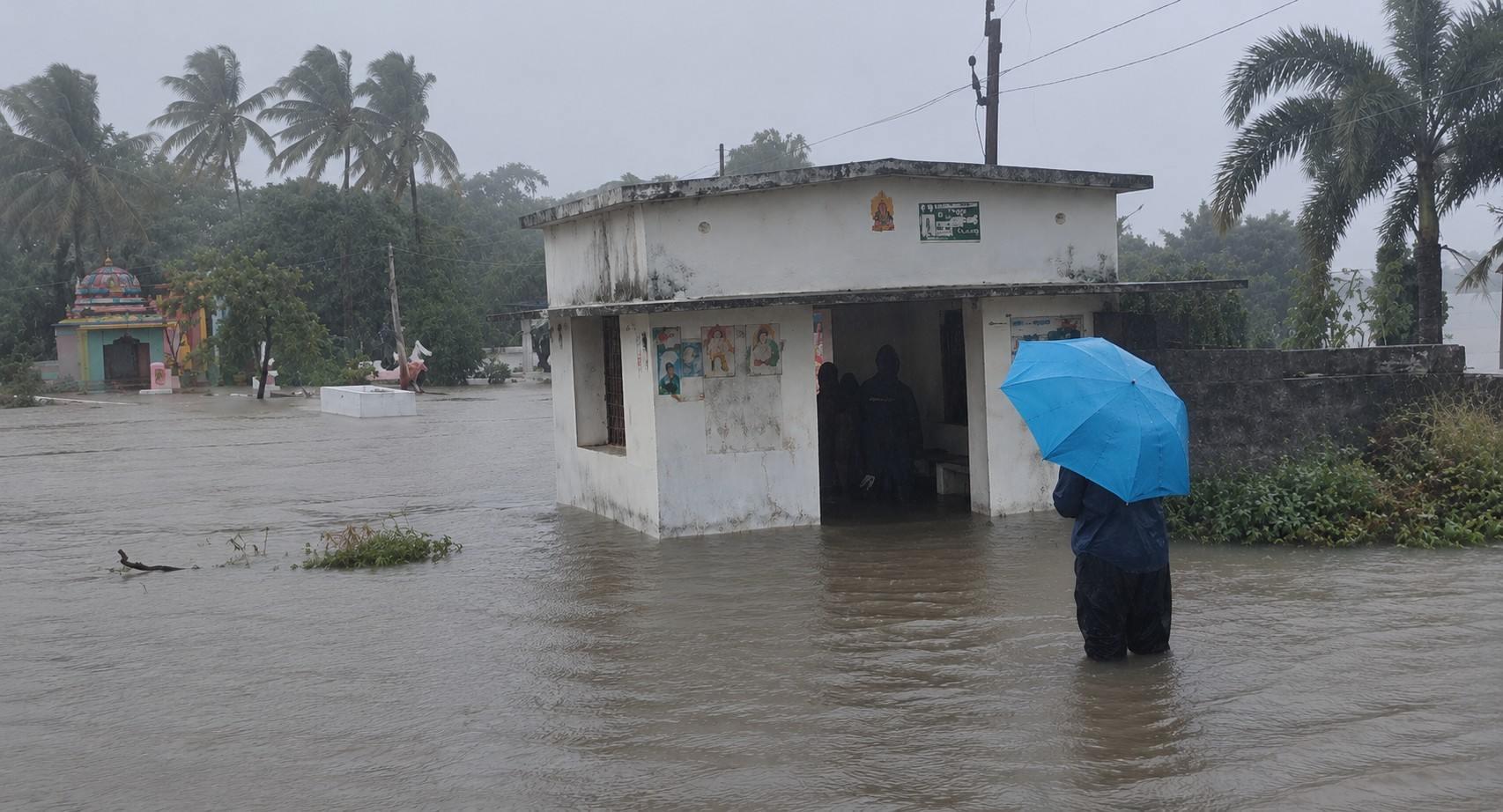
Cyclonic Storm Arnab crossed the Andhra Pradesh coast on Wednesday as heavy rain and powerful winds affected coastal districts. A flood alert was issued for 167 villages in Srikakulam.
The system began moving across the coast after remaining nearly stationary offshore for several hours. In its 8:40 a.m. bulletin, the India Meteorological Department (IMD) said the very severe cyclonic storm had shown practically no movement during the preceding three hours.
At that time, Arnab was located around 30 km east of Narsapur, 45 km south-southwest of Yanam and 70 km south-southwest of Kakinada. The storm’s wall cloud region had already moved over land, while maximum sustained winds were forecast at 115-125 kmph, with gusts reaching 140 kmph.
The IMD had earlier projected that the system would cross the coast between Bapatla and Visakhapatnam, close to the south of Yanam. Winds reached 135 kmph at landfall, while a storm surge of nearly 2 metres above the astronomical tide was observed near Kakinada.
Visakhapatnam received 21.1 cm of rain. Rainwater damaged roads in Chodavaram, Paderu and Narsipatnam, while paddy fields in Srikakulam were submerged and several streets were flooded. Farmers have expressed concern over substantial crop losses as rain and strong winds continue.
A flash-flood alert is in force for Bapatla, Guntur, Krishna, NTR, Eluru, Konaseema, East Godavari, Anakapalli, Visakhapatnam, Manyam and Srikakulam districts. The IMD warned that flooding could occur at any time and forecast very heavy rainfall in the belt stretching from Bapatla to Srikakulam on Wednesday.
Andhra Pradesh Chief Minister N Chandrababu Naidu reviewed the situation and instructed officials to remain alert.
The IMD had issued a red warning in its earlier bulletin, the highest level in its warning system, and cautioned about the storm’s post-landfall impact on Andhra Pradesh and adjoining southern Odisha.
Odisha has also received rainfall from the system. The latest bulletin recorded 94 mm in Gopalpur, 67 mm in Puri and 38 mm in Bhubaneswar.
The Bay of Bengal generally witnesses cyclonic activity between October and December. A year earlier, Cyclone Montha made landfall near Kakinada around midnight, causing extensive damage to crops and roads across the same coastal region.
Arnab is expected to weaken as it moves further inland, with the IMD and the Andhra Pradesh government continuing to monitor the situation.

 Follow us