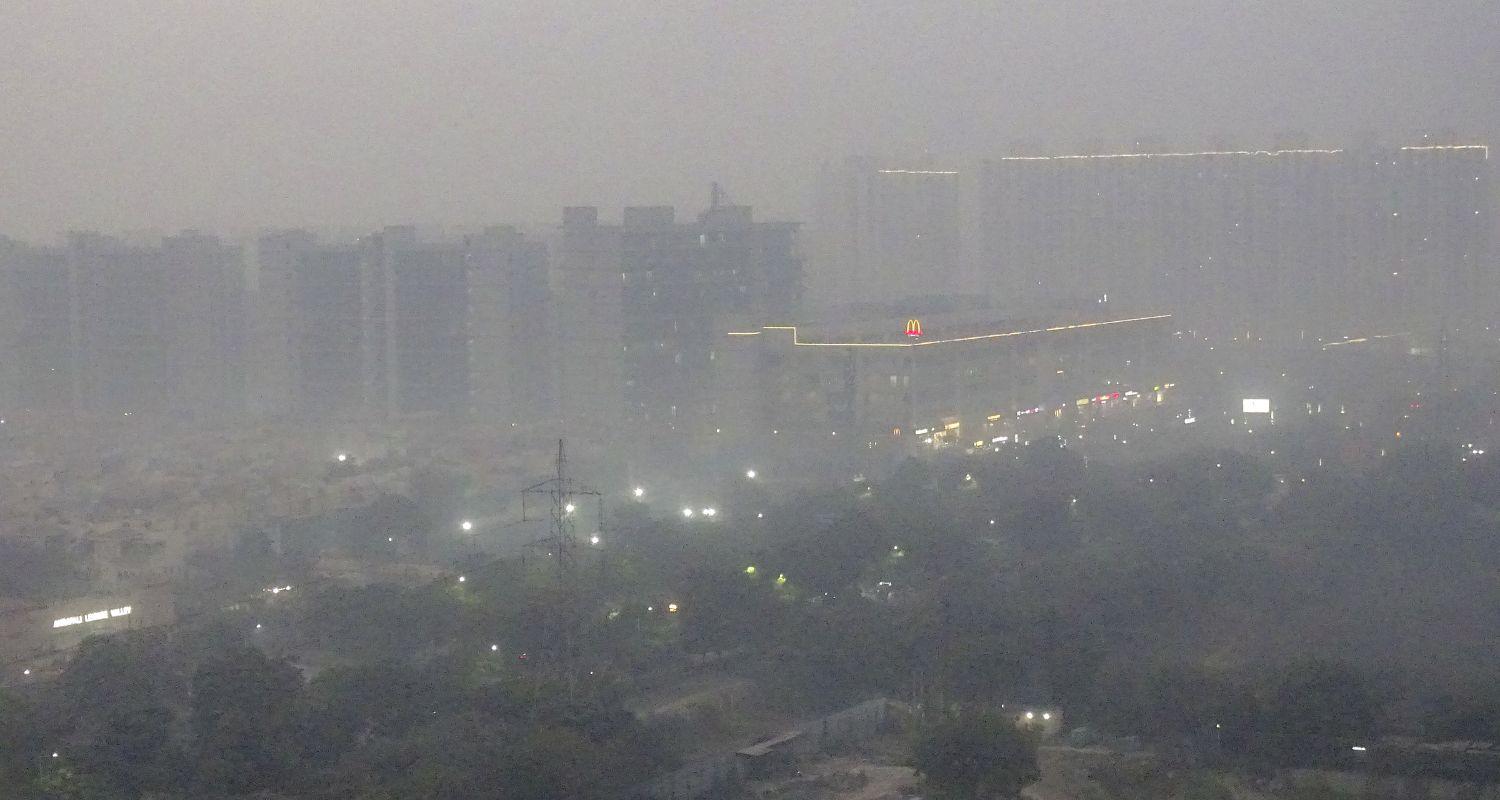
Tuesday morning was no different than days of the past few weeks for the national capital region, whose residents woke up to thick fog and air quality that was being termed as hazardous.
The Air Quality Index (AQI) levels crossed 400 at 27 monitoring stations and several others, slipping into the ‘severe plus’ range and exposing residents to extreme levels of pollution even as stringent measures to control it remained in place.
At 9 am on Tuesday, the city recorded an AQI of 415, slipping from the ‘very poor’ category recorded a day earlier, according to data from the Central Pollution Control Board (CPCB). Of 40 monitoring stations, 27 recorded ‘severe’ air quality with AQI readings above 400, a level known to have serious health impacts, and five stations were in the ‘severe plus’ category with AQI readings above 450.
Of these, Anand Vihar recording an AQI of 470, Nehru Nagar of 463, Okhla was at 459, Mundka recorded 459 and Sirifort was at 450, as per data from the CPCB’s SAMEER app.
According to the CPCB standards, an AQI from 0-50 is considered ‘good’, 51-100 ‘satisfactory’, 101-200 ‘moderate’, 201-300 ‘poor’, 301-400 ‘very poor’, and 401-500 ‘severe’.
Also Read: Delhi’s AQI stays very poor
Weather-wise, dense fog added to drop in temperatures, leading to reduced visibility. Palam recorded 50 metres visibility under dense fog conditions with west-southwesterly winds at 5 kmph at 8 am, while Safdarjung reported 100 metres visibility with calm winds at the same time.
Visibility improved slightly by 8.30 am, with Palam recording 100 metres visibility under dense fog with west-southwesterly winds at 5 kmph and Safdarjung reporting 150 metres visibility with calm winds.
Meanwhile, the minimum temperature in Delhi had dropped to 8.8 degrees Celsius on Tuesday, which is 1.3 degrees above normal, the India Meteorological Department (IMD) said.
The maximum temperature is expected to hover around 23 degrees Celsius, with the forecast indicating dense fog conditions during the day.

 Follow us