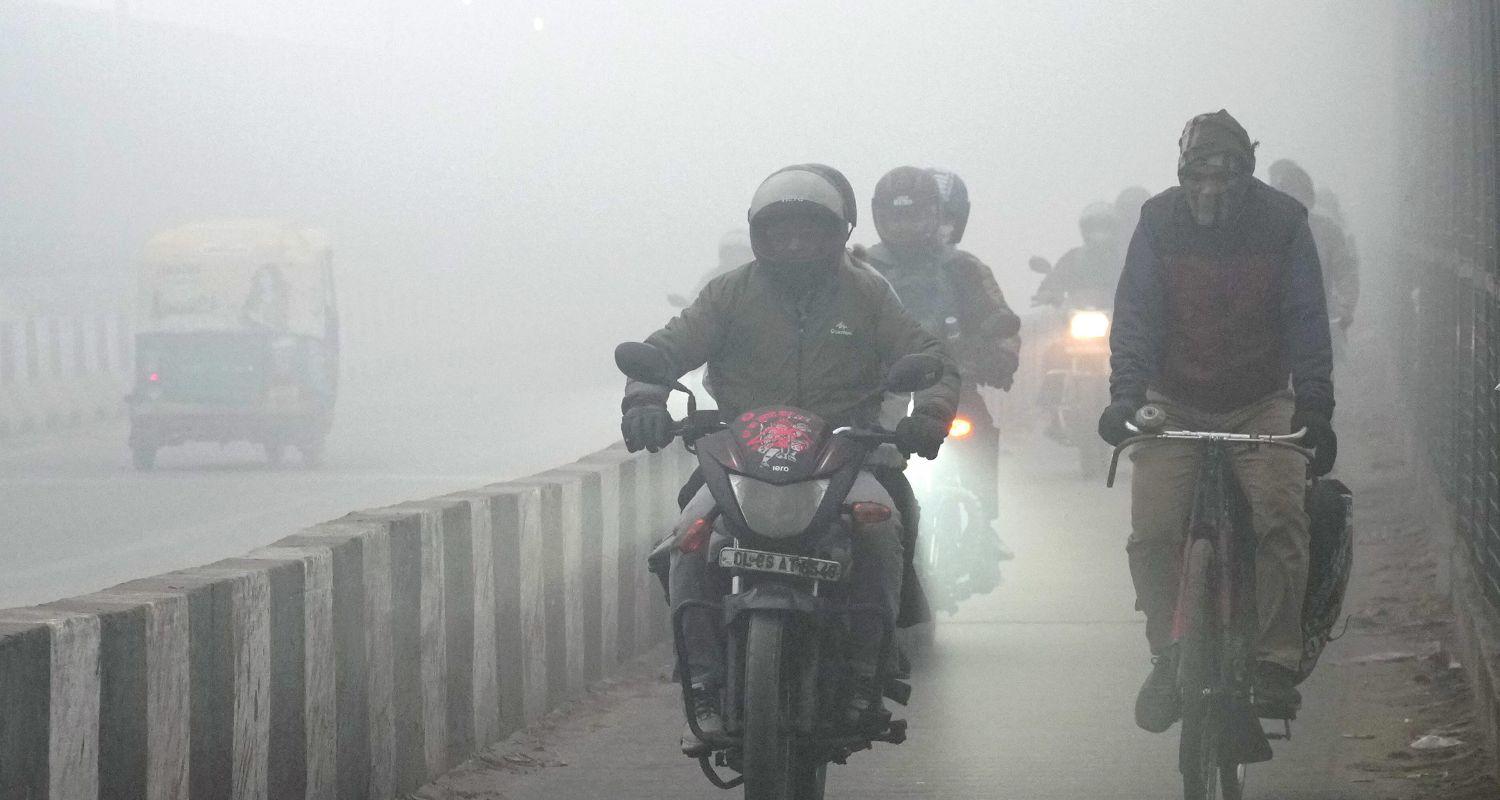
Air pollution in Delhi was no closer to normalising on Saturday morning, as the Air Quality Index (AQI) touched dangerously close to ‘severe’ category at 384, while dense fog caused low visibility.
As several parts of the capital city and its surrounding areas remained cloaked in a grey blur ofsmog and fog, buildings and flyovers seemed to fade. Commuters too had a tough time negotiating driving in the wee hours, and the situation is expected to remain the same over the weekend, as predicted by the India Meteorological Department (IMD) a day earlier.
The lowest visibility up to 8.30 am was recorded at Safdarjung, where it dropped to 200 metres, followed by Palam at 350 metres, according to official data.
According to data from the CPCB, out of the 40 air quality monitoring stations across Delhi, 16 recorded air quality index (AQI) in the ‘severe’ zone, while 24 were ‘very poor’. ITO was the worst at 437.
Also Read: IMD predicts 'severe' AQI over weekend in Delhi
The Central Pollution Control Board (CPCB) classifies an AQI between 201 and 300 as ‘poor’, 301 and 400 ‘very poor’, and 401 and 500 ‘severe’.
On Friday, Delhi’s AQI stood at 374, with 11 of the 40 monitoring stations in the ‘severe’ category and 29 in the ‘very poor’ range.
The AQI is likely to worsen over the next two days, with the Air Quality Early Warning System for Delhi forecasting that pollution levels may slip into ‘severe’ on Sunday and Monday, amid unfavourable meteorological conditions.
To mitigate the toxic pollution levels, a ban on non-Delhi private vehicles below BS-VI emission standards and enforcement of the 'No PUC, No Fuel' rule came into force on Thursday.
Under the rule, no vehicle can get a refill at any fuel pump without a valid Pollution Under Control (PUC) certificate.

 Follow us