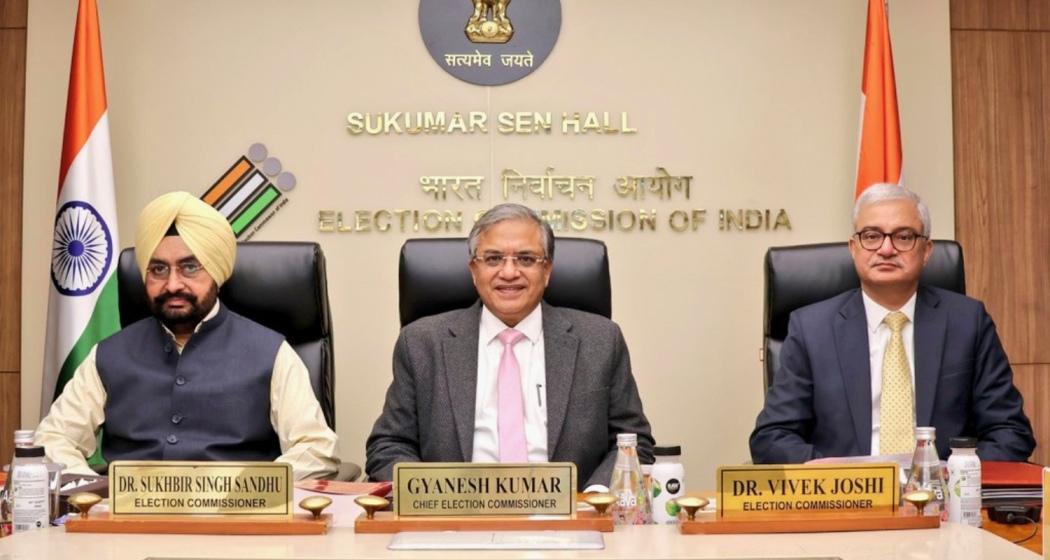
The Election Commission on Thursday strongly defended its decision to undertake a Special Intensive Revision (SIR) of electoral rolls, describing the exercise as “fair, just and reasonable”, and urged the Supreme Court to dismiss petitions challenging the process in Bihar.
Senior advocate Rakesh Dwivedi, appearing for the poll panel, told a Bench headed by Chief Justice Surya Kant and Justice Joymalya Bagchi that a roving and fishing inquiry into the revision could not be permitted at the behest of a few non-governmental organisations and political figures.
“None of the 66 lakh persons whose names were deleted in the Bihar SIR approached this court, the High Court, or even the Election Commission,” Dwivedi submitted, referring to petitions filed by the Association for Democratic Reforms (ADR), the People’s Union for Civil Liberties (PUCL), and several parliamentarians.
Dwivedi made the submissions during the final hearing of a batch of pleas challenging the Election Commission’s decision to conduct SIRs in different states, including Bihar. He urged the court to dismiss the petitions with costs, asserting that the exercise was a lawful and transparent use of powers under the Representation of the People Act, 1950.
He argued that once the Commission invokes Section 21(3) of the Act, which governs special revisions, the manner and procedure of conducting the exercise fall entirely within its discretion. “Section 21(3) operates independently of Section 21(2), which relates to routine revisions. There is no requirement that every SIR must follow an identical process,” he said.
Also read: Ahead of polls, Bengal courts its bureaucracy
Dwivedi pointed out that Bihar had not witnessed a special intensive revision for nearly two decades and that the exercise was necessitated by demographic changes, including urbanisation and population movement. Merely deviating from manuals meant for routine revisions could not render the process arbitrary or illegal, he added.
The senior advocate also cited the Citizenship (Amendment) Act, 2003, arguing that the law introduced stricter citizenship verification norms after the last SIR and reflected legislative consensus on addressing concerns linked to cross-border migration.
Justice Bagchi, however, questioned whether the amended citizenship framework had been cited as the basis for the present revision, noting that the Commission’s order did not explicitly refer to illegal migration. He observed that migration ordinarily referred to lawful movement and that inter-state migration was constitutionally protected.
Dwivedi clarified that the objective of the SIR was to examine citizenship strictly within the framework of Article 326 of the Constitution, which guarantees adult suffrage.
Emphasising safeguards, he said Booth Level Agents conducted door-to-door verification, over five crore SMS alerts were sent, and nearly 76 per cent of voters were not required to submit any documents. Those who did were allowed to provide one of 11 prescribed documents.
The petitioners, however, contend that deviations from the prescribed revision process risk arbitrary exclusion of eligible voters and lack transparency.

 Follow us