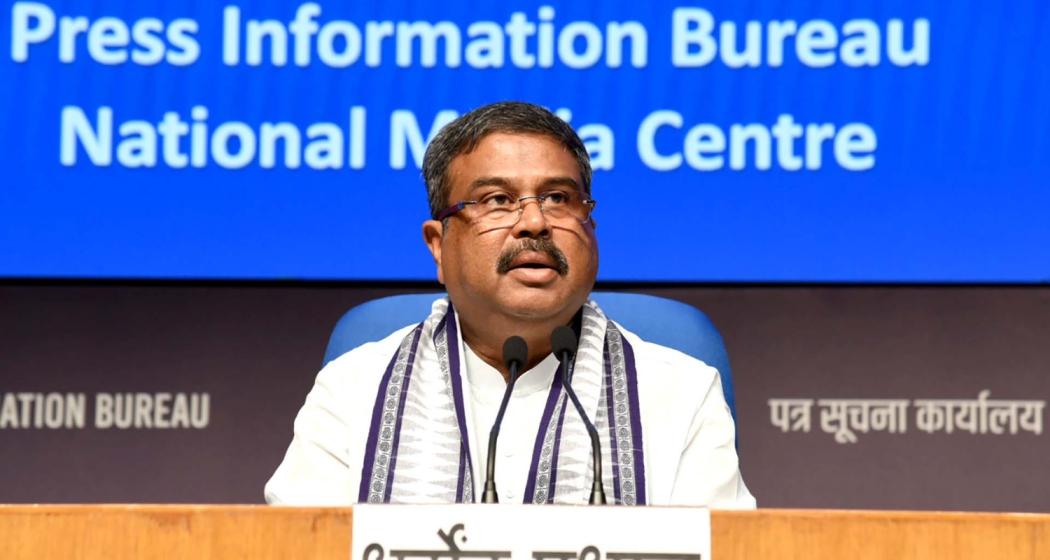
Union Education Minister Dharmendra Pradhan on Thursday expressed regret over the controversy surrounding a Class 8 NCERT social science textbook and said “accountability will be fixed” and action taken against those responsible, after the Supreme Court imposed a blanket ban on the book over a chapter on “corruption in judiciary”.
Pradhan said the Centre has the “utmost respect” for the judiciary and assured full compliance with the court’s directions. “I am very sad at what has happened. There was no intention to insult the judiciary,” he said, adding that those involved in drafting the controversial chapter would face action.
The remarks came hours after a bench of the Supreme Court led by Chief Justice of India Surya Kant, and comprising Justices Joymala Bagchi and Vipul M Pancholi, ordered an immediate ban on the textbook. The court directed the seizure of all physical copies and the removal of digital versions.
The bench also issued show-cause notices to the Director of the National Council of Educational Research and Training (NCERT) and the Secretary, Department of School Education, asking why criminal contempt proceedings should not be initiated.
Also read: SC imposes blanket ban on Class 8 NCERT textbook
During the hearing, the court sought a “deeper probe” into the matter and indicated that it suspected a “deep-rooted conspiracy” to malign the judiciary. “We would like to have a deeper probe. We need to find who is responsible and we will see who are there,” the Chief Justice said, describing the inclusion of the chapter as a “calculated move”.
“Heads must roll, I am not going to close these proceedings,” the CJI observed, stressing the need to identify those accountable for the publication.
The Solicitor General, Tushar Mehta, tendered an unconditional apology before the court in the suo motu proceedings. Earlier, NCERT had also expressed regret over the “inappropriate material”.
The controversy centres on a chapter in the Class 8 social science textbook that referred to “corruption in judiciary”, which the court found objectionable. The bench said it was concerned about the potential impact of such content on young students and the institutional credibility of the judiciary.
The court’s order triggered immediate political and administrative responses, with the education ministry initiating internal steps to review the drafting and approval process behind the textbook.
While the government has signalled cooperation with the judicial inquiry, the Supreme Court made it clear that the matter would be examined thoroughly to determine individual responsibility.

 Follow us