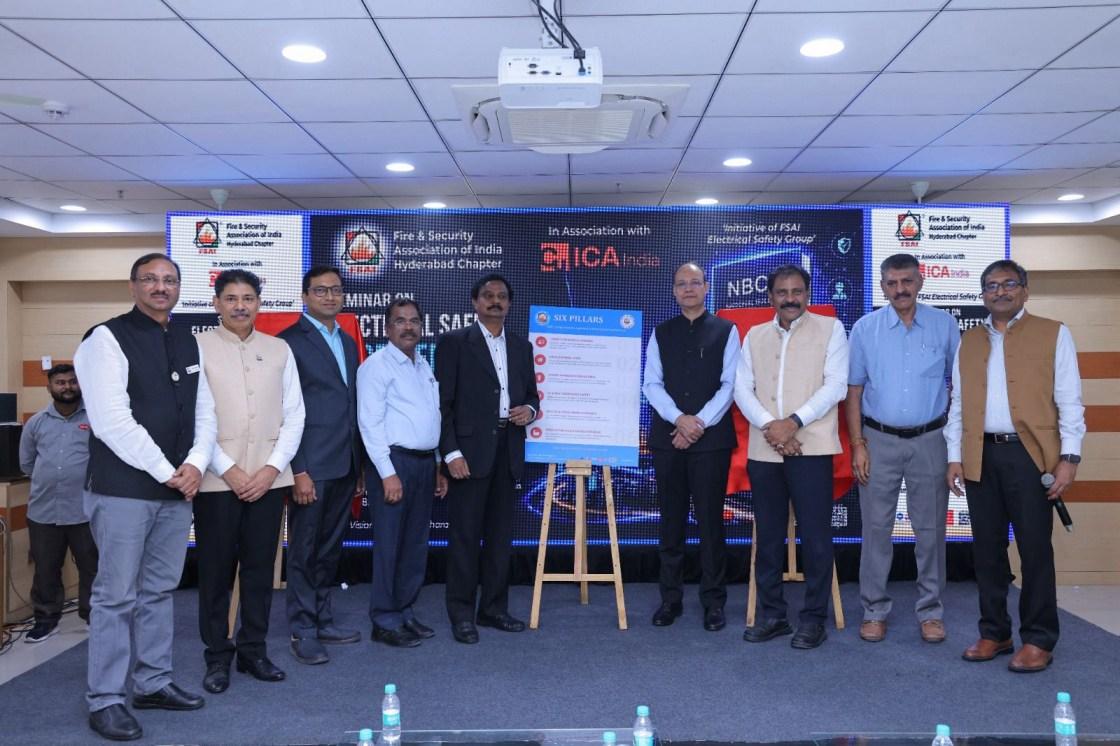
With nearly 60 per cent of fire incidents in India attributed to electrical faults, the Fire & Security Association of India (FSAI), Hyderabad Chapter, has unveiled a comprehensive Six-Pillar Approach aimed at improving electrical safety standards and reducing fire risks nationwide.
The roadmap was announced during a seminar titled Electrical Safety Excellence — Beyond Compliance, organised by the FSAI Hyderabad Chapter in collaboration with the International Copper Association (ICA) India in Hyderabad. The event brought together regulators, policymakers, engineers, safety professionals and industry leaders to deliberate on strengthening safety practices in India’s rapidly expanding infrastructure landscape.
Experts at the seminar highlighted that with increasing urbanisation, infrastructure growth and the adoption of technologies such as electric vehicle (EV) charging systems and solar power installations, a proactive approach to electrical safety is essential. They stressed the need to go beyond regulatory compliance and focus on risk management, training and preventive measures.
A major highlight of the event was the discussion on key provisions under the National Building Construction Standards (NBCS) 2026, which are expected to significantly influence building design, electrical safety management and fire protection systems across the country.
Addressing the gathering, K. Nanda Kumar, Chief Electrical Inspector to the Government and Ex-Officio Chairperson of the Telangana Electrical Licensing Board, emphasised the importance of adopting robust safety practices. He said that as infrastructure becomes more complex, stakeholders must prioritise quality installations, regular audits and enhanced safety protocols to minimise risks and protect lives.
Echoing similar concerns, Vikram Singh Mann, Director General of Telangana Fire, Disaster Response, Emergency and Civil Defence, said a significant number of fire incidents continue to occur due to unsafe electrical installations. He stressed the need for collaboration among regulators, industry, designers and end users to integrate electrical safety and fire protection into a unified risk management framework.
Linga Reddy, Chief Engineer, Electrical R&B Department, Telangana, said the updated NBCS 2026 framework presents an opportunity to strengthen infrastructure resilience and embed safety considerations from the planning stage through execution and operation.
Also read: Kolkata warehouse collapse: Death toll rises to 16
During the event, Manoj Wahi, President of the FSAI Hyderabad Chapter, outlined the newly launched Six-Pillar Approach. The initiative focuses on capacity building for electrical professionals, residential safety inspections through the Ghar Suraksha Audit programme, electrical safety education for schoolchildren, awareness on the safe deployment of EVs and other emerging technologies, public outreach through digital platforms, and improving compliance among MSMEs while creating a national database on electrical accidents.
The day-long programme featured technical sessions on NBCS 2026 compliance, implementation of IS 18732 standards, cable selection, earthing and lightning protection systems, and the safe integration of EV charging infrastructure and solar photovoltaic systems.
Additional sessions covered arc flash hazards, hazardous area classification, static electricity and global safety benchmarks based on NFPA standards. The programme concluded with discussions on fire protection systems for electrical installations aligned with Indian and international standards.
The event was organised under the leadership of Manoj Wahi, Huzefa Hussain, Shivaramakrishnan V. and Valluri Srinivas, senior office-bearers of FSAI.
Established in 2002, FSAI is a national body dedicated to promoting fire safety, security and loss prevention through training, awareness programmes and industry collaboration. ICA India, a non-profit organisation, works to improve electrical safety, energy efficiency and sustainability, and trains more than 10,000 electrical professionals annually.
The initiative is expected to play a key role in strengthening India's electrical safety ecosystem and reducing the growing risk of fire incidents linked to faulty electrical installations.

 Follow us