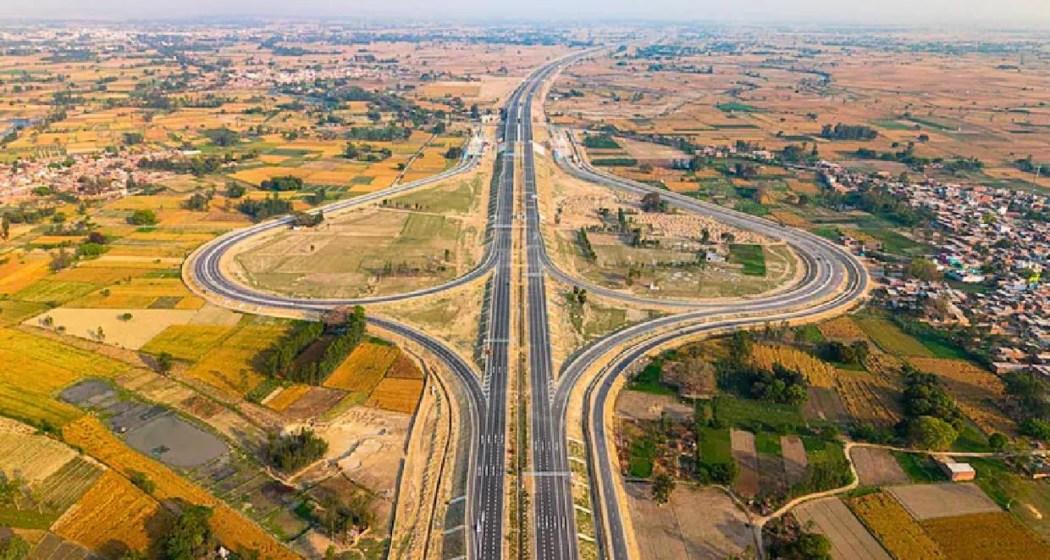
The Uttar Pradesh government has said that the newly opened 594-km Ganga Expressway is expected to significantly reduce freight transit time across the state and generate annual logistics savings of up to ₹30,000 crore, positioning it as a major industrial and warehousing corridor linking western and eastern regions.
The six-lane expressway, expandable to eight lanes, connects Meerut to Prayagraj across 12 districts and is being positioned as a key logistics backbone to improve connectivity between the National Capital Region and eastern Uttar Pradesh.
Officials estimate that the state currently handles around 245-260 million tonnes of intra-state freight annually, including food grains, construction material and retail goods, while outbound freight volumes stand at 135-150 million tonnes, driven by electronics, leather and agricultural produce.
UP Industrial Development Minister Nand Gopal Gupta said the corridor would “mark a new chapter” in the state’s economic trajectory by accelerating industrial growth, logistics efficiency, agriculture, tourism and employment generation.
Gupta said the expressway, inaugurated by Prime Minister Narendra Modi on April 29 in Hardoi, has already reduced travel time between Meerut and Prayagraj from around 10-12 hours to nearly 5-8 hours.
“The expressway is not merely a road project but an integrated manufacturing and logistics corridor. Faster freight movement and reduced transportation costs can generate annual logistics savings of ₹25,000–30,000 crore,” he said.
He added that the state has received 987 investment proposals worth around ₹46,660 crore along the corridor, with 12 industrial nodes being developed across 6,507 acres. Sectors such as manufacturing, textiles, food processing, pharmaceuticals, electronics, warehousing and e-commerce are expected to benefit from improved connectivity.
Also read: PM Modi inaugurates 594-km Ganga Expressway in UP
Officials said proposed industrial parks in pharma, textiles and IT sectors are expected to generate large-scale employment opportunities and strengthen regional supply chains.
Industry executives said the expressway could reshape logistics planning across northern India. Dipanjan Banerjee, Chief Commercial Officer at Blue Dart, said the corridor addresses a long-standing connectivity gap between the NCR and eastern Uttar Pradesh.
“The missing link has been a seamless northern corridor connecting the NCR belt directly to eastern districts. The Ganga Expressway effectively bridges that gap,” he said.
He added that faster and more predictable freight movement would benefit e-commerce, pharmaceuticals, FMCG and agricultural supply chains, especially in Tier-2 and Tier-3 cities.
Jitendra Srivastava, CEO of Triton Logistics & Maritime, said the corridor would improve supply chain predictability and strengthen multimodal freight movement, including air cargo linkages. He noted that northern India accounts for around 31.3 per cent of the country’s air freight movement.
“The corridor will improve movement of perishables, textiles and electronics and enhance Uttar Pradesh’s global trade competitiveness,” he said.
Nikhil Agarwal, President of CJ Darcl Logistics Ltd, said warehousing demand was already rising along the corridor, with cities such as Prayagraj, Hardoi and Shahjahanpur emerging as logistics hubs due to improved connectivity and lower land costs.
Officials added that the expressway will integrate with major corridors, including Agra-Lucknow, Bundelkhand, Purvanchal and Delhi-Mumbai expressways, strengthening long-term industrial linkages.
Spanning 12 districts, the corridor is expected to contribute over ₹1 lakh crore to the state economy in the long term and support Uttar Pradesh’s ambition of becoming a $1 trillion economy.

 Follow us