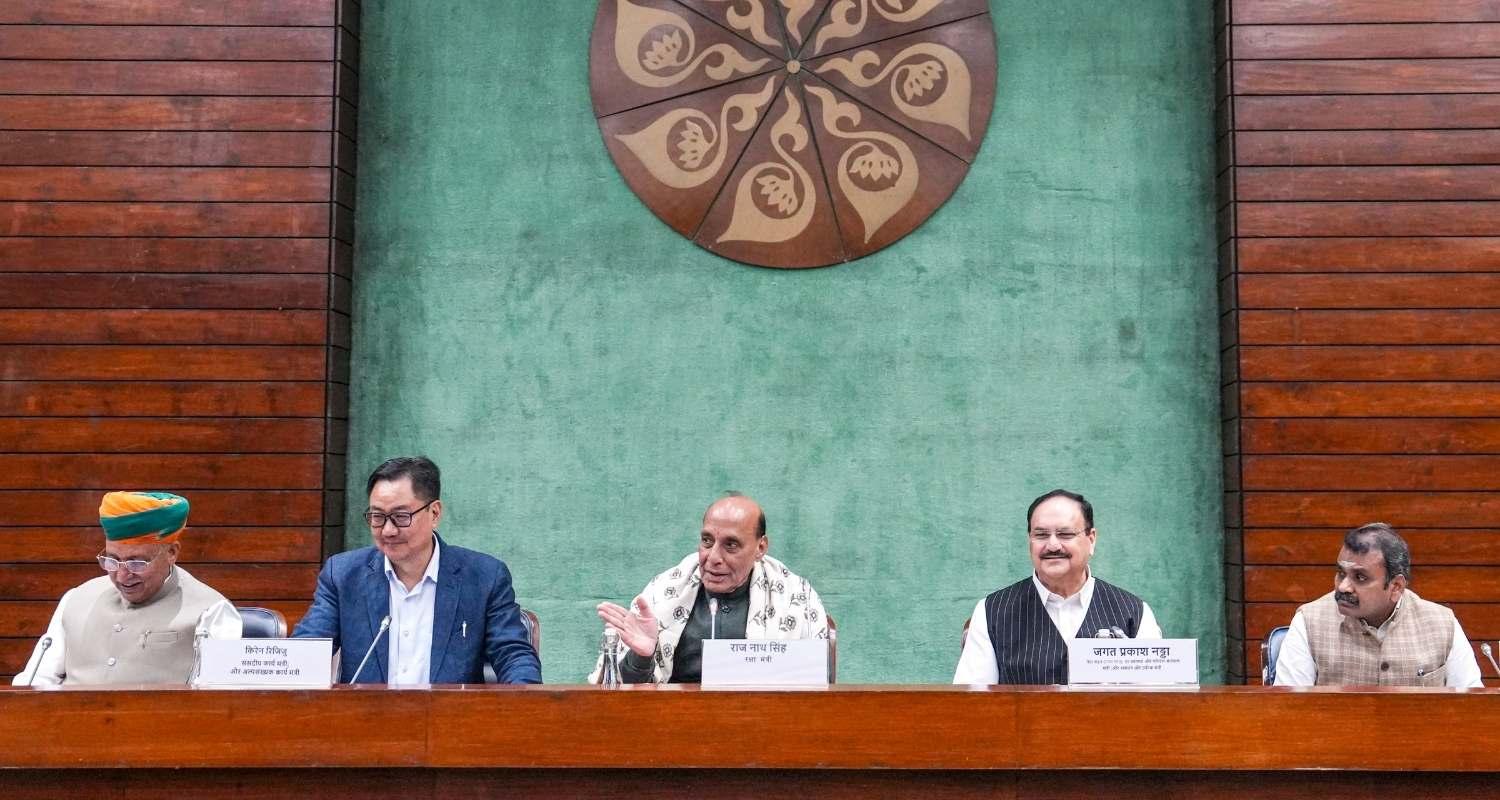
An all-party meeting was convened on Sunday by the government ahead of the Winter Session of Parliament, bringing together leaders from across the political spectrum on the eve of a short but high-stakes session.
The meeting, held at Parliament House, saw the opposition raise a series of issues it intends to pursue in both Houses, including the Special Intensive Revision of electoral rolls, the recent blast in Delhi, and important foreign policy matters. The government, for its part, laid out its legislative agenda and appealed for cooperation to ensure the smooth functioning of the proceedings.
However, after the meeting concluded, the Congress, pointing to the abbreviated length of the session, accused the government of appearing determined to derail Parliament.
The Winter Session of Parliament commences on Monday and is scheduled to conclude on December 19. This year, the session will have only 15 sittings—a significant reduction from the customary 20 sittings—making it one of the shortest winter sessions in recent years.
Earlier on Sunday, Parliamentary Affairs Minister Kiren Rijiju held separate discussions with floor leaders of various political parties in both the Lok Sabha and Rajya Sabha. A meeting of the Business Advisory Committee is also slated for Sunday evening, with additional meetings of the Business Advisory Committees for the Lok Sabha and Rajya Sabha to follow later in the week.
Speaking to reporters before the all-party meeting, Rijiju called for restraint and stressed the need for constructive and uninterrupted parliamentary debates. “Since it’s the winter season, we hope everyone works with a cool head and avoids heated exchanges. Debate is part of Parliament and I hope there will be no disturbances. Working with a calm mindset will benefit the nation and ensure the session runs smoothly,” he said.
GOVERNMENT WANTS TO DERAIL PARLIAMENT: CONGRESS
Congress MP Gaurav Gogoi, after the all-party meeting, accused the BJP-led central government of attempting to derail the parliamentary process by curtailing the length of the Winter Session and scheduling a shorter-than-usual sitting of Parliament of India.
"The winter session is only 19 days long, of which discussions can take place only for 15 days. This will likely be the shortest winter session ever. Therefore, it seems the government itself wants to derail Parliament," he said.
He added, "It seems that the current government is burying the entire parliamentary decorum, derailing it, and digging the grave of this tradition of Indian democracy. And that's why all opposition parties are united on this issue. Tomorrow, we will have a meeting of all our parties with Kharge ji".
Also Read: Cong urges PM to convene all-party meeting post return
14 BILLS TO BE INTRODUCED
The Winter Session of Parliament is set to commence with a robust legislative agenda, prominently featuring the introduction of the Atomic Energy Bill, 2025. This proposed legislation aims to regulate the use of atomic energy while simultaneously opening the door for private sector participation in India’s nuclear ecosystem.
Another major bill on the government’s priority list is the Higher Education Commission of India Bill, 2025. The legislation seeks to establish a single overarching central commission that will promote greater institutional autonomy for universities and higher education institutions, introduce transparent and credible accreditation frameworks, and strengthen regulatory oversight with the ultimate goal of elevating academic standards across the country.
The government has lined up several other significant pieces of legislation for the session, including:
- The Jan Vishwas (Amendment of Provisions) Bill, 2025;
- The Insolvency and Bankruptcy Code (Amendment) Bill, 2025;
- The Manipur Goods and Services Tax (Second Amendment) Bill, 2025, which will replace an existing ordinance;
- The Repealing and Amending Bill, 2025;
- The National Highways (Amendment) Bill, 2025, which is designed to streamline and make more transparent the process of land acquisition for highway development projects.
In addition, the following bills are scheduled to be tabled during the session:
- The Corporate Laws (Amendment) Bill, 2025, which will amend provisions of the Companies Act, 2013 and the Limited Liability Partnership Act, 2008;
- The Securities Markets Code Bill, 2025, a comprehensive measure to consolidate the Securities and Exchange Board of India Act, 1992, the
- Depositories Act, 1996, and the Securities Contracts (Regulation) Act, 1956 into a single unified code for securities markets;
- The Insurance Laws (Amendment) Bill, 2025;
- The Arbitration and Conciliation (Amendment) Bill, 2025, which incorporates revisions to the Arbitration and Conciliation Act, including changes to Section 34, in light of recent observations made by the Supreme Court;
- The Central Excise (Amendment) Bill, 2025;
- The Health Security & National Security Cess Bill, 2025.
In a notable development ahead of the session, the government recently withdrew its earlier proposal to grant the President direct powers to issue regulations for the Union Territory of Chandigarh, following objections raised by multiple political parties. This decision highlights the continuing political significance and influence of all-party coordination forums.
With the opposition gearing up to aggressively question the government on issues of electoral integrity, alleged security lapses, and key foreign policy matters, while the government pushes forward an ambitious slate of structural reforms spanning the energy, education, infrastructure, and financial markets sectors, the coming session promises to be an intensely packed affair that combines far-reaching legislative goals with sharp political confrontations.
Also Read: Ahead of Parliament session, centre convenes All Party Meeting

 Follow us