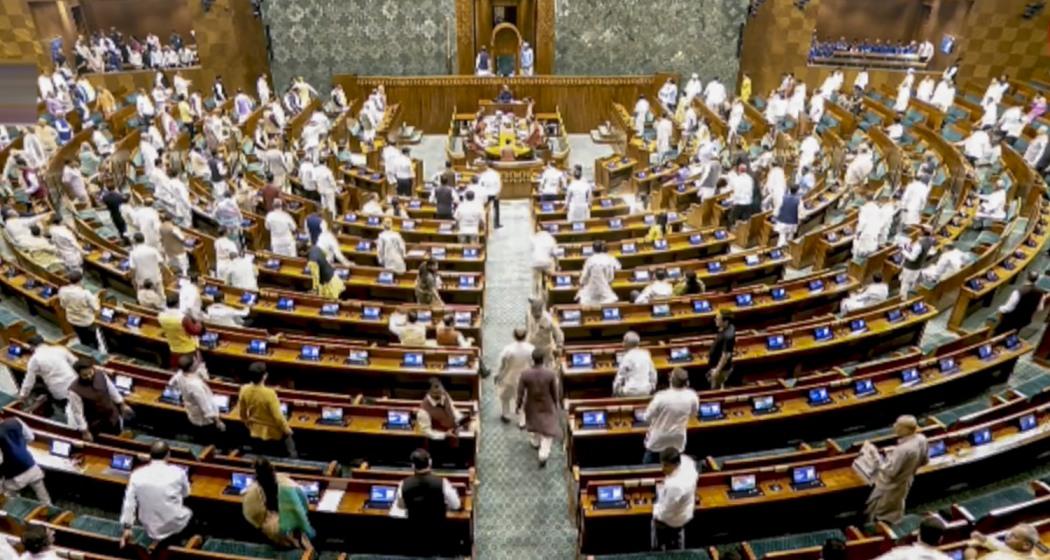
The Centre on Sunday released a set of Frequently Asked Questions (FAQs) explaining the rationale behind introducing the women’s reservation legislation in Parliament, days after the constitutional amendment bill failed to secure a two-thirds majority in the Lok Sabha.
The Constitution (131st Amendment) Bill, which proposed 33 per cent reservation for women in the Lok Sabha and state assemblies, could not pass after opposition parties refused to support the associated delimitation framework.
According to the government document, the three bills introduced on April 16 included the Constitution (131st Amendment) Bill, the Delimitation Bill, and the Union Territories Laws (Amendment) Bill.
The Centre said the legislation was brought at this stage to ensure that women could benefit from reservation in time for the 2029 general elections, arguing that waiting for the post-2026 Census and delimitation exercise would delay implementation.
It stated that the existing legal framework under the ‘Nari Shakti Vandan Adhiniyam’ links women’s reservation to delimitation following the Census, but the government sought to delink the process to avoid delay in implementation.
The FAQs also explained that if passed, the bills would have enabled 33 per cent reservation for women in Parliament and state assemblies from the 2029 elections.
On the question of increasing Lok Sabha seats, the government said expansion from 543 to around 850 seats was proposed to ensure proportional representation based on population growth from 54 crore in 1971 to around 140 crore today.
It added that a uniform 50 per cent increase in seats across states would preserve balance in representation, while ensuring fair expansion for all regions.
Also read: Will implement women's reservation, no power can stop us: Rajnath
The Centre denied allegations that delimitation would disadvantage southern or smaller states, saying the proportional share of seats for states would remain stable or improve marginally under the proposal.
It also clarified that no amendments were proposed to the Delimitation Commission Act and that the legal framework for delimitation would remain unchanged, requiring parliamentary approval and presidential assent.
On representation for Scheduled Castes and Scheduled Tribes, the government said delimitation would actually increase the number of reserved seats in line with population growth.
The FAQs further clarified that reservation cannot be based on religion under the Constitution, and said caste census data collection was already part of an ongoing process.
Explaining the procedural delay, the Centre said delimitation typically takes around two years due to its consultative nature, making immediate implementation before the 2024 elections unfeasible.
It also reiterated that a separate bill was required for Union Territories such as Jammu and Kashmir, Delhi and Puducherry due to their distinct legislative frameworks.
The release comes amid sharp political debate over the linkage between women’s reservation and delimitation, which ultimately led to the bill’s defeat in the Lower House.

 Follow us