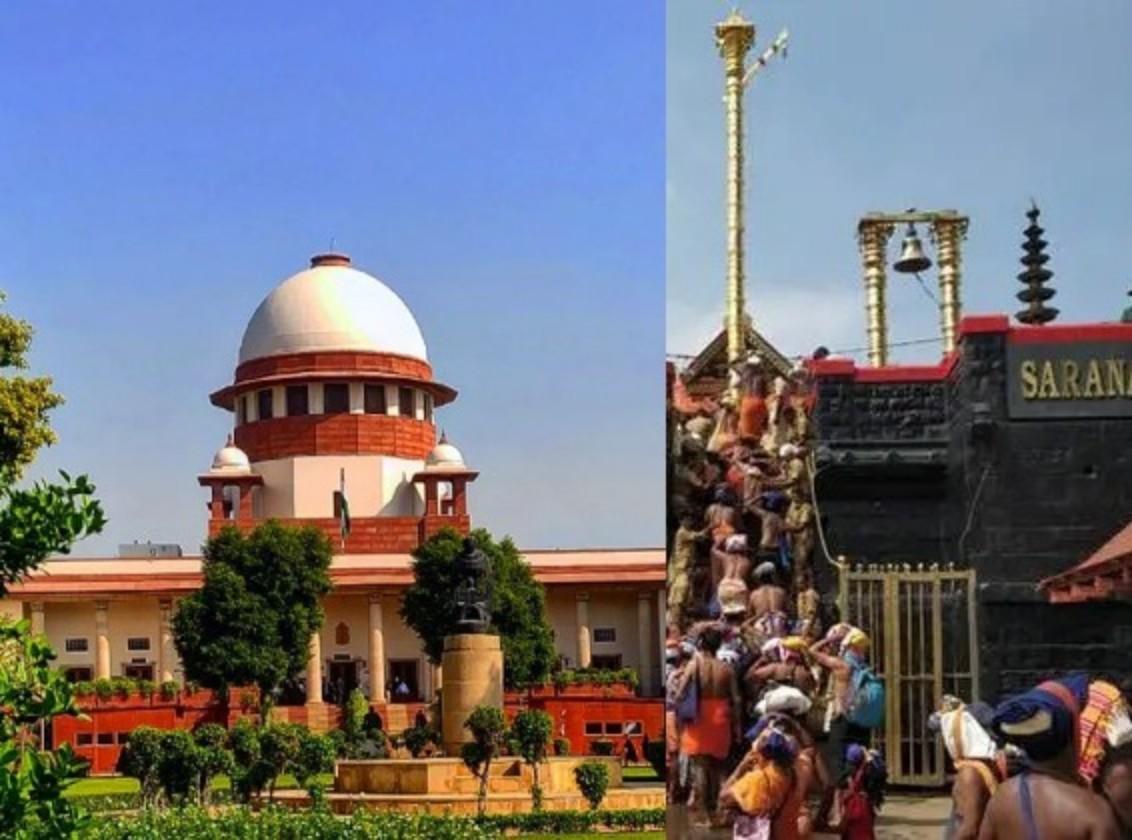
The Supreme Court on Wednesday said that one of the most difficult tasks for a court is to declare the beliefs of millions of people as wrong or erroneous, and that a religion cannot be stripped of its essential practices in the name of social reform.During the hearing of the Sabarimala reference, the Apex Court orally commented that it is difficult for a Court to declare the faith of millions of people wrong.
A Constitution Bench of Chief Justice of India (CJI) Surya Kant along with Justice BV Nagarathna, Justice MM Sundresh, Justice Ahsanuddin Amanullah, Justice Aravind Kumar, Justice Augustine George Masih, Justice Prasanna B Varale, Justice R Mahadevan and Justice Joymalya Bagchi made the observation during the hearing of a reference case arising out of the Sabarimala temple entry matter.
"The most difficult task for a court might be how to give a declaration that the belief of millions of people is wrong or erroneous," CJI Kant said, while responding to submissions over maintainability of public interest litigation (PIL) petitions in religious matters.Similarly, Justice Sundresh asked whether Courts can decide such questions without hearing representatives of millions.
Justice Nagarathna too echoed similar concerns and remarked that such PILs should not be entertained when the petitioner is only an interloper.She further said that a religion cannot be stripped of its core in the name of social reform."We cannot hollow out religion in the name of social welfare reform," Justice Nagarathna remarked.
On the fourth day of the hearing, Senior Advocate Dr Abhishek Manu Singhvi was addressing the 9-judge bench on behalf of the Travancore Devaswom Board.Dealing with the seventh issue raised in the reference -whether the Court can entertain a Public Interest Litigation questioning a religious practice at the instance of a person not belogning to that religion- Singhvi advocated that the Courts should adopt a very high threshold to entertain such PILs. Singhvi said that traditions followed for centuries in temples like Sabarimala and Guruvayoor cannot be suddenly questioned in PILs filed by third parties.
At this juncture, Justice Bagchi posed a hypothetical query - if a religious leader preaches mass suicide as a method to attain salvation, and the followers are attempting to end their lives, can't the Court act on a PIL filed by a person not belonging to that sect questioning that practice. Saying that it was an "extreme case", Singhvi said that the Court may perhaps be justified in entertaining such a PIL in extraordinary circumstances. But the ordinary rule should be one of non-interference. The Chief Justice said that in such an extreme case, the Court might even act suo motu, without waiting for a PIL.
Conceding that he was not arguing for an absolute bar of PIL, Singhvi said that PILs questioning regular religious practices cannot be entertained on the ground of violation of rights. He advocated that the threshold for PILs in religious affairs should be ten times higher than for other PILs.

 Follow us