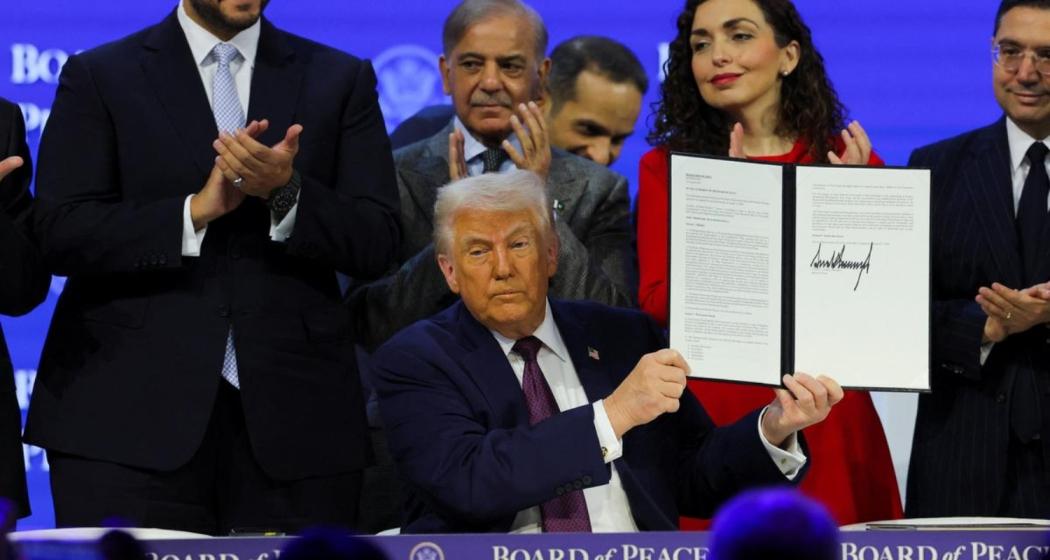
India was among several countries that did not attend the signing ceremony for US President Donald Trump’s proposed “Board of Peace” at Davos on January 22, an initiative unveiled on the sidelines of the World Economic Forum to work towards lasting peace in Gaza and address wider global conflicts.
Prime Minister Narendra Modi was among a number of global leaders invited by Trump to join the board, announced during the second phase of the Israel–Hamas ceasefire agreement in the Gaza Strip. France, the United Kingdom, China and Germany were also absent from the ceremony.
Trump hosted the signing event at the Swiss resort town, projecting the “Board of Peace” as a new international body aimed at promoting peace and stability in Gaza and beyond. India is yet to take a decision on joining the initiative, with New Delhi weighing various aspects of the proposal, which involves sensitive geopolitical issues.
India has consistently advocated a two-state solution to the Palestine question, with Israel and Palestine living side by side-in-peace and security within recognised borders.
Also read: Trump pits ‘Board of Peace’ against UNSC
Countries that joined the ‘Board of Peace’ included Argentina, Armenia, Azerbaijan, Bahrain, Belarus, Egypt, Hungary, Kazakhstan, Morocco, Pakistan, the United Arab Emirates, Saudi Arabia and Vietnam. Several others, including Germany, Italy, Paraguay, Russia, Slovenia, Türkiye and Ukraine, have remained non-committal.
Washington has described the Board of Peace as an international organisation intended to “promote stability, restore dependable and lawful governance, and secure enduring peace in areas affected or threatened by conflict”, according to its charter. The document states that durable peace requires “pragmatic judgment, common sense solutions, and the courage to depart from approaches and institutions that have too often failed”.
The board’s top tier will comprise heads of state, operating under Trump’s leadership. The United States has said the body will play a central role in implementing Trump’s 20-point plan to provide strategic oversight, mobilise international resources and ensure accountability as Gaza moves from conflict to peace and development.
The plan includes proposals to make Gaza a de-radicalised, terror-free zone that does not threaten its neighbours, alongside large-scale redevelopment for the benefit of its residents.
The White House has already announced the formation of a founding executive board to operationalise the initiative. Its members include US Secretary of State Marco Rubio, former British Prime Minister Tony Blair, US special envoy to the Middle East Steve Witkoff, businessman and Trump’s son-in-law Jared Kushner, and World Bank president Ajay Banga. The executive board will oversee an administrative body titled the National Committee for the Administration of Gaza.

 Follow us